Cheese dairies of the Bernese Oberland
Where can I actually watch cheese being made near Interlaken?
The most reliable spot is the Emmentaler Schaukäserei in Affoltern im Emmental, which makes cheese on public view every day of the year. Genuine alpine dairies above Grindelwald and in the Simmental only operate during the alp season, roughly late May to early October, and several need a hike or a lift to reach.
The cheese counter in any Interlaken supermarket will sell you Emmentaler, Gruyère and Alpkäse side by side, and most visitors never think about where any of it actually comes from. That’s a shame, because the region around Interlaken produces some of the country’s best-known cheese, and a couple of the places that make it are genuinely worth a detour rather than just a photo of a wheel of cheese in a shop window.
Three different things called “cheese dairy”
It helps to separate what’s actually on offer before planning a trip, because the three types are not interchangeable and confusing them wastes a day.
The Schaukäserei (literally “show dairy”) in Affoltern im Emmental is a commercial demonstration dairy that makes cheese on public view every day, all year, for tourists. It is reliable, indoor, and easy to reach on a fixed schedule.
Alp dairies (Alpkäserei) above villages like Grindelwald and throughout the Simmental are working farms that happen to make cheese as a byproduct of summer grazing. They only operate during the alp season, some require a walk to reach, and none of them run on a tourist timetable — you’re a guest at someone’s workplace, not a visitor at an attraction.
Valley dairy cooperatives that supply the big brands (the ones behind most Emmentaler on Swiss supermarket shelves) are working industrial sites and generally not set up for visitors at all. If a shop or tour claims direct access to one of these, check what you’re actually being shown.
The Schaukäserei in Affoltern: how Emmental is actually made
The Emmentaler Schaukäserei sits in Affoltern im Emmental, about 25 kilometres north of Bern, in the valley that gives the cheese its name. It opened in 1972 specifically to show the public how Emmentaler AOP is made, and it still does that several times a day, every day of the year, through glass viewing windows rather than a screen.
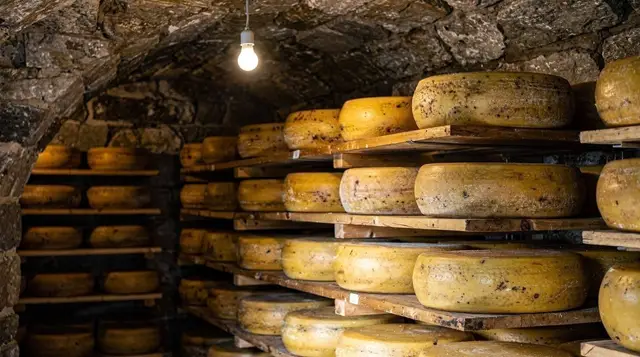
What you’ll actually see: raw milk delivered by local farmers, warmed and set with rennet in a large copper kettle, cut into curd, and pressed into wheels that can weigh up to 100 kilograms — among the largest cheese wheels made anywhere. Those wheels then go into the maturing cellar for anywhere from 4 to 18 months, developing the characteristic holes as bacteria produce carbon dioxide inside the paste. The Schaukäserei’s own cellars hold thousands of wheels at different stages, and you can walk through part of it.
Getting there from Interlaken Ost by train runs via Bern, then a regional connection north into the Emmental — allow roughly 1.5 hours each way, so it’s a half-day trip on its own or, better, folded into a longer day that also covers Bern’s old town. Driving takes about an hour and there’s free parking on site.
On site there’s a restaurant serving Emmental specialities (expect a cheese-heavy fondue or Chäsplättli, roughly CHF 25–35 for a main), a shop selling the cheese by weight, and — usefully for anyone travelling with children — a play area and picnic space. If you’d rather cover the ground by bike than by train, a guided route through the Emmental countryside covers several dairy villages in a day:
a private guided e-bike tour through the Emmental takes in the rolling farmland between dairies rather than just the Schaukäserei itself, with an e-bike doing most of the climbing on the region’s gentle but persistent hills.
Alternatively, a straightforward timed ticket avoids any queue at the demonstration windows on a busy day:
an Emmentaler Schaukäserei entry ticket covers the viewing gallery, the cellar, and the exhibition on the cheese’s history, which goes back to written references from the 13th century, though the AOP-protected “Emmentaler” name and recipe as sold today are a more recent standardisation.
Alpine dairies above Grindelwald: cheese with a view
Above Grindelwald, a handful of working alps make cheese through the summer using milk from cattle grazing directly on those slopes — a genuinely different product from anything trucked in from the valley. The best-known accessible one sits at Bussalp, on the hiking route toward First and the Faulhorn ridge; during the alp season the dairy there sells cheese, butter and Sirup direct from the hut, and walkers on the Bachalpsee or Faulhorn routes pass right by it.
This only works between roughly late May and early October. Outside that window the cattle are back in the valley barns for winter, the Sennen (alpine dairymen) who live up there for the season have gone home, and the huts are locked. Even within season, opening hours are informal — a chalkboard, not a website — so treat “the dairy is open” as a bonus on a hike rather than something to build a whole day around.
For something more structured, a guided small-group tour through Bernese Oberland villages typically stops at a producer selling direct, with commentary on what you’re tasting and why alp cheese differs from the valley product:
a small-group tour to Swiss villages in the Bernese Oberland by car removes the guesswork of finding an open dairy on the day, at the cost of losing the choose-your-own-pace flexibility of doing it independently.
If your priority is the view and the hike rather than the cheese specifically, the routes past Bussalp connect into the wider network covered in our guide to day hikes from Interlaken, and the Bachalpsee approach is detailed separately in our Bachalpsee hike guide.
Simmental alpage dairies: Lenk, Boltigen and beyond
The Simmental — the valley running south-west from Thun toward Lenk — is Berner Alpkäse country. This is the cheese with AOP protection specifying it must be made by hand, on an alp above roughly 1,000 metres, during the summer grazing season only, from milk produced on that same alp. In practice that means small batches, heated in copper kettles over a wood fire in most traditional operations, made once or twice a day rather than continuously.
Villages worth knowing here: Lenk sits at the head of the valley and has several alp producers selling direct in season; Boltigen and Zweisimmen are lower down and more accessible by train, with cheese shops in the villages stocking the alp product even when you can’t reach the alp itself; Jaunpass, on the way toward Gruyère country, marks roughly where Bernese Alpkäse territory gives way to the French-speaking cheese region around Gruyères.
A car makes a real difference here — the working alps sit on farm roads above the villages with little or no bus service, so without a car you’re generally buying from a village shop rather than watching production. If you want the hard-cheese side of alpine tradition specifically, rather than the softer Alpkäse style, a tasting experience built around one of Switzerland’s oldest cheeses is a reasonable substitute for a farm visit:
an Alp Sbrinz cheese tasting, “the gold of the Alps” covers how Sbrinz is aged for a minimum of 18 months and shaved rather than sliced, with a guided tasting rather than a live production demonstration — check the current itinerary if watching cheese actually being made is the point for you.
| Where | Type | When it’s accessible | Car needed? |
|---|---|---|---|
| Affoltern (Emmental) | Commercial Schaukäserei | Every day, year-round | No — reachable by train via Bern |
| Bussalp (above Grindelwald) | Working alp dairy | Late May–early Oct, informal hours | No — walking route from Grindelwald |
| Lenk / Boltigen (Simmental) | Working alp dairies | Late May–early Oct, informal hours | Mostly yes, for the alps themselves |
| Village cheese shops (Simmental) | Retail only | Year-round, normal shop hours | No |
The Alpsaison: from ascent to descent
None of the alp dairies exist without the seasonal cattle migration that’s been happening in this region for centuries. In spring, once the snow has cleared from the higher pastures, herds are walked up from valley farms to alp pastures that can sit anywhere from 1,000 to over 2,000 metres — the Alpaufzug. The cattle, and the Sennen who go with them, stay up there through the summer, and this is the only period when alp cheese is actually made, because it’s the only period when the herd is grazing that specific patch of mountain.
In September, as the grass runs out and weather turns, the herds come back down — the Alpabzug, or Alpabtrieb. In many Bernese Oberland villages this is marked with a procession: the lead cows decorated with flowers and oversized bells, the whole herd walked through the village street, and often a small market alongside selling that season’s cheese and butter. Dates aren’t fixed on a calendar — they depend on the year’s grass and weather at altitude — so if you want to see one, ask locally a week or two ahead rather than planning around a guessed date months in advance.
Outside this window, “alp cheese” sold in shops is stock from the previous season’s production, aged in a cellar rather than fresh — still genuine, but the dairy itself will be shut and empty.
Getting there from Interlaken
| Destination | Journey from Interlaken Ost | Best by |
|---|---|---|
| Affoltern (Schaukäserei) | ~1h30, via Bern | Train, or car (~1h) |
| Bussalp (above Grindelwald) | ~35 min to Grindelwald, then a hike or local bus up | Train + on foot |
| Lenk | ~1h, via Spiez and Zweisimmen | Train |
| Boltigen / Zweisimmen | ~45–55 min, via Spiez | Train |
A Swiss Travel Pass or the regional Berner Oberland Pass covers the train legs to any of these; details on which pass suits a Bernese Oberland-based trip are in our Swiss Travel Pass guide. If you’re combining a dairy visit with wider regional travel, the Bernese Oberland regional pass is worth pricing against single tickets:
a Bernese Oberland Jungfrau Travel Pass for 3 to 8 days bundles the trains and cable cars used for most of this region, including the connections toward the Emmental and Simmental, though it’s only worth the outlay if you’re also using it for the mountain excursions covered in our best mountain excursions guide.
What to actually buy and bring home
The honest answer depends on budget. Berner Alpkäse AOP or Hobelkäse (a firmer, shaving cheese) bought at an alp or a good village shop runs roughly CHF 30–40 per kilogram — expensive by Swiss standards, which is already expensive by most standards, but it’s a genuinely limited seasonal product made in small batches. Emmentaler AOP from a Coop or Migros deli counter costs roughly CHF 18–24 per kilogram and is very good cheese; buying it there rather than at a tourist-facing shop saves money without any real drop in quality, since it’s frequently the same cooperatives supplying both.
Practical notes for travelling with it: ask the counter to vacuum-pack a piece if you’re flying, since it holds up far better in luggage that way and avoids the smell problem in a shared suitcase. Hard cheeses like Emmentaler, Alpkäse and Sbrinz travel considerably better than soft cheese — there’s little reason to buy anything soft for the journey home.
If you’re also interested in the wider food scene rather than cheese specifically, our guides to fondue and raclette in Interlaken and Swiss chocolate near Interlaken cover the other two things visitors usually want to eat their way through, and Swiss souvenirs actually worth buying puts cheese in context against watches, chocolate and knives.
Common mistakes
The most common one is timing: arriving in December expecting to see an alp dairy in action, when the working alps have been shut since October and won’t reopen until late spring. The Schaukäserei in Affoltern is the fallback that works year-round precisely because it’s not weather- or season-dependent.
The second is assuming any shop labelled “cheese dairy” or any tour mentioning cheese includes a live demonstration. Several tasting experiences, including hard-cheese tastings built around Sbrinz or Alpkäse, are exactly what they say — tastings with context — rather than a chance to watch production. That’s not a defect, but it’s worth knowing before booking if watching the process is what you actually want.
The third is underestimating driving time to reach working alps in the Simmental: farm roads are narrow, often single-track with passing places, and slower than the map distance suggests. Add 20–30 minutes to whatever a map app estimates for the final stretch above any Simmental village.
If cheese is one stop on a wider Emmental or Bernese Oberland day rather than the whole point of the trip, our day trips from Interlaken guide and Bern day trip guide both cover how to combine it sensibly with the rest of what’s nearby, and for eating well without overspending on the day itself, see eating cheap in Interlaken and our wider Interlaken restaurant guide.
Cheese dairies of the Bernese Oberland: frequently asked questions
Is the Emmentaler Schaukäserei worth the trip from Interlaken?
Yes if you want to see cheese-making rather than just eat cheese. It runs demonstrations several times a day, every day of the year, with a restaurant and shop attached. It’s roughly 1.5 hours each way from Interlaken Ost via Bern, so it works best as part of a Bern day rather than a dedicated round trip.
Can I visit an alpine cheese dairy above Grindelwald?
Some alp dairies sell direct from the hut during the alp season (late May to early October) and a few, such as the one at Bussalp, welcome walkers passing through on the way to First or Faulhorn. Outside that season the cattle and cheesemakers are back down in the valley and the huts are shut.
What is Berner Alpkäse and how is it different from ordinary Emmentaler?
Berner Alpkäse AOP is made by hand on alp pastures above roughly 1,000 metres, only during the summer grazing season, from the milk of cows grazing that specific alp. Ordinary Emmentaler is made year-round in valley dairies from milk brought in daily by tanker, at much larger volume.
When is the Swiss alp season and can I see the cows go up or come down?
Cattle typically go up to the alp pastures in May (Alpaufzug) and come back down in September (Alpabzug or Alpabtrieb), when many villages hold a procession with decorated cows and bells. Exact dates vary by valley and altitude and are set locally each year, not on a fixed calendar.
What cheese should I actually buy to take home from the Bernese Oberland?
Berner Alpkäse AOP or Hobelkäse if you want something genuinely regional and can pay CHF 30 to 40 per kilogram; Emmentaler AOP from a Coop or Migros deli counter at roughly CHF 18 to 24 per kilogram if you just want good cheese for less money. Ask the counter to vacuum-pack it if you’re flying.
Do I need a car to reach the alp dairies in the Simmental?
It helps. Public transport reaches Lenk, Boltigen and Zweisimmen by train, but most working alp dairies sit above the villages on farm roads with limited or no bus service, so you’ll be walking the last stretch or driving.
Is the Alp Sbrinz cheese tasting tour actually at a working alp?
It’s built around tasting Sbrinz, one of Switzerland’s oldest hard cheeses, with context on how alpine hard cheese is made and matured, rather than a live cheese-making demonstration on the day. Check the current itinerary before booking if watching production is the point for you.
Is the Schaukäserei suitable for a rainy day with children?
Yes. It’s indoors, the cheese-making happens behind glass on a fixed schedule, there’s a play area and a restaurant, and the whole visit takes 1 to 2 hours, which makes it one of the more reliable wet-weather options within reach of Interlaken.
Interlaken food & drink tours on GetYourGuide
Verified deep-linked GetYourGuide tours. Book through these links and we earn a small commission at no cost to you.
GetYourGuide does not provide a product photo for this activity — the image shows the meeting point, photographed by us.