Fondue and raclette in Interlaken
When is fondue and raclette season in Interlaken, and where should I eat it?
Cheese fondue and raclette are sold year-round for tourists, but they taste right and cost less between October and April, when locals actually eat them. Expect CHF 26 to 32 per person for a normal fondue moitié-moitié in town, and CHF 34 to 45 at a mountain restaurant; the hotels lining the Hoheweg tend to charge more for the same pot than places a five-minute walk away in Unterseen or Matten.
What the menus don’t tell you about the season
Every restaurant on the Hoheweg will sell you a pot of melted cheese in July, sweating through your one clean shirt at 26 degrees outside, because visitors ask for it and margins are good. That does not make it the right month. Fondue and raclette are winter food in origin: ways to use hard, aged cheese and stale bread through the cold months in an alpine farmhouse with no fresh produce to speak of. The cheese itself is better between October and April too, since Gruyère and Vacherin Fribourgeois both improve with the autumn milk and the ageing that follows it.
None of which means you cannot order fondue in August. It means you should expect a slightly different, slightly more tourist-priced version of the dish outside the cold months, and that if you are visiting between November and March you are eating it at the time locals actually eat it, in restaurants that are not just performing Swiss cliché for a coach party between Interlaken Ost and the Jungfraujoch.
What a normal fondue and raclette actually cost
Switzerland is expensive and there is no way to write around that honestly. The trick with fondue and raclette specifically is that the price gap between an ordinary restaurant and a tourist-priced one is unusually wide for what is, after all, cheese and bread.
| Where | Fondue moitié-moitié, per person | Raclette, per person (3-4 rounds) | Notes |
|---|---|---|---|
| Restaurant in Unterseen or Matten | CHF 24-28 | CHF 28-34 | Bread included, salad usually extra |
| Restaurant on or near the Hoheweg | CHF 30-38 | CHF 34-42 | Same dish, higher rent passed on |
| Village restaurant, Lauterbrunnen | CHF 26-30 | CHF 30-36 | Honest pricing, limited choice of kitchens |
| Mountain restaurant (Schilthorn, Glacier 3000) | CHF 38-45 | CHF 40-48 | Premium covers the cost of supplying a kitchen by cable car |
| Guided fondue or raclette experience | CHF 60-100+ | CHF 60-100+ | Price includes transport, a setting, sometimes a boat or a chairlift |
Add a glass of Fendant, Chasselas or another dry Swiss white for CHF 6 to 9; the wine is traditional rather than decorative, since a cold drink with hot melted cheese sits badly and the acidity in a dry white is what stops the fondue feeling heavy. Bread comes with the pot almost everywhere; a side salad, at CHF 6 to 9, usually does not, and is worth ordering if you want anything green on the table.
Service is included in the bill by law, as it is everywhere in Switzerland, so the rounding you see locals do at the till is a rounding gesture, not a tip in the sense used in most other countries. Nobody will chase you for more.
Moitié-moitié, and why it is not a marketing term
Moitié-moitié means half and half: half Gruyère, half Vacherin Fribourgeois, melted together with white wine, a little kirsch in some kitchens, and a touch of garlic rubbed into the pot beforehand. It is the standard fondue in the Bernese Oberland and across French-speaking Switzerland, and it is what you will get if you order “fondue” without qualification almost anywhere near Interlaken.
The reason it matters beyond trivia is texture. Gruyère alone makes a firmer, sharper fondue that some kitchens serve as “fondue moitié Gruyère” for people who want more bite. Vacherin Fribourgeois on its own melts softer and blander. Moitié-moitié splits the difference deliberately, and a kitchen that gets the ratio wrong produces something either stringy or flat. If a fondue tastes thin and one-note, it is very often not moitié-moitié at all but a cheaper blend padded with a processed melting cheese, which happens more often at the high-turnover addresses directly on the Hoheweg than in the smaller restaurants of Unterseen.
Where to actually eat it, away from the coach-party addresses
The single most useful piece of advice for fondue in Interlaken is geographic: cross the river or the tracks. The Hoheweg and the immediate area around Interlaken West are where the largest hotels and the highest rents sit, and both get reflected in the menu. Walk fifteen minutes into Unterseen, the old town on the other side of the Aare, or into Matten to the south, and the same dish costs noticeably less at restaurants that are cooking for Bodeli residents on a Tuesday night as much as for visitors.
Chalet Swiss, on the edge of the Höhematte, is the closest Interlaken gets to a purpose-built fondue and raclette address, all timber and cowbells, and it is honest about what it is: a good, correctly made fondue in a setting built for visitors, priced accordingly. Restaurant Schuh, an Interlaken institution on the Höheweg since the nineteenth century, does fondue alongside its better-known cakes and chocolate, and is a reasonable middle ground between authenticity and convenience.
If you are spending a day up the valley, Lauterbrunnen village has restaurants serving fondue at village prices rather than resort prices, useful if you are already there for the waterfalls and do not want to travel back down before dinner. The car-free villages higher up, Wengen and Mürren, charge a premium of their own, since every ingredient arrives by train or cable car rather than by road, but the food is generally solid rather than phoned in, because there is no passing trade to coast on.
Fondue and raclette at altitude
Eating fondue on top of a mountain sounds like a gimmick and is, at least in part, but it is also a legitimate way to combine a viewpoint with an actual meal rather than a CHF 8 slice of cake at a self-service counter. The Schilthorn’s revolving Piz Gloria restaurant serves fondue and raclette at 2,970 metres, at a clear premium over valley prices, which is fair given that every ingredient has to travel up by cable car. The Glacier 3000 restaurant near Gstaad does the same at similar altitude, and both are worth booking rather than turning up and hoping, since seating is limited and lift departures are timed.
The catch with any mountain restaurant is the lift itself. Cable cars and mountain railways in the Jungfrau region close for scheduled maintenance in spring and again in autumn, and several close on high-wind days without much notice, which is the single most common way a planned mountain meal gets cancelled. Check the operator’s status page or the cable cars and funiculars guide the morning you travel, not the week before, and always have a valley alternative in mind for the same evening.
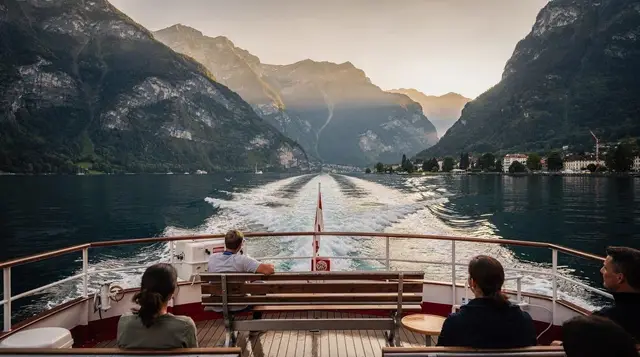
For something more organised, a chocolate fondue float on the lake pairs dessert fondue with the scenery rather than the altitude — worth booking through a chocolate fondue boat trip on the lake if the idea of eating fondue while actually floating on Lake Thun or Lake Brienz appeals more than a restaurant table. On the savoury side, a guided outing that pairs raclette with a walk through Lauterbrunnen and Wengen is a reasonable way to get the food and the villages in one afternoon, through a Lauterbrunnen and Wengen raclette tasting.
If the idea of combining an outdoor activity with a plate of raclette afterwards sounds more like your evening than a formal restaurant, there is also a raclette and rafting outing on the river that does exactly that. And for a full day up at altitude that ends with a cheese-heavy dinner, the round trip covered by a Glacier 3000 cable car ticket gets you to the restaurant without driving over the Col du Pillon yourself.
Raclette, done properly
Raclette in its traditional form is not a communal pot but a half-wheel of cheese melted by a fire or a grill and scraped onto a plate with boiled potatoes, gherkins and pickled silverskin onions; the modern electric raclette grill, with its little pans of cheese for each diner, is a home-kitchen adaptation that most restaurants here have moved away from in favour of the traditional scrape-and-serve method, or at least offer both. A restaurant serving raclette “by the round” will keep bringing fresh scrapes until you say stop, in the same way a fondue pot keeps getting topped up, so pace yourself on the bread and potatoes rather than filling up on the first round.
Ordering both fondue and raclette at the same sitting is unusual and most kitchens will gently talk you out of it — they are variations on the same idea, hard alpine cheese melted and eaten hot, and doing both back to back tends to be more cheese than most people actually want in one evening, however good the first round tastes.
When the season genuinely runs, and when it does not
Restaurants at valley level in Interlaken, Unterseen and Matten keep fondue and raclette on the menu all year, because enough visitors ask for it in every season that taking it off would cost more in disappointed tables than it saves in cheese. The honest read is still that October to April is when it is being cooked for people who actually want it that way, and April through September is largely tourist demand being met competently rather than eagerly.
Mountain restaurants are a different case, tied directly to when the lifts run. The Schilthorn and Glacier 3000 restaurants operate on the same schedule as their cable cars, which means they close for the spring and autumn maintenance windows along with everything else up there, typically a period of one to three weeks depending on the year and the lift. If a fondue at altitude is the plan rather than a nice-to-have, check the specific lift’s operating calendar before booking anything, since the restaurant simply does not exist as an option on a closure day.
Winter brings its own version of the same food culture into the ski villages: Wengen and Mürren both have mountain restaurants doing fondue and raclette for skiers coming off the slopes at lunch, which is a different, more casual version of the dish than a booked evening table, usually eaten quickly at a shared bench in ski boots.
Booking, timing and the small etiquette that saves an evening
Fondue restaurants in Interlaken rarely need a reservation on a Tuesday in June, but they fill up fast on winter weekends and around Christmas, when both residents and visitors want the same tables at the same time. If you are set on a specific restaurant during the cold months, book a day or two ahead by phone; walk-ins on a December Saturday often mean a long wait or no table at all.
The pot arrives hot and stays hot on a small burner at the table; stir it occasionally as you eat to keep it from separating, and expect a thin, slightly crisp layer of cheese, the religieuse, to form at the bottom by the end. Scraping it up and eating it is normal, not a faux pas, and in some households it is considered the best part.
Dropping your bread in the pot and losing it is treated as a minor joke rather than a real infraction almost everywhere, whatever old rumours about buying a round of drinks might suggest — nobody in Interlaken is going to hold you to that.
If the whole idea still feels more appealing as dessert than dinner, the chocolate version on the water via a chocolate fondue float is the lower-commitment way to try fondue in Interlaken without booking a full evening around it, and it runs regardless of which cheese restaurant has a table free that night.
Planning the rest of the trip around a good meal
Food is rarely the only reason to build an evening in Interlaken, but it is a reasonable anchor for one. Pair a fondue dinner in Unterseen with an afternoon at Harder Kulm, a short funicular ride from Interlaken Ost, so you arrive back down hungry rather than full. On a day trip further into the valley, Lauterbrunnen and a village restaurant dinner make a sensible pairing before the last train back.
For a broader sense of what else the region’s kitchens do well beyond melted cheese, the restaurant guide and the eating cheap guide both cover ground this page does not, and the cheese dairies of the Bernese Oberland guide is worth reading before you order, since knowing where the Gruyère and Vacherin in your pot actually came from changes how the whole meal reads.
Anyone travelling in winter should also check Interlaken in winter for what else is realistically open, and budget-minded visitors will find the wider cost picture in Interlaken on a budget, since a fondue dinner is one of the more predictable line items in an otherwise expensive week.
Lake cruises & boat tours on GetYourGuide
Verified deep-linked GetYourGuide tours. Book through these links and we earn a small commission at no cost to you.
GetYourGuide does not provide a product photo for this activity — the image shows the meeting point, photographed by us.