Mürren and Schilthorn skiing: small slopes, the Inferno and no queues
Is Mürren-Schilthorn worth skiing over Wengen or Grindelwald?
Mürren-Schilthorn is a small area of around 50 km of pistes reached by cable car from Stechelberg or Lauterbrunnen, with far shorter lift queues than Grindelwald and the annual Inferno race run down its black terrain. It suits confident intermediates and advanced skiers better than beginners, who find broader nursery slopes in Wengen.
Mürren and the Schilthorn are the small option in a region that otherwise sells itself on scale. While the Jungfrau ski region markets around 200 km of interlinked pistes across Grindelwald, Wengen and Mürren, the Mürren-Schilthorn sector on its own is closer to 50 km, reached by a single cable car line from the valley floor. That sounds like a disadvantage until the first Saturday you stand at the base station in Stechelberg and walk straight onto the cable car instead of queuing behind a coach party. This is the quiet corner of the Jungfrau region, the one with the steepest reputation, the biggest amateur ski race in the world, and a car-free village that most skiers only see from the window of a cable car cabin.
A small ski area, deliberately
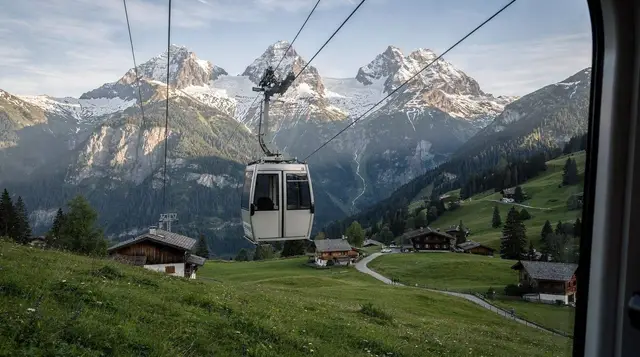
Mürren sits at 1,650 m on a shelf above the Lauterbrunnen valley, with no road connection at all — access is by cable car from Stechelberg or by the Lauterbrunnen–Grütschalp cable car and onward train. That isolation is exactly what keeps the skiing quiet. There is no day-tripper traffic jam because there is no traffic. The resident population is under 500, and skier numbers on the mountain rarely feel that different from the village below.
The terrain splits into two halves. Below Mürren, gentler red and blue runs serve Winteregg, Maulerhubel and the Allmendhubel funicular area, good intermediate cruising with views across to the Eiger, Mönch and Jungfrau. Above Mürren, the Schilthornbahn cable car climbs via Birg to the Schilthorn summit at 2,970 m, opening up the steeper, more exposed terrain the area is known for. A separate guide covers the summit itself, its cable car history and the revolving restaurant at Piz Gloria and the Schilthorn in more detail.
| Statistic | Mürren-Schilthorn |
|---|---|
| Total marked pistes | around 50 km |
| Summit altitude | 2,970 m (Schilthorn) |
| Base altitude | 795 m (Stechelberg) |
| Vertical drop, top to valley | around 2,170 m |
| Main lift | Schilthornbahn cable car (Stechelberg–Mürren–Birg–Schilthorn) |
| Season | mid-December to mid-April, snow dependent |
Getting up there: Stechelberg, Mürren and the Schilthornbahn
There are two practical routes in. The most direct is by road or postbus to Stechelberg at the head of the Lauterbrunnen valley, where the Schilthornbahn cable car starts. It rises in stages — Stechelberg to Mürren, Mürren to Birg, Birg to the Schilthorn summit — with the option to get off at Mürren for the lower pistes or continue straight to the top. The alternative is the rail route: a cable car from Lauterbrunnen station up to Grütschalp, then a scenic train along the cliff edge into Mürren itself.
Both approaches avoid driving into the village, because there is nowhere to drive to. Mürren and neighbouring Gimmelwald are among the handful of settlements in the region that are properly car-free, and the logistics of getting skis, boots and children up by cable car rather than by car is worth planning for rather than discovering on the day — the general mechanics are covered in the guide to cable cars and funiculars across the region.
For a first visit, or if you are staying down in Interlaken rather than up in Wengen or Mürren itself, a guided day trip removes the need to work out cable car connections and lift pass counters in German on your first morning.
a small-group day trip up to Mürren and the Schilthorn from Interlaken covers the cable car connections and gives a fixed window at the summit, which is a reasonable way to see the terrain before deciding whether to come back with skis.
The Inferno: Europe’s biggest amateur ski race
Mürren’s outsized reputation among skiers has one specific cause: the Inferno Rennen. Run by the Kandahar Ski Club of Mürren since 1928, it takes competitors from the Schilthorn summit down to Lauterbrunnen, a drop of around 4,200 vertical metres over roughly 15 km — widely described as the longest downhill ski race in the world.
It is held on a Thursday and Saturday in mid to late January, and it is wildly oversubscribed: roughly 1,800 places are allocated by ballot each year, drawing entrants from well beyond Switzerland. The race shuts the mountain to recreational skiers for the day, so if the dates fall inside your trip, check the current calendar in the guide to Bernese Oberland events and festivals before booking lift passes.
The Inferno’s route roughly traces the black terrain covered below, which is one reason the area punches above its size in reputation among skiers who have never actually skied Mürren — the name circulates in ski media far more than the piste count would suggest.
The black runs, and who they actually suit
The signature terrain drops from Schilthornhütte, below the summit, down through a narrow chute locally known as the Kanonenrohr — the “gun barrel” — before opening onto steeper red and black pitches toward Mürren. It is not groomed daily, it narrows in places to little more than a couloir, and in flat light it is easy to misjudge the pitch. This is genuinely advanced terrain, not resort marketing calling a moderate red run “black” to justify a reputation.
For skiers still consolidating parallel turns, the better plan is the red network around Winteregg and Maulerhubel, on the lower half of the mountain below Mürren, which is wide, consistently pitched and largely sheltered from wind. The general character of skiing across the wider region, including how Mürren compares for ability level, is covered in skiing in the Jungfrau region, and a direct comparison against the resort most beginners default to instead is in Wengen versus Mürren.
| Run type | Where | Suits |
|---|---|---|
| Blue/red cruising | Winteregg, Maulerhubel, Allmendhubel | Intermediates, families |
| Red, more exposed | Upper mountain toward Birg | Confident intermediates |
| Black, Kanonenrohr chute | Schilthornhütte to Mürren | Advanced skiers only |
| Off-piste / ungroomed | Around Birg, guide recommended | Experts with local knowledge |
Lift passes and costs
A pass covering only the Mürren-Schilthorn sector currently runs to roughly CHF 65 to 70 for an adult day pass, at the prices in effect when this guide was last checked. The combined Jungfrau ski region pass, which adds Grindelwald, Wengen, Grindelwald First and Kleine Scheidegg-Männlichen to the same ticket, costs more, typically around CHF 90 to 95 a day, and only makes sense if you plan to ski more than one sector during your stay.
Half-day and multi-day rates reduce the per-day cost noticeably on the regional pass, so it is worth pricing out a 3- or 4-day pass against buying single days if your trip includes more than a couple of ski days. Regional passes such as the Berner Oberland Pass do not typically include ski lift access on top of the transport benefit — check the small print rather than assuming.
| Pass | Approximate adult price |
|---|---|
| Mürren-Schilthorn, 1 day | CHF 65–70 |
| Jungfrau ski region, 1 day (Grindelwald, Wengen, Mürren) | CHF 90–95 |
| Jungfrau ski region, 3 days | discounted per-day rate, check current tariff |
Beginners, families and non-skiers
Mürren is not the easiest base for a first ski trip. The nursery slopes near Allmendhubel and the village are serviceable, with a ski school running lessons, but there is less flat, forgiving terrain than in Wengen, which most first-timers in the region choose instead. If your group mixes skiers and non-skiers, Mürren still has plenty to do off the slopes: the Allmendhubel funicular serves a sledge run down to the village, and further afield the region’s dedicated sledging and toboggan runs are worth a look for a non-ski day.
For a guided introduction that takes the planning off your hands, a sledge day trip through Lauterbrunnen and Mürren from Bern combines the two villages with a groomed toboggan run rather than skis.
Non-skiers who would rather walk than sledge have options too, since the snowshoeing and winter hiking network extends around Mürren’s lower slopes on marked winter trails, well away from the pistes. a guided snowshoe tour from Interlaken is a reasonable way to try it without buying or renting snowshoes for one outing.
Mürren-Schilthorn versus Wengen and Grindelwald
The three resorts sit on one lift ticket but feel like different mountains. Grindelwald is the largest and busiest, with the most beginner terrain and the most infrastructure, including the newer Eiger Express gondola. Wengen sits between the two in size, with a longer beginner and intermediate network and the Lauberhorn World Cup downhill course — covered separately in the Wengen and Lauberhorn ski guide. Mürren is the smallest, steepest and quietest of the three, with no road access at all.
| Mürren-Schilthorn | Wengen | Grindelwald | |
|---|---|---|---|
| Size | around 50 km | mid-sized | largest in the region |
| Access | cable car only, no road | cog railway, no road for cars | road and rail |
| Character | steep, quiet, advanced-leaning | classic, varied, race history | busiest, most beginner terrain |
| Best for | confident skiers wanting space | mixed-ability groups | families, first-timers |
Weather, wind closures and the best time to go
The Schilthornbahn is more exposed to wind than the gondolas serving Grindelwald or the Jungfraujoch line, and the top section between Birg and the Schilthorn summit is the first to close on a gusty day, sometimes while the lower mountain around Mürren keeps running normally.
Check the when mountain railways open and close guide before committing to a summit-focused day, and build in a lower-mountain backup plan rather than assuming the top will be open because the forecast looked calm from the valley. Outside the ski season, the same exposure and the spring and autumn maintenance closures apply to the cable car generally, which matters if your trip falls at either edge of the December-to-April window.
Snow reliability is generally good given the altitude, but a warm spell can strip the lower pistes toward Mürren while the upper mountain stays skiable — worth checking recent snow reports rather than booking blind on dates alone. General seasonal planning for the wider area, including what a winter stay in Interlaken itself looks like off the slopes, is covered in Interlaken in winter.
After skiing
Mürren’s après-ski is low-key compared with Wengen or Grindelwald — a handful of bars and hotel terraces rather than a strip of options — which suits the area’s general character. The wider region’s more active après scene, and where to find it, is covered in après-ski in the Jungfrau region. For food after a day on the black runs, mountain restaurants around Winteregg and the mountain huts and berghaus dining guide cover the on-mountain options, which tend to be simpler and less crowded than the equivalents in Grindelwald.
Planning a Mürren-Schilthorn ski day
For visitors staying down in Interlaken or Lauterbrunnen rather than up in Mürren itself, the cable car connections add a genuine hour or more to the day compared with resorts you can ski straight out of. Building that into your schedule matters more here than almost anywhere else in the region. A private option removes the timing pressure if you are travelling with a small group: a private day trip covering Lauterbrunnen, Mürren and the Schilthorn from Bern sets its own pace rather than following a fixed group schedule, which is useful if conditions mean you want more time on the mountain and less at the viewpoints.
If a Mürren ski day is one stop in a longer winter itinerary around the region, the Interlaken four-day winter itinerary sequences it against Grindelwald and Wengen so lift passes and travel days do not overlap unnecessarily.
Mürren-Schilthorn ski FAQ
How big is the Mürren-Schilthorn ski area?
The area totals around 50 km of marked pistes served by the Schilthornbahn cable car and a handful of smaller lifts around Mürren, Birg and the Schiltgrat. That is a fraction of the linked Jungfrau ski region’s roughly 200 km, but the trade-off is short lift queues and consistently steep, north-facing snow.
What is the Inferno race?
The Inferno Rennen is an amateur downhill race from the Schilthorn to Lauterbrunnen, roughly 4,200 vertical metres over about 15 km, run by the Kandahar Ski Club of Mürren since 1928. It is oversubscribed every year, with around 1,800 places allocated by ballot for the late-January date, and the mountain closes to ordinary skiers while it runs.
Are the Schilthorn’s black runs really that hard?
The run from Schilthornhütte down through the Kanonenrohr chute is genuinely steep and narrow, closer to a couloir than a groomed piste in places, and it is not always pisted. Confident advanced skiers manage it comfortably; anyone still working on parallel turns should stay on the red runs around Winteregg and Maulerhubel instead.
Can beginners learn to ski at Mürren?
There are nursery slopes at Allmendhubel and near the village centre, with a ski school offering lessons, but the amount of easy terrain is limited compared with Wengen’s broader beginner network. First-timers often base themselves in Wengen and visit Mürren for a day.
How do you reach Mürren and the Schilthorn without a car?
From Lauterbrunnen, a cable car climbs to Grütschalp and a train then runs along the cliff edge to Mürren. Alternatively, drive or take a bus to Stechelberg and ride the Schilthornbahn cable car, which continues via Mürren and Birg to the Schilthorn summit. Mürren and Gimmelwald, the villages en route, are both car-free.
When does the Mürren-Schilthorn season run, and can it close for wind?
The season typically runs from mid-December to roughly mid-April, snow conditions permitting. The exposed Schilthornbahn cable car is more wind-sensitive than gondolas elsewhere in the region, and the Birg-to-Schilthorn section can close on a gusty day even when Mürren itself is calm and fully skiable.
Is Mürren-Schilthorn quieter than Wengen or Grindelwald?
Yes, noticeably. Mürren has no road access and a small resident population, so lift queues are short and the pistes rarely feel crowded, even on a clear Saturday when Grindelwald’s slopes are busy.
What does a lift pass for Mürren-Schilthorn cost?
A Mürren-Schilthorn-only day pass costs roughly CHF 65 to 70 for an adult at the time of writing, cheaper than the combined Jungfrau ski region pass covering Grindelwald and Wengen too, which runs to around CHF 90 to 95 a day. Multi-day and half-day rates bring the per-day cost down.
Mountain excursions on GetYourGuide
Verified deep-linked GetYourGuide tours. Book through these links and we earn a small commission at no cost to you.
GetYourGuide does not provide a product photo for this activity — the image shows the meeting point, photographed by us.