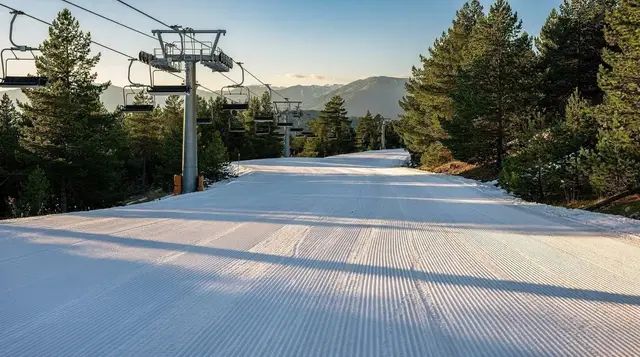
Skiing in the Jungfrau region
What is the Jungfrau Ski Region and how big is it?
The Jungfrau Ski Region links three separate sectors above Grindelwald, Wengen and Murren, with around 210km of marked pistes and roughly 40 lifts. A single Jungfrau Ski Region pass covers all three, though they are not physically joined and switching sectors means a valley transfer by train or road.
Three sectors, not one ski area
“The Jungfrau Ski Region” sounds like a single connected mountain, and the marketing photographs encourage that idea. It isn’t one. It’s three separate lift networks, each rising from its own valley town, joined only by a shared lift pass and by trains running along the valley floor. Skiers moving between sectors in the same day are taking the train back down, not skiing across a ridge.
The three sectors are Grindelwald-First, Kleine Scheidegg-Mannlichen (which links onward to Wengen), and Murren-Schilthorn. Each has a different character, a different base altitude and a different crowd. Picking the right one for your ability and mood matters more here than at a single large resort, because a wrong choice means a full valley transfer to fix it, not a five-minute traverse.
For visitors who want the mountains without the skis, a guided day out such as the Swiss ski experience day in the Jungfrau region bundles equipment, a lesson slot and lift access into one booking, which removes most of the logistics covered below.
The three sectors compared
| Sector | Base town | Top station | Altitude | Focus | Approx. piste km |
|---|---|---|---|---|---|
| Grindelwald-First | Grindelwald (1,034m) | First | 2,168m | Beginners, families, wide blues | ~60km |
| Kleine Scheidegg-Mannlichen | Grindelwald / Wengen (1,274m) | Eigergletscher / Mannlichen | 2,320m / 2,343m | Long intermediate cruising, Lauberhorn terrain | ~90km |
| Murren-Schilthorn | Murren (1,650m) | Schilthorn | 2,970m | Steeper pistes, off-piste, freeride | ~55km |
The figures move a little year to year as individual runs are reclassified, but the proportions hold: Kleine Scheidegg-Mannlichen is the biggest of the three by a clear margin, First is the gentlest, and Murren-Schilthorn is the smallest but the most demanding.
Grindelwald-First: the easy option
First’s lift leaves directly from Grindelwald’s Firstbahn station, a short walk from the main street, which makes it the sector with the least friction between bed and piste. The nursery slopes at Bodmi sit right at the base, and the runs down from Schreckfeld and Bort are wide, groomed blues that rarely intimidate a first-week skier. Ski schools cluster here for the same reason.
It isn’t only for beginners. The run from First back to Grindelwald is a genuine 1,100m vertical descent when conditions allow it the whole way, and the sector connects to Bussalp for quieter, less-groomed terrain away from the main lift lines. But the character of the sector skews easy, and strong skiers tend to use First for one morning before moving on.
In summer this same lift network carries the First cliff walk and mountain cart runs; in winter the infrastructure switches almost entirely to skiing and sledging.
Kleine Scheidegg-Mannlichen: the main event
This is where most of the piste kilometres live, and where the Jungfrau region’s skiing reputation actually comes from. The sector spreads across the open bowl below the Eiger, Monch and Jungfrau, reached either from Grindelwald via the Eigergletscher lifts or from Wengen via the Mannlichen cable car, with Kleine Scheidegg itself acting as the hub where routes from both sides meet.
The Eiger Express, the gondola opened in December 2020, cut the journey from the Grindelwald Terminal to Eigergletscher to around 15 minutes, replacing a slower train connection and reducing the queues that used to build up at the old base station on cold mornings. It’s now the fastest way into this sector from the Grindelwald side.
The runs themselves are long, mostly red-graded, and consistently scenic in a way that’s hard to overstate without sounding like marketing copy: skiing directly toward the north face of the Eiger is simply what happens here, not a special excursion. This is also the terrain used for the men’s World Cup downhill each January, the Lauberhorn race, which starts above Wengen and remains the longest downhill course on the World Cup calendar. Recreational skiers can ride sections of the same route outside race weeks.
Wengen itself is car-free, reached by train from Lauterbrunnen, and functions as a ski-in ski-out base for this sector in a way Grindelwald doesn’t quite manage for its own.
Murren-Schilthorn: the quiet, steep one
Murren sits at 1,650m, already higher than either Grindelwald or Wengen, which helps its snow reliability at the base. The village is car-free, reached by cable car from Stechelberg or by a scenic mountain railway from Lauterbrunnen via Grutschalp, and it stays noticeably quieter than the other two sectors even in high season, partly because it’s a longer approach from Interlaken and partly because it has less beginner terrain to draw families.
What it does have is the Schilthorn itself at 2,970m, the revolving Piz Gloria restaurant at the top, and from Birg partway down, the region’s most serious off-piste access, including couloirs that require a guide and the right conditions rather than a casual detour. The Kandahar piste from Schilthorn down to Murren is a genuine black run and forms part of the Inferno, an amateur race held most years that has run since 1928 and remains one of the longest ski races in the world by descent.
This sector suits confident intermediates who want fewer crowds and stronger skiers who want terrain with real consequence. It suits beginners least of the three.
The lift pass and what it costs
A single Jungfrau Ski Region pass covers lifts across all three sectors, which matters because buying separate tickets sector by sector works out more expensive if you’re moving around during your stay.
| Pass | Approx. adult price | Notes |
|---|---|---|
| Half-day (from ~12:30) | CHF 55-60 | Covers one sector or all three from that time |
| Full day | CHF 72-77 | Prices rise slightly in peak weeks (Christmas, February) |
| 2 days | CHF 140-150 | Consecutive days |
| 6 days | CHF 370-390 | Daily rate drops to roughly CHF 62-65 |
| Junior (6-17) | ~50% of adult | Under 6 usually free with a guardian’s pass |
These are indicative figures, not a quote: the operator revises them most seasons and adds early-booking discounts online that undercut the walk-up price. Confirm the current numbers at jungfrau.ch before you commit, particularly if you’re buying for a family, since the junior and multi-day combinations change the maths quickly. The Jungfrau Travel Pass and Berner Oberland Pass are separate products covering trains and excursions rather than ski lifts specifically, and holders of a Swiss Travel Pass still need to buy ski lift access on top.
Equipment rental is available at the base of every sector, typically CHF 45-65 per day for a full ski or snowboard set including boots, with multi-day rates working out cheaper per day. Booking rental online the night before saves queuing at altitude on a cold morning.
Snow elevation: the part that catches people out
This is the detail that ruins the most days here, more than any single piece of etiquette or planning advice. Grindelwald sits at 1,034m and Wengen at 1,274m: both are low enough that a mild or late-arriving winter can leave the valley floor green, or slushy, while the terrain above roughly 2,000m is fully white and entirely skiable. Visitors who judge conditions by looking out of their hotel window in the village frequently write the whole trip off unnecessarily.
The reverse also happens: a cold snap can dump snow on the upper sectors while the access roads and lower runs into the villages stay marginal, meaning the final few hundred metres down to base can be icy or thin even when the main terrain is excellent. Murren, at 1,650m, is the one village less exposed to this problem, which is part of why its sector holds its base-level snow more reliably late in the season.
Check each sector’s own snow report rather than the general weather forecast for Interlaken. The three operators publish piste-by-piste conditions and the number of lifts running, which is a far better guide than the sky above the valley floor.
Getting to each sector without a car
None of the three sectors needs a car, and in the case of Wengen and Murren a car is actively useless since neither village allows one. From Interlaken Ost:
- Grindelwald-First: direct train to Grindelwald (~35 minutes), then the Firstbahn gondola from the station.
- Kleine Scheidegg-Mannlichen via Grindelwald: train to Grindelwald Terminal, then the Eiger Express to Eigergletscher.
- Kleine Scheidegg-Mannlichen via Wengen: train to Lauterbrunnen, change for Wengen, then the Mannlichen cable car or the cog railway up to Kleine Scheidegg.
- Murren-Schilthorn: train to Lauterbrunnen, then either the cable car via Stechelberg or the railway via Grutschalp to Murren, then the Schilthornbahn.
Journey times from Interlaken run 45 minutes to just over an hour depending on the sector and connection, which is short enough to base yourself in Interlaken itself rather than in one of the mountain villages, if you don’t mind an earlier start and don’t need the last lift down at closing time. Staying in Wengen or Murren instead removes that commute entirely but locks you into whichever sector sits on your doorstep for casual half-days.
For a broader look at how the region’s trains, cable cars and funiculars fit together outside ski season too, see the guide to cable cars and funiculars in the region.
Ski school and lessons
All three sectors run ski schools, with the largest concentration at Grindelwald-First given its beginner-friendly terrain. Group lessons typically run half-day or full-day, with private instruction available by the hour at a significant premium. Booking a few days ahead in the February and Christmas peak weeks is worth doing, since popular instructors and time slots do sell out.
Families with young children specifically should look at First’s Bodmi area first: it has the dedicated learning terrain, the shortest walk from parking and station, and the highest density of ski schools built around exactly that age group.
For a genuinely hands-off introduction, the guided day-long ski experience in the Jungfrau region handles equipment and instruction together rather than requiring separate bookings for rental and lessons.
When the season runs, and when it doesn’t
The Jungfrau Ski Region typically operates from mid-December to mid-April, though this varies by sector and by how much snow has actually fallen. First and Kleine Scheidegg-Mannlichen, sitting higher overall, tend to open earliest and hold on longest into spring. Murren-Schilthorn’s exact dates depend more heavily on the season, since its terrain is less extensive and less forgiving when cover is thin.
As with the region’s summer lifts, winter lifts close periodically for scheduled maintenance, and individual sections close on high-wind days, particularly the more exposed cable cars up to Schilthorn and Mannlichen. Check the specific sector’s operating status the morning you plan to go rather than assuming a pass covers guaranteed access; for more on this pattern across the region generally, see when mountain railways open and close.
Beyond the piste
Not every winter day here needs skis. First and Grindelwald both run dedicated toboggan runs, some of them multi-kilometre descents lit for evening use; see the guide to sledging and toboggan runs for specifics. Marked winter walking trails and snowshoeing routes fan out from most of the same lift stations, giving non-skiing companions somewhere to go that isn’t simply waiting in a village café.
After the lifts close, Grindelwald has the most concentrated après-ski scene of the three base towns; the apres-ski guide to the Jungfrau region covers where that happens and what it costs. For a wider view of the season generally, including what’s realistic to fit into a short trip, the Interlaken in winter guide and the four-day winter itinerary both build around exactly this three-sector structure.
Visitors combining a ski trip with the region’s famous rail journey upward can also add the Jungfraujoch, including its overnight stay option at 3,600m, via the Jungfraujoch Top of Europe overnight experience, or arrive from Zurich on the Zurich to Jungfrau region day trip by train for a first look at the terrain before committing to a full ski stay.
Skiing in the Jungfrau region: your questions answered
How many kilometres of pistes does the Jungfrau Ski Region have?
Around 210km spread across the three sectors: Grindelwald-First, Kleine Scheidegg-Mannlichen-Wengen, and Murren-Schilthorn. The Kleine Scheidegg-Mannlichen sector is the largest of the three and links through to Wengen.
Which sector is best for beginners?
Grindelwald-First, particularly the Bodmi nursery slopes at the base and the gentle blues around Schreckfeld and Bort. It has the shortest, easiest terrain and the most ski schools per square kilometre.
Which sector is best for experienced skiers?
Murren-Schilthorn. It carries the steepest official pistes, the most off-piste terrain accessed from Birg and the Schilthorn, and the Kandahar run down to Murren, part of the annual Inferno race course. It is also the quietest of the three sectors.
Do I need a car to ski the Jungfrau region?
No. Every sector is reached by train, cable car or a combination of both from Interlaken Ost. A car adds nothing except parking costs, since Wengen and Murren are car-free and Grindelwald’s stations sit next to the town centre.
How much does a Jungfrau Ski Region lift pass cost?
An adult day pass runs to roughly CHF 72-77 depending on the season, with multi-day passes bringing the daily rate down to around CHF 60-65. Half-day passes from early afternoon and afternoon-only passes from around 1pm are cheaper again. Check current prices at jungfrau.ch before you travel, since they are revised most seasons.
Can non-skiers still go up the mountains in winter?
Yes. Every lift station sells scenic return tickets alongside ski passes, and the Schilthorn, First and Mannlichen all keep restaurants and viewing platforms open through winter for anyone arriving on foot, by sledge or simply for the view.
When does the Jungfrau region ski season run?
Broadly mid-December to mid-April, though exact opening and closing dates vary by sector and by snow year, and lifts also close for scheduled maintenance in shoulder weeks. First and Kleine Scheidegg-Mannlichen usually open earliest and close latest because their upper sections sit above 2,000m.
Is there snow guaranteed down at village level?
No. Grindelwald sits at 1,034m and Wengen at 1,274m, both low enough that a mild winter can leave the valley floor bare while the pistes above 2,000m are fully skiable. Check the sector’s own snow report rather than judging by what the town looks like.
Skiing & winter experiences on GetYourGuide
Verified deep-linked GetYourGuide tours. Book through these links and we earn a small commission at no cost to you.
GetYourGuide does not provide a product photo for this activity — the image shows the meeting point, photographed by us.