Four days in Interlaken in winter
Why four days works for a winter-not-skiing trip
Interlaken in winter is quieter, colder and shorter on daylight than the summer version everyone sees in photos, and that changes how a trip should be built. Four days is enough to fit one proper mountain day, one lake-and-village day with a clear-weather summit, and a slower day built around a Christmas market or thermal spa rather than another cable car queue. It is not enough to also add Zermatt or the Jungfraujoch without cutting something else, so this plan keeps the base fixed in Interlaken and treats Grindelwald, Wengen and Mürren as day trips out and back.
The order below assumes December to February conditions: short days, real cold at altitude, and a genuine chance that one lift closes for wind on any given morning. Build in a buffer rather than booking every hour, and check when mountain railways open and close before locking in dates, since some winter maintenance windows and reduced schedules run right through the season on smaller lifts.
Day 1: Arrive in Interlaken and get your bearings
Most trains from Zurich Airport, Geneva or Bern arrive at Interlaken Ost, the station for the Jungfrau railways and Lake Brienz boats, roughly two hours from Zurich and under an hour from Bern. Interlaken West sits closer to the Hoheweg and the town centre, so if your hotel is near there, stay on the train one more stop rather than walking the length of town with luggage in the cold.
Spend the afternoon on foot: the Hoheweg runs along the edge of the Hohematte, the protected meadow in the middle of town, past the grand hotels that made Interlaken’s reputation in the 19th century. In winter the meadow is often frosted rather than green, and paragliders still land here on clear days even in January. Walk fifteen minutes to Interlaken Ost and take the eight-minute funicular up to Harder Kulm if the sky is clear late in the day; sunset over the two lakes from 1,322 metres is a reasonable way to spend two hours without committing to a full excursion.
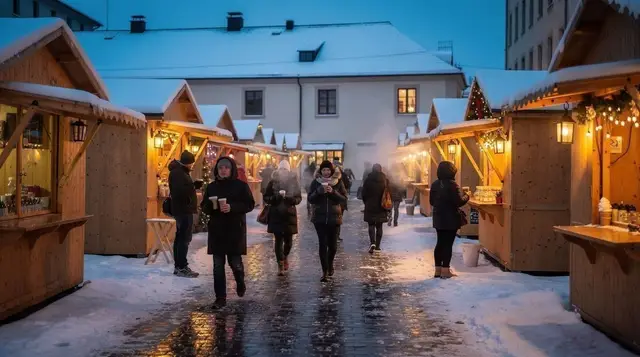
In the evening, choose between a Christmas market, if you are visiting in late November or December, and a thermal spa. Interlaken’s own market runs in the Höhematte area in the run-up to Christmas; further options exist in Bern and Thun (see Christmas markets of the Bernese Oberland). If markets are not your thing or you are travelling in January or February, book an evening at one of the thermal baths near Interlaken instead — a genuinely good way to warm up after a day of travel, and less crowded on a weekday evening than a weekend afternoon.
Dinner: a fondue or raclette is the obvious winter choice and Interlaken has no shortage of places serving both — see the fondue and raclette guide for where it is done properly rather than reheated for tour groups.
Day 2: Grindelwald — skiing or sledging under the Eiger
This is the ski-or-sledge day. Interlaken Ost to Grindelwald takes about 35 minutes by train, arriving under the north face of the Eiger. Grindelwald and neighbouring Wengen share a large connected ski area (see skiing in the Jungfrau region), and beginners are well served by ski schools based in the village.
the Grindelwald gondola up to Mount First covers the cable car ride and, in winter, gives access to the First Mountain toboggan run — a graded route of several kilometres that needs no ski experience, only sturdy gloves and low expectations of dignity on the icy sections. Sledges rent at the top station; check conditions before committing, since the run closes after heavy snowfall until it is groomed. If you would rather ride up and take in the view without sledging, the First return ticket from Interlaken covers the gondola and the panoramic terrace at 2,168 metres, with the Eiger, Mönch and Jungfrau lined up across the valley on a clear day.
Grindelwald First is one of the lifts most exposed to wind closures in this region, so build a fallback into the day: if First is closed, the Grindelwald First guide lists alternative viewpoints, and the village itself has enough shops and cafés along its single main street to absorb a delayed morning without the day being wasted. For the sledging and toboggan runs more broadly, First is the easiest to reach without a car, but Big Pintenfritz and other runs exist elsewhere in the region if First is out of action.
Return to Interlaken by early evening; the last connecting trains from Grindelwald run reasonably late, but winter timetables are thinner than summer ones, so check the exact departure before you get to the station.
Day 3: Lauterbrunnen, Wengen and the Schilthorn from Mürren
This is the clear-weather summit day, and the one most worth rescheduling if the forecast is poor, since the Schilthorn’s 2,970-metre summit is only worth the ticket price with visibility. Interlaken Ost to Lauterbrunnen takes about 20 minutes, dropping you into the valley of 72 waterfalls with the 297-metre Staubbachfall visible directly above the village.
From Lauterbrunnen, a cable car climbs to car-free Mürren, one of three villages in the region — alongside Wengen and Gimmelwald — reachable only by rail or cable car; cars stay behind in Lauterbrunnen or Stechelberg. A private option covering this whole loop is the private Lauterbrunnen, Mürren and Schilthorn trip, which removes the need to work out connections yourself if you are short on time or travelling with a group.
From Mürren, the cable car continues via Birg to the Schilthorn — Piz Gloria, the revolving restaurant made famous by a 1969 Bond film, at 2,970 metres. On a clear winter day the 360-degree panorama takes in the Eiger, Mönch and Jungfrau on one side and the Bernese lowlands on the other; see the Schilthorn and Piz Gloria guide for current ticket prices and the two competing routes up (via Mürren or via Stechelberg). Skiers can also treat this as an entry point to the Mürren-Schilthorn ski area, which is smaller and quieter than Grindelwald’s.
On the way back down, stop in Wengen, reached by rail from Lauterbrunnen rather than from Mürren directly — the two villages face each other across the valley but are not linked by cable car. Wengen has more restaurants than Mürren and a gentler, more residential feel; a private walking tour of Wengen is a low-key way to see the village properly rather than just passing through on the way to a train, and pairs well with the Wengen and Lauberhorn ski guide if skiing is on the agenda for a future visit.
If you would rather end the day slowly instead of rushing back for dinner in Interlaken, book the sunset hike and cheese fondue evening in Wengen — a short walk followed by fondue, timed for the last train back down to Lauterbrunnen and on to Interlaken. Note how car-free villages work before you go: luggage porters and small electric taxis exist for hotel transfers, but there is no dropping bags at a car door.
Day 4: A flexible day — Jungfraujoch, a buffer, or slow mornings in Interlaken
Keep the last full day deliberately open. Three winters in four this works as a buffer against a lift closure on days two or three; use it to repeat whichever excursion got weathered out, since both the Grindelwald First cableway and the Schilthorn cable car can close on short notice in high wind.
If both earlier days went to plan, this is the day to consider the Jungfraujoch, Europe’s highest railway station at 3,454 metres, reached either via Lauterbrunnen and the Kleine Scheidegg or via the Eiger Express from Grindelwald Terminal. It is the most expensive single excursion in the region and, in winter, one of the coldest — dress for temperatures well below freezing even on a sunny day. The day trip to the Jungfraujoch from Interlaken bundles the rail connections into a single ticket, or see the Jungfraujoch guide for booking it yourself and checking the ice palace and Sphinx observatory opening hours, which are shorter in winter.
If the weather has been difficult all trip, skip another mountain day entirely. Interlaken itself has enough indoor options for a slow morning — see things to do in Interlaken when it rains — and the Interlaken in winter guide covers what stays open in the low season versus what shuts between mid-season school holidays. A second, shorter thermal spa session before an evening train or flight the next morning is a reasonable way to end the trip without another early cable car start.
Costs and passes across the four days
| Item | Approximate cost (CHF) | Notes |
|---|---|---|
| Grindelwald First return | 90–100 | Gondola only; toboggan sledge rental extra |
| Schilthorn return from Mürren | 110–120 | Cheaper with a Half Fare Card |
| Jungfraujoch return | 200–230 | Discounted with Good Morning tickets on early trains |
| Mid-range double room, Interlaken | 120–200 / night | Higher in the week around Christmas and New Year |
| Fondue or raclette dinner | 30–45 per person | Cheese, not meat fondue, at most restaurants |
| Thermal spa entry | 25–40 | Evening tickets sometimes discounted |
A Swiss Travel Pass covers regional trains and buses but not the summit cable cars at full discount, so weigh it against a Berner Oberland or Jungfrau Travel Pass if the whole trip stays within this region. Either way, check current travel costs for Interlaken before booking, since lift prices are revised most seasons.
What to pack and what to watch for
Winter at altitude here is not the same cold as Interlaken’s valley floor. Temperatures at the Schilthorn or Jungfraujoch regularly sit 15 to 20 degrees colder than in town, with wind chill on top on an exposed viewing platform. Layer up, bring proper gloves, and check the altitude, weather and what to pack guide before the trip rather than after arriving underdressed.
The single biggest planning risk on this itinerary is treating every cable car booking as fixed. Grindelwald First and the Schilthorn cableway both close in wind that would barely register in the valley, and the cable cars and funiculars explained guide covers how each operator publishes live status. Book flexible tickets where the operator allows it, check the forecast the night before rather than a week out, and treat Day 4 as the release valve that keeps a weathered-out morning from costing you the trip’s best view.
FAQ: planning a winter trip around Interlaken
Do I need a car for this itinerary?
No. Trains and cable cars link Interlaken, Grindelwald, Lauterbrunnen, Wengen and Mürren, and Wengen and Mürren are car-free villages anyway. A Berner Oberland Pass or Jungfrau Travel Pass covers most of the routes used across these four days.
What does this itinerary cost in winter?
Budget roughly CHF 250 to CHF 400 per person for lift tickets and cable cars alone, plus CHF 120 to CHF 200 a night for mid-range accommodation in Interlaken. The Schilthorn and Jungfraujoch tickets are the two biggest single costs, each over CHF 100 return.
Is four days in winter enough to see Grindelwald, Wengen and Mürren?
Yes, as a taster rather than a ski holiday. One full day covers Grindelwald First, one covers Lauterbrunnen, Mürren and the Schilthorn, and the other two absorb Interlaken itself, weather buffers and shorter excursions like Wengen.
What happens if a cable car closes for wind?
Grindelwald First and the Schilthorn cableway both close in high wind, sometimes with only a few hours’ notice on the operator’s website. Keep one day free of a fixed booking so a closure on the Schilthorn day can be swapped for the Grindelwald day, or vice versa.
Can I ski without being an experienced skier?
Grindelwald and Wengen both run ski schools for beginners, and the Grindelwald First toboggan run needs no ski experience at all, only warm gloves and a willingness to fall over on ice. Sledges can be rented at the top station.
How many daylight hours do I actually get in winter?
Around nine, from roughly 8am to 5pm in December and January, with the sun disappearing behind the surrounding peaks in the valley floor even earlier. Plan the cable car days to start by 9am and treat anything after 4pm as evening.
Is Mürren or Wengen better for a winter overnight?
Mürren sits higher and closer to the Schilthorn, so an overnight there saves an early cable car queue, but Wengen has more restaurants and a direct rail link down to Lauterbrunnen. This itinerary treats both as day visits from Interlaken to keep one base for four nights.
Skiing & winter experiences on GetYourGuide
Verified deep-linked GetYourGuide tours. Book through these links and we earn a small commission at no cost to you.
GetYourGuide does not provide a product photo for this activity — the image shows the meeting point, photographed by us.