Wengen and the Lauberhorn ski guide
What is the Lauberhorn and when is the Wengen ski race?
The Lauberhorn is a 4.48 km downhill course above Wengen, the longest run on the men's Alpine Ski World Cup calendar, raced on the third weekend of January alongside a slalom. Outside race week, Wengen's own ski area covers around 40 km of mostly easy and intermediate pistes linked to Grindelwald via Kleine Scheidegg and Mannlichen.
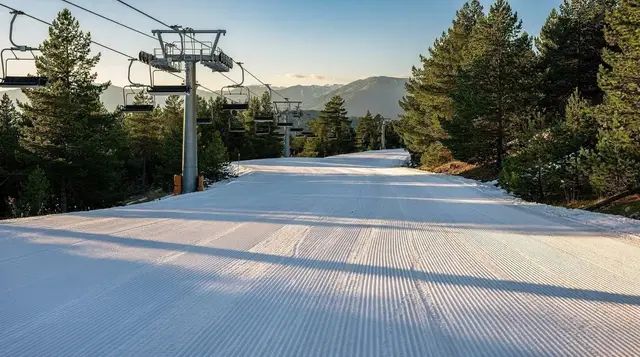
For one weekend every January, a car-free village of around 1,300 permanent residents becomes the epicentre of Alpine ski racing. The Lauberhorn downhill is the longest, and by most racers’ own account the most demanding, course on the men’s World Cup calendar, and it runs on the mountainside directly above Wengen. The rest of the winter, the same slopes revert to something much gentler: a family-friendly ski area linked by cograilway and cable car to Kleine Scheidegg and Mannlichen, with none of the crowds and none of the finish-line grandstands.
This guide covers both versions of Wengen: the race, what it actually involves for a visitor who wants to watch it, and the skiing available for the other roughly 16 weeks of the season when nobody is being timed.
A village built on one thousand vertical metres
Wengen sits at 1,274 m on a sunny shelf above the Lauterbrunnen valley, reached only by the Wengernalp cog railway from Lauterbrunnen station — there is no road. Cars stop at the Lauterbrunnen car park; everything after that moves by rail, cable car or on foot. That single fact shapes the whole place: no traffic noise, no parking problem in the village, and a slower pace that has made Wengen a fixture on British and Scandinavian winter-holiday lists since Victorian times, well before the race existed.
The Lauberhorn name belongs to the mountain shoulder above the village, between the Kleine Scheidegg saddle and the valley floor. The downhill course is carved into its face, and for 51 weeks of the year it is simply part of the normal piste network — the same run that recreational skiers use to come down from Kleine Scheidegg. For one week it is closed, prepared, and turned into a World Cup circuit watched by tens of thousands in the finish arena and on television.
The Lauberhorn downhill: the longest run on the World Cup calendar
At 4.48 km, the Lauberhorn is the longest downhill course used in the Alpine Ski World Cup, and it has run at Wengen every year since 1930 with only a handful of interruptions for war or weather — making it, alongside the Hahnenkamm at Kitzbühel, one of the two oldest fixtures on the circuit. The course drops roughly 1,020 vertical metres from start to finish, and the winning run typically takes around two minutes 24 seconds, longer than any other downhill on tour.
A handful of sections have their own names among racers and regulars, useful to know if you are watching from the piste rather than the television coverage:
| Section | What happens there |
|---|---|
| Start (Lauberhorn peak, ~2,315 m) | Steep pitch straight out of the gate, little room for error |
| Hundschopf | A rock outcrop the course jumps over blind, one of the most photographed moments on the circuit |
| Canadian Corner | Named after a Canadian racer’s crash here in the 1980s; a fast, off-camber turn |
| Silberhorn jump | Long airborne section with a view back towards the Jungfrau massif |
| Haneggschuss | The flat-out straight where racers hit their top speed, close to 155 km/h |
| Target jump (Ziel-S) | A blind compression into the final turns above the arena |
| Finish arena | Below the village, where the grandstands and hospitality tents are built each January |
Wengen’s own ski patrol and the race organisers maintain the course itself, but conditions on race week depend on the same weather that affects every mountain in the region: wind above a certain threshold cancels training runs, and low cloud can push the whole schedule back a day. The reserve day exists precisely because this happens most years to some degree.
The Lauberhorn weekend: what actually happens and when
The race weekend is fixed to the third weekend of January. The exact dates shift by a few days from year to year because the World Cup calendar is set season by season, so check the current FIS schedule rather than assume the same weekend as last year.
| Day | Typical event |
|---|---|
| Wednesday | First downhill training run |
| Thursday | Second downhill training run, sometimes a combined event |
| Friday | Final training run or a shortened race, depending on the year’s programme |
| Saturday | Downhill (the main event) |
| Sunday | Slalom |
Training runs matter more here than at most World Cup stops, because racers use them to learn a course that only appears once a season and is unusually long and technical. If your primary interest is the atmosphere rather than the specific discipline, Saturday’s downhill draws the largest crowds and the most television coverage; Sunday’s slalom is shorter, easier to follow live because the whole course is visible at once, and noticeably less crowded.
Watching for free versus paying for a seat
Standing areas along large sections of the course — including near the Hundschopf and along the final approach to the arena — are open to anyone holding a valid ski pass or a race-day village pass, at no extra charge beyond that. What costs money, and sells out early, are the grandstand seats built into the finish arena itself and any hospitality packages sold alongside them. If you want a guaranteed seat with a clear view of the finish line, that has to be bought well ahead through the race organiser’s own channels; walk-up tickets on the day are not reliable.
Booking a race-weekend trip
Three things go wrong most often for visitors planning a Lauberhorn trip, all avoidable with enough lead time:
- Accommodation in Wengen itself sells out fast, and prices for race week routinely run close to double the normal winter rate. Booking inside three months of the event usually means no rooms left in the village at any price.
- Interlaken and Lauterbrunnen absorb the overflow. Both put you back in Wengen within about 45 minutes by train and cog railway on race morning, and both have far more beds than Wengen’s roughly 1,300 residents can house.
- Trains fill up on race Saturday. The Wengernalp railway runs extra services during the event, but the early departures from Lauterbrunnen still get crowded; arriving with a two-hour buffer before the scheduled start is the safer plan, especially with skis or a sledge to carry.
A Swiss Travel Pass or the regional Jungfrau Travel Pass covers the train and cograilway legs into Wengen either way, race week or not, which is one less thing to plan around on the day.
Skiing Wengen the rest of the season
Outside the third week of January, Wengen is one of the gentler ski villages in the Jungfrau region, and that reputation is deliberate rather than a limitation. The local terrain above the village is mostly blue and red pistes, well groomed, with long sunny run-outs back towards the station — a good fit for families, beginners and anyone skiing on older-style skis who wants width and visibility rather than steep pitch.
The Wengen sector connects at Kleine Scheidegg to the larger Jungfrau Ski Region network, which also serves Grindelwald and Mannlichen on the same lift pass. Combined, the linked area covers roughly 200 km of marked pistes across the three sectors, though Wengen’s own slice is closer to 40 km. Strong skiers typically base themselves in Wengen for the views and the village atmosphere, then ride up to Kleine Scheidegg or across to the Eigergletscher and Mannlichen sides for the steeper black runs and the longer descents.
| Route | Character |
|---|---|
| Wengen village to Wengernalp | Wide, gentle, good for beginners and families |
| Kleine Scheidegg to Wengen (the Lauberhorn piste) | The World Cup course itself as an ordinary red run in season |
| Eigergletscher area | Higher, steeper, more exposed to wind closures |
| Mannlichen to Kleine Scheidegg | Long red/blue traverse with Eiger and Jungfrau views the whole way; see the Mannlichen to Kleine Scheidegg trail guide for the summer version of the same route |
Lift passes for the Jungfrau region are sold by the day, by several days, or as part of the broader regional passes. A single day covering the Wengen–Grindelwald–Mannlichen sectors runs into the CHF 80–90 range for an adult at current list prices, with the usual discounts for half-fare card holders, multi-day purchases and children; always check the current tariff on the Jungfrau Railways site before travelling, since Swiss lift prices are revised most seasons and this is not a place where costs come down.
Snow reliability is decent by regional standards because the pistes sit between about 1,270 m and 2,320 m, but like everywhere in the Bernese Oberland, the upper lifts close for scheduled maintenance in spring and sometimes for wind in midwinter — worth checking the live lift status the morning of, not the night before, if a specific run is the reason for the trip.
If you are not skiing at all
A large share of Wengen’s winter visitors never clip into skis, and the village is set up for that. Cleared winter footpaths run along the valley shelf with the Eiger and Jungfrau in constant view, and several operators run guided outings for exactly this crowd.
A guided evening walk up from the village with a stop for cheese fondue after a sunset hike is a straightforward way to see the north faces lit up without carrying any ski gear at all, and a private walking tour focused on the alpine views around Wengen works well for anyone travelling with a mix of skiers and non-skiers in the same group.
For families, a countryside farm tour aimed at families based in Wengen fills a half-day without needing snow experience at all, and the sledging and toboggan runs above the village are a genuine alternative to skiing rather than a consolation prize — several of the marked runs are long enough to fill an afternoon. For a slower pace still, a guided snowshoe tour run out of Interlaken reaches quieter terrain than the main pistes and needs no prior experience.
Getting to Wengen and moving around once there
Wengen is reached only by rail. From Interlaken Ost, trains run to Lauterbrunnen in around 20 minutes, then the Wengernalp cog railway climbs to Wengen in a further 15 to 20 minutes — a total journey of roughly 45 minutes door to door, and one of the more scenic short rail rides in the Jungfrau railway network. There is no road into the village and nowhere to park inside it; drivers leave the car in the large multi-storey at Lauterbrunnen station and take the train up from there, exactly as everyone else does.
Inside Wengen itself, distances are short enough to walk, and electric taxis (small battery vehicles, since combustion cars are not permitted) cover the rest, useful with luggage or after dark on an icy pavement. The connection onward to Grindelwald and the Eiger Express side of the valley runs via Kleine Scheidegg on skis or on foot in winter, or the long way round by train via Interlaken when the direct link is not an option.
Wengen against the rest of the region
Wengen’s closest comparison is Mürren, the other car-free village across the valley, reached via Lauterbrunnen and Stechelberg rather than through Kleine Scheidegg — see the Wengen versus Mürren comparison and the Mürren and Schilthorn ski guide for how that side of the valley differs. Mürren’s terrain leans steeper and its views centre on the Schilthorn and the Eiger’s north face from a different angle; Wengen’s leans gentler and sits closer to the Grindelwald side of the network.
For a broader look at how the region’s ski areas stack up against each other, including Adelboden and Lenk further along the Bernese Oberland, the skiing in the Jungfrau region overview is the place to start before choosing a base. And for what to do once the lifts close for the day, the après-ski guide to the Jungfrau region covers Wengen alongside Grindelwald and Mürren.
If a January trip is built specifically around the race, it is worth reading the events and festivals guide for the Bernese Oberland alongside this page, since the Lauberhorn weekend is only one of several fixed winter dates that affect train crowding and hotel prices region-wide. For the winter season more broadly, the Interlaken in winter guide and the four-day Interlaken winter itinerary both fold Wengen in as a day or two within a longer regional stay, which suits most visitors better than a Wengen-only trip.
Wengen and Lauberhorn: your questions answered
When is the Lauberhorn race in 2026 and 2027?
The Lauberhorn weekend is fixed to the third weekend of January every year. Downhill training runs Wednesday to Friday, the downhill itself is Saturday and the slalom is Sunday. Exact dates move by a few days year to year, so check the FIS Alpine Ski World Cup calendar before booking trains or hotels.
Do I need a ticket to watch the Lauberhorn downhill?
No. Standing areas along most of the course, including the Hundschopf and the finish arena approach, are free once you have a valid ski pass or a village entry ticket for race day. Grandstand seats in the finish arena and hospitality areas are ticketed and sell out months ahead.
How fast do skiers go on the Lauberhorn?
Racers reach roughly 155 km/h on the Haneggschuss straight, among the highest speeds recorded anywhere on the World Cup circuit. The course drops about 1,020 vertical metres over 4.48 km and the winning time is usually around two minutes 24 seconds.
Is Wengen good for skiing outside race week?
Yes, and it is far quieter. Wengen’s slopes are mostly gentle to intermediate, well suited to families and improving skiers, and the same lift pass covers the connected runs above Grindelwald through Kleine Scheidegg and Mannlichen, giving access to steeper terrain for stronger skiers.
How do you get to Wengen and can you drive there?
You cannot drive into Wengen. Leave the car at the large car park in Lauterbrunnen and take the Wengernalp cog railway up, a ride of about 15 minutes. From Interlaken Ost the full journey by train and cog railway takes roughly 45 minutes.
Where do you stay for the Lauberhorn weekend?
Rooms in Wengen itself sell out early and prices roughly double for race week; book six months or more ahead if you want to stay in the village. Interlaken and Lauterbrunnen have more capacity and put you back in Wengen inside 45 minutes on race morning.
Is the Lauberhorn downhill ever cancelled?
Fog, high wind or a lack of snow have forced cancellations or reduced programmes in the past, most recently the training runs. The organisers keep a reserve day, but there is no guarantee of a re-run if conditions do not improve, so build a day of slack into any trip planned specifically around the race.
Skiing & winter experiences on GetYourGuide
Verified deep-linked GetYourGuide tours. Book through these links and we earn a small commission at no cost to you.
GetYourGuide does not provide a product photo for this activity — the image shows the meeting point, photographed by us.