Getting there is most of the story
Zermatt sits at the head of a dead-end valley in the canton of Valais, roughly 100 kilometres south-west of Interlaken as the crow flies, and considerably further by rail. There is no direct line. From Interlaken, the standard route runs south-west to Spiez on the BLS network, then continues to Visp, where you change onto the metre-gauge Matterhorn Gotthard Bahn for the final climb up the valley to Zermatt itself. The whole journey takes about 2 hours 15 minutes each way, with one change at Visp (the Spiez connection is usually a same-platform transfer). Trains run roughly hourly, and the Swiss rail network’s punctuality holds up on this route as well as anywhere else in the country.
If you hold a Swiss Travel Pass, the journey is included at no extra cost. Without one, a standard second-class one-way fare runs to roughly CHF 80 to 90; a Half Fare Card cuts that by half and pays for itself on a single trip this length. Book a seat reservation if you are travelling in July or August, since the Zermatt line gets busy and standing for over two hours is no one’s idea of a good start to the day.
The town itself has been car-free since the early twentieth century, and it shows the moment you step off the train. Electric taxis, hotel buggies and the occasional horse-drawn sled in winter share the streets with pedestrians; there are no private combustion cars anywhere in the resort. Drivers leave their vehicle at the large car park in Täsch, four kilometres down the valley, and take the shuttle train the rest of the way (every 20 minutes, a 12-minute ride). It is a genuinely different atmosphere from Interlaken’s own quieter car-free villages of Wengen and Gimmelwald, simply because Zermatt is so much bigger: around 5,700 permanent residents, swelling considerably in ski season.
The Gornergrat railway: the classic view
The Gornergrat Bahn opened in 1898 and remains the best-known way to see the Matterhorn from Zermatt. It is a rack railway, similar in principle to the Jungfrau line or the Schynige Platte railway above Interlaken, climbing from the valley floor at Zermatt (1,604 metres) to the Gornergrat terminus at 3,089 metres in about 33 minutes. Unlike the Jungfraujoch, there is no tunnel: almost the entire ride is above ground, in the open, with the Matterhorn visible for long stretches once the train clears the treeline.
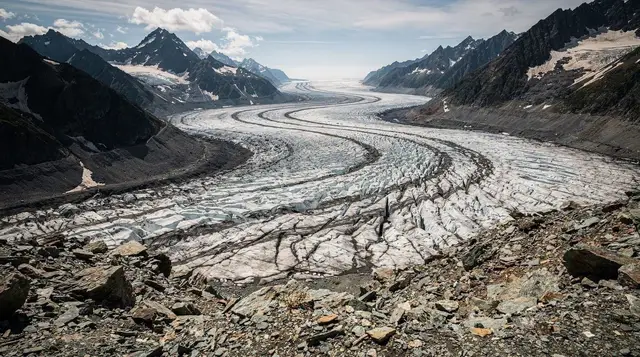
At the top, the panorama takes in not only the Matterhorn but the Monte Rosa massif, the Gorner glacier directly below, and on a clear day a long line of 4,000-metre peaks along the Italian border. There is a hotel and restaurant at the summit station, along with a small observatory, and the platform gets crowded around midday tour groups; an early or late train thins the numbers considerably.
a return ticket on the Gornergrat cog railway is the straightforward way to book this, and travelling early — the first departures leave around 7am in summer — both beats the queues and gives you the best odds of a cloud-free Matterhorn, since cumulus tends to build through the morning. For a guided option that also covers logistics from further afield, there is a small-group day trip to Gornergrat run from Zurich, useful if you are combining a Zermatt visit with a wider Swiss itinerary rather than basing yourself in the Bernese Oberland.
Matterhorn Glacier Paradise: onto the ice, at a price
The more expensive and more dramatic option is Matterhorn Glacier Paradise, reached by cable car via Furi and Trockener Steg to a station at 3,883 metres — the highest cable car station in Europe. This is a genuinely different experience from Gornergrat: rather than viewing the Matterhorn from a distance, you are standing on the glacier itself, with a viewing platform looking directly into Italy and, on the clearest days, as far as Mont Blanc. There is a Glacier Palace ice cave carved into the glacier, and in summer a small snow park where you can try tobogganing regardless of the season down in the valley.
The trade-offs are cost and crowding. A return ticket runs noticeably higher than Gornergrat, and queues for the cable car build fast on clear-sky days in July and August, when both tourists and skiers (the glacier ski area operates year-round) compete for cabin space. the cable car ticket up to Matterhorn Glacier Paradise is worth pre-booking a day or two ahead in peak season rather than queuing at the base station and hoping.
Altitude is worth taking seriously here: 3,883 metres is higher than the Jungfraujoch, and some visitors feel the thinness of the air, particularly if they have come straight up from sea level with no acclimatisation. A headache or mild breathlessness is common and not usually dangerous, but anyone with a heart or lung condition should check with a doctor before making the trip, and everyone should move at a slower pace than they would at valley altitude.
Sunnegga and the Stellisee: the cheaper, quieter alternative
If the budget or the queues for the big two put you off, Sunnegga is the honest middle option. A funicular — mostly underground — climbs from the edge of the village to Sunnegga at 2,288 metres in under four minutes, considerably faster and cheaper than either Gornergrat or the glacier cable car. From Sunnegga a further short gondola or an easy 20-minute walk reaches Lake Stellisee, a small alpine lake that on a still morning reflects the Matterhorn almost perfectly. It is one of the more photographed spots in the region for exactly that reason, so arrive early if a crowd-free reflection shot matters to you.
Sunnegga is also the better choice for families or anyone with limited mobility or time: less altitude, less walking, and a considerably shorter queue in high season, since day-trippers on a tight schedule tend to head straight for Gornergrat or the glacier and skip it.
What a day actually costs
Zermatt is not a cheap add-on to a Bernese Oberland trip, and being upfront about the numbers saves a nasty surprise on the day.
| Item | Approximate cost (CHF, per person) |
|---|---|
| Return train, Interlaken Ost–Zermatt (no pass) | 160–180 |
| Return train (Half Fare Card) | 80–90 |
| Return train (Swiss Travel Pass) | included |
| Gornergrat return | around 100 |
| Matterhorn Glacier Paradise return | around 160–180 |
| Sunnegga funicular return | around 30 |
| Lunch on the mountain | 25–40 |
Add it up and a day trip from Interlaken with one mountain excursion and lunch lands somewhere around CHF 200 to 250 per person without a rail pass, more if you attempt both Gornergrat and the glacier in the same day. That is roughly double what a day at Grindelwald First or Harder Kulm costs from Interlaken itself, largely because of the rail distance rather than the lift prices, which are broadly comparable across the Jungfrau and Zermatt regions.
Making it a longer stay
Given the travel time involved, staying one or two nights in Zermatt turns a rushed, expensive day into a more comfortable trip. It lets you split Gornergrat and the glacier across two mornings — both are best done early for light and crowds — and gives you an evening in the village itself, which has a genuine Alpine character despite the tourist volume, with old timber granaries on stone mushroom stilts still standing among the newer hotels. Accommodation in Zermatt runs at a premium similar to or above central Interlaken; budget travellers are usually better off staying in Täsch or further down the valley and coming up for the day.
For those extending into wider Valais rather than doubling back to Interlaken, Zermatt sits on one branch of the Glacier Express route, the well-known scenic line that continues on to St Moritz; see the Glacier Express guide for how that connects. Sion, the Valais cantonal capital with its hilltop castles and vineyards, is a reasonable add-on for anyone continuing down the Rhone valley rather than returning the same way, and a guided walking tour and wine tasting in Sion is a way to use a stopover there rather than just changing trains.
When not to bother
Both Gornergrat and Matterhorn Glacier Paradise close sections of track or cable car for scheduled maintenance, typically for a period in spring and sometimes in late autumn — check the Zermatt Bergbahnen website for exact dates before travelling in those windows, since this is the single most common way visitors waste a long, expensive day. High wind can also close the upper glacier cable car section, more often in winter than summer.
If cloud has settled over the valley for days and shows no sign of lifting, it is worth switching your plans to something lower and less weather-dependent, or delaying the Zermatt leg of the trip by a day if your itinerary allows it — the same logic that applies to the Schilthorn and other high viewpoints closer to Interlaken.
Practical notes for the day
Bring layers regardless of season: temperatures at 3,883 metres run well below whatever Interlaken is experiencing, often by 20 degrees or more, and wind chill on the glacier platform is real even on a sunny day. Sunglasses and sun cream matter more than they seem to at altitude, since UV exposure increases with elevation and reflection off snow. Sturdy shoes are worth it even for a viewing-platform visit, since ice and packed snow persist on the Glacier Paradise walkways well into summer.
Buy tickets online in advance where possible; both the Gornergrat Bahn and the Matterhorn Glacier Paradise cable car sell tickets through their own websites and through the counters in Zermatt, but online booking guarantees a time slot on the busiest days and saves a queue at the base station.
For anyone assembling a longer Swiss itinerary, it is worth reading the Swiss Travel Pass guide before deciding whether to buy point-to-point or cover Zermatt within a wider pass, since the arithmetic depends heavily on how many other train journeys and mountain excursions you are planning across the trip; the Jungfrau and Berner Oberland Pass guide covers the equivalent question for the Interlaken side of the region.
Left luggage lockers are available at both Interlaken Ost and Zermatt station if you are doing this as a genuine day trip and don’t want to carry bags up the mountain; see the luggage and lockers guide for locations and prices.
For a wider view of how a Zermatt day compares with staying closer to base, the Zermatt versus Interlaken comparison and the dedicated Zermatt day trip from Interlaken guide go through timings and trade-offs in more detail than fits here, and the Gornergrat and Matterhorn Glacier Paradise guide compares the two lift systems head to head for anyone still deciding which one earns the ticket price.
FAQs about visiting Zermatt from Interlaken
How do you get from Interlaken to Zermatt?
By train from Interlaken Ost, changing at Spiez and again at Visp onto the Matterhorn Gotthard Bahn. The whole journey takes around 2h15 and is covered by the Swiss Travel Pass; without a pass, expect to pay in the region of CHF 80 to 90 each way, second class, at full fare.
Can you drive into Zermatt?
No. Zermatt has been car-free for over a century. Visitors leave their car at the large multi-storey car park in Täsch, four kilometres below, and finish the journey on the shuttle train, which runs every 20 minutes and takes 12 minutes.
Which is better, Gornergrat or Matterhorn Glacier Paradise?
Gornergrat gives the classic postcard view of the Matterhorn from the side, on a cog railway dating to 1898, and is the cheaper and less crowded of the two. Matterhorn Glacier Paradise takes you onto the glacier itself at 3,883 metres, with a genuine ice palace and a view into Italy, but costs more and draws longer queues, especially in high summer.
Is Zermatt doable as a day trip from Interlaken?
Yes, if you leave on one of the first trains and accept a long day: roughly 4h30 on trains alone, leaving perhaps six to seven hours in Zermatt for one mountain excursion and lunch. Anyone wanting to see both Gornergrat and the glacier station comfortably should stay at least one night.
How much does a day in Zermatt actually cost?
Budget from around CHF 200 per person for the round trip from Interlaken plus one return cable car or cog railway ticket, before food. Add both Gornergrat and Matterhorn Glacier Paradise in the same day and the lift costs alone can pass CHF 200 per person.
What if it’s cloudy on the day I visit?
The Matterhorn is often clear early and clouds over by mid-morning, particularly in summer, so a first-train start improves your odds noticeably. Check the Zermatt webcams the evening before and on the morning of your visit; there are no refunds on lift tickets for weather, only for a full lift closure.
Do lift tickets to Gornergrat or the glacier need to be booked in advance?
Booking ahead is not compulsory but is worth doing in July and August and over the Christmas and February ski holidays, when the first cabins of the day sell out. Outside those windows you can generally buy on arrival, though a pre-booked ticket saves time at the counter.
Is Zermatt in Switzerland or does it feel Italian?
Zermatt is in the canton of Valais, German-speaking, though the Matterhorn Glacier Paradise cable car crosses onto the Italian side of the massif, where the same lift system connects down to Cervinia. You do not need a passport for the cable car crossing itself, but carry ID if you plan to descend into Italy.