Interlaken vs Zermatt: which Swiss base is right?
Should I stay in Interlaken or Zermatt for one week in the Swiss Alps?
Interlaken is cheaper, easier to reach and has a wider spread of activities from paragliding to lake cruises. Zermatt is pricier and more remote but delivers a closer, more dramatic mountain, the Matterhorn, and Europe's highest cable car station. For one week with day trips, Interlaken is the more practical base; for a single-mountain focus, Zermatt wins.
Two Alpine bases, two different weeks
Interlaken and Zermatt turn up on the same shortlist for a reason: both put you within an hour or two of a genuinely famous Alpine summit, both sit at the foot of major glacier systems, and both are built almost entirely around getting visitors up a mountain and back down again in a day. Past that, they are quite different places to actually spend a week.
Interlaken is a valley town of around 5,900 people (roughly 15,000 across the wider Bodeli area with Unterseen and Matten), wedged on flat ground between Lake Thun and Lake Brienz, with cars, buses and two railway stations running through the middle of it. Zermatt is a single car-free village at 1,620 m in the canton of Valais, reached only by rail or cable car, with the Matterhorn visible from most of its main street.
This guide compares them on the things that actually decide a one-week trip: how hard each is to reach, what a realistic daily budget looks like, what there is to do beyond the flagship summit, and which one handles poor weather better. It closes with a straight verdict for travellers who have to pick one.
Getting there and getting around
Interlaken has two stations, Interlaken Ost and Interlaken West, and sits on through routes from most of Switzerland’s main hubs. From Interlaken Ost, Bern is about 52 minutes, Zurich around 2 hours 5 minutes, Zurich Airport the same, Basel about 2 hours, and Geneva around 2 hours 45 minutes. Lucerne is roughly 1 hour 50 minutes via the scenic Brünig line. None of these require a change of direction that catches out a tired traveller with luggage.
Zermatt is a longer detour. There is no road access at all into the village; everyone arrives at Täsch by car or bus and takes a shuttle train the last few kilometres, or arrives directly by train via Visp. From Interlaken Ost, the trip to Zermatt runs via Spiez and Visp and takes about 2 hours 15 minutes with one or two changes. From Zurich it is closer to 3 hours 30 minutes, and from Geneva around 3 hours 40 minutes. Neither of these is unreasonable for a single journey, but it does mean that combining both destinations properly means at least one long travel day, not a casual half-day hop.
Within each base, the picture also differs. Interlaken itself is walkable, and the surrounding villages — Grindelwald, Lauterbrunnen, Wengen, Mürren — are reached by direct trains or cable cars, most within 20 to 40 minutes. See our guide to getting around by train, bus and boat for the detail. Zermatt is more self-contained: once you are in the village, everything from grocery shopping to the base stations of the Gornergrat and the Matterhorn Glacier Paradise is within a 10 to 15 minute walk, and electric taxis cover the rest.
Prices: both are Switzerland, but not equally Switzerland
Neither destination is cheap, and Switzerland’s overall cost level applies in both. But Zermatt sits at the higher end even by Swiss standards. A simple restaurant lunch that costs CHF 22 to 28 in Interlaken commonly runs CHF 28 to 38 in Zermatt. Three-star hotel doubles in Interlaken start around CHF 150 to 190 a night in summer; in Zermatt, comparable rooms are more often CHF 220 to 320, and drop only modestly outside peak weeks. Some of this is genuine scarcity — every building material and every delivery to Zermatt arrives by rail or small electric vehicle, which pushes up construction and supply costs across the board.
| Item | Interlaken (typical) | Zermatt (typical) |
|---|---|---|
| 3-star hotel double, summer | CHF 150–190 | CHF 220–320 |
| Simple restaurant lunch | CHF 22–28 | CHF 28–38 |
| Return ticket to the flagship summit | CHF 220 (Jungfraujoch, discounted) | CHF 130 (Gornergrat, discounted) |
| Coffee, sitting down | CHF 4.50–5.50 | CHF 5.50–6.50 |
Curiously, the flagship summit ticket runs the other way: the Gornergrat is noticeably cheaper than the Jungfraujoch, partly because the Jungfraujoch involves more tunnel infrastructure and a higher altitude gain. For a full cost breakdown, see what a realistic day in Interlaken costs and our wider Interlaken travel costs guide.
The signature mountain: Jungfraujoch vs Gornergrat and the Matterhorn Glacier Paradise
This is usually the deciding factor for people choosing between the two. From Interlaken, the Jungfraujoch sits at 3,454 m, reached by a rack railway opened in 1912 that tunnels through the Eiger itself, arriving at the highest railway station in Europe. The view is of the Aletsch Glacier, the longest ice stream in the Alps, plus the flanks of the Eiger, Mönch and Jungfrau close up. It is genuinely impressive, but it is also expensive (full price return fares exceed CHF 200 without a discount pass) and frequently crowded at midday.
From Zermatt, the equivalent trip is the Gornergrat railway, a cogwheel line from 1898 climbing to 3,089 m directly facing the Matterhorn — arguably the single most photographed mountain view in the country. Zermatt also has the Matterhorn Glacier Paradise cable car, which at 3,883 m is the highest cable car station in Europe, with a glacier cave and a ski area open even in summer.
Both towns suffer the same seasonal problem: lines close for scheduled maintenance in spring and autumn, and cable cars anywhere in the region can shut for wind regardless of season. Always check the operator’s live status the morning of your trip rather than assuming a ticket bought in advance guarantees a clear run — this single point spoils more days than any other in this region. See when mountain railways open and close for the pattern by month.
Beyond the flagship summit
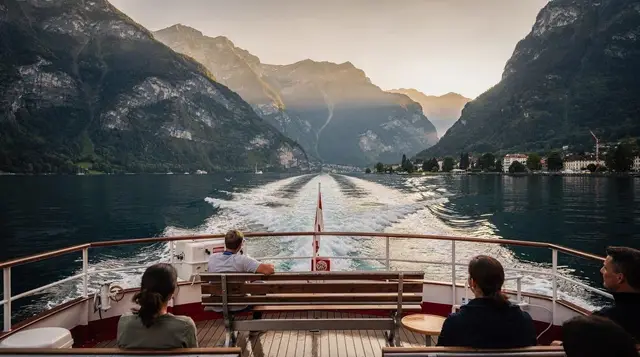
This is where the two towns diverge most. Interlaken’s appeal was never really about one mountain — it is a hub. From the same base you can reach Harder Kulm by an 8-minute funicular for a cheap sunset view, cruise Lake Thun or Lake Brienz by paddle steamer, ride the 1893 cogwheel line to Schynige Platte, or spend a day at Grindelwald First.
Interlaken is also the region’s adventure sports hub: paragliding lands on the Höhematte in the middle of town, and canyoning, rafting and skydiving all operate out of local outfitters. Our paragliding guide and best day hikes from Interlaken cover the range.
a scenic skydive over the Jungfrau region is the kind of activity Interlaken supports that Zermatt simply does not offer in the same volume — the flat valley floor and reliable thermals around Interlaken are what built its adventure-sports reputation in the first place.
Zermatt’s variety is narrower but deep in one direction: skiing and high-altitude mountaineering. It has one of the largest connected ski areas in the Alps, glacier skiing available most of the year, and serious mountaineering routes including the Matterhorn ascent itself for qualified climbers with guides. Outside winter sports, activities thin out quickly — there is excellent hiking (the balcony trail from Sunnegga is a genuine highlight) but nothing resembling Interlaken’s cruise-and-lake culture, since Zermatt has no lake at all.
If your week is built around one big-mountain moment, Zermatt delivers it cleanly. If your week needs seven different things to do, Interlaken’s spread is hard to match.
Car-free villages, in both regions
Neither town is unique in going car-free — the whole Bernese Oberland has several villages built the same way. Near Interlaken, Wengen, Mürren and Gimmelwald allow no private cars; access is by train or cable car from Lauterbrunnen or Stechelberg, and the appeal is the same quiet, engine-free atmosphere Zermatt is known for. Read how car-free villages work before planning a stay in any of them — the practical detail is where to leave a rental car and how luggage gets moved.
Zermatt is simply the largest and best-known example of the pattern, with roughly 5,700 residents and a car ban that covers the entire village, not just the historic centre.
Weather and the wet-day problem
Interlaken has a structural advantage here: because it sits low in a valley junction with two lakes, there is always a lower-altitude fallback when the peaks are clouded in — museums, lake cruises, indoor attractions in town, or a look at things to do in Interlaken when it rains. Zermatt has fewer low-altitude options; when the Matterhorn is hidden in cloud, which happens often given the mountain’s habit of generating its own weather, there is comparatively less to do at valley level besides shopping and museums.
Which to choose for one week
For a single week, most travellers get more from basing in Interlaken. It is cheaper across accommodation and food, easier and quicker to reach from every major Swiss airport and city, and gives access to a genuinely wide spread of activities — lakes, mountain railways, adventure sports, and multiple satellite villages — without needing a second base. A one-week Interlaken itinerary comfortably fills seven days without repetition.
Zermatt earns its place if the Matterhorn itself, rather than the region around it, is the point of the trip — for skiers in winter, for the Gornergrat view, or for climbers with the Matterhorn on their list. In that case, three or four nights in Zermatt with the rest of the week in Interlaken or Lucerne makes more sense than a full week in either single town; see our Grand Tour of Switzerland from Interlaken, 7 days for a route that includes a Zermatt stop without wasting the rest of the week in transit.
For travellers weighing this decision alongside other regional comparisons, our Interlaken vs Lucerne and Jungfraujoch vs Schilthorn guides use the same cost-and-access approach.
Interlaken vs Zermatt: frequently compared questions
Can I visit both Interlaken and Zermatt in one week?
Yes, but it costs a travel day. The train from Interlaken Ost to Zermatt takes about 2 hours 15 minutes via Spiez and Visp, so a return day trip eats roughly 5 hours in transit. Most one-week itineraries either base in Interlaken and add Zermatt as a single long day trip, or split the week with two or three nights in each.
Is Zermatt more expensive than Interlaken?
Generally yes. Zermatt hotel rates and restaurant prices run higher than Interlaken’s, partly because every good sits and every guest arrives by train or electric taxi rather than by car, and partly because the village trades on being car-free and Matterhorn-facing. Interlaken has more budget hostels and mid-range chalets.
Which has better views, Jungfraujoch or Gornergrat?
They show different things. The Jungfraujoch (3,454 m, reached from Interlaken via Grindelwald or Lauterbrunnen) puts you inside a saddle between the Eiger and Mönch with a view over the Aletsch Glacier. The Gornergrat (3,089 m, from Zermatt) faces the Matterhorn directly and is widely reckoned the single best mountain-railway view in Switzerland.
Is Zermatt car-free like Interlaken’s satellite villages?
Zermatt itself is entirely car-free, like Wengen, Mürren and Gimmelwald near Interlaken. Visitors leave cars in Täsch and take a short shuttle train into the village. Interlaken itself allows cars; it is the villages higher in the valleys, not Interlaken town, that go car-free.
Which is better for families with children?
Interlaken, on balance. It has flatter walks around the two lakes, boat trips that double as sightseeing and entertainment, and a wider choice of easier cable cars. Zermatt’s terrain is steeper and its excursions, especially the Matterhorn Glacier Paradise, involve more altitude and cold for young children.
Which is better for serious hikers?
Both regions have excellent hiking, but they suit different trips. Interlaken puts you within reach of a larger number of varied trails in a single week, from the Faulhorn ridge to the Lauterbrunnen valley. Zermatt has fewer trailheads but arguably the single most striking hike in Switzerland, the Matterhorn-facing balcony trail from Sunnegga to Zermatt.
How do I get from Interlaken to Zermatt by train?
From Interlaken Ost, take the train towards Spiez, change for Visp, then change again for the Matterhorn Gotthard Bahn to Zermatt. The full journey is about 2 hours 15 minutes and is covered by the Swiss Travel Pass; no advance reservation is required outside peak summer weekends. A guided option such as the private day trip to Zermatt and Blausee removes the changes entirely if you would rather not manage connections.
Does the Swiss Travel Pass cover both regions?
It covers all standard trains, buses and most boats in both regions, but the summit attractions are only partly included. Expect roughly 25 to 50 percent discounts on the Jungfraujoch, Gornergrat and Matterhorn Glacier Paradise rather than free travel, since these lines are run by separate private companies. If you are basing in Interlaken for the week and only adding Zermatt as a side trip, it is worth pricing the pass against single tickets first; see the Swiss Travel Pass guide for the comparison. Travellers staying closer to town can also cover local ground on an e-bike rented in Interlaken rather than paying for short local train hops.
Lake cruises & boat tours on GetYourGuide
Verified deep-linked GetYourGuide tours. Book through these links and we earn a small commission at no cost to you.
GetYourGuide does not provide a product photo for this activity — the image shows the meeting point, photographed by us.