The real cost of a day in Interlaken
I keep a receipt from my first proper day in Interlaken: a small coffee, a Tagesteller, a beer, a return boat ticket to Spiez and a single mountain ticket. Total, in francs, more than I’d have spent on two days in most other places I’d travelled that year. Nothing on that receipt was a rip-off. That’s the part that took me longest to accept.
Where the money actually goes
Switzerland doesn’t have tourist-trap pricing the way some destinations do, where the price triples within sight of a monument. What it has is a uniformly high cost base, because Swiss minimum and median wages are among the highest in Europe, and every coffee, plate and lift ticket carries that wage inside it. A barista in Interlaken earns roughly what a barista earns in Zurich or Geneva, which is roughly double what the same job pays across the border in Germany or France. That single fact explains most of what follows.
| Item | Typical price (CHF) | Notes |
|---|---|---|
| Small coffee, café or Beiz | 4.50-5.50 | Lakefront terrace adds ~CHF 1 |
| Draught beer, 3-5 dl | 6.00-7.50 | Same range in Bern, Lucerne, Zurich |
| Tagesteller (lunch set) | 22.00-28.00 | Weekday lunch only, usually until 2pm |
| Evening main course | 32.00-45.00 | No lunchtime discount applies |
| Lake boat, short hop | 20.00-24.00 | E.g. Interlaken West to Spiez, one way |
| Lake boat, full round trip | 35.00-45.00 | Either Lake Thun or Lake Brienz |
| Cable car or funicular, mid-range | 40.00-70.00 | Harder Kulm, Niederhorn, Schynige Platte |
| Jungfraujoch, standard return | ~220.00 | Discounted with Good Morning ticket or rail passes |
Coffee and beer: the everyday baseline
A coffee in an ordinary café away from the Hoheweg costs about what a coffee costs anywhere in urban Switzerland - CHF 4.50 to 5.50 for a small cup, more if you want milk foam architecture. Beer follows the same logic: a 3 dl Stange of lager is CHF 6 to 7, a 5 dl Grosses maybe CHF 7.50. These prices don’t spike near the station or the Hohematte the way they would in a city built around a single landmark; Interlaken is small enough that a café three streets back from the lake charges almost the same as one facing it.
Lunch versus dinner: the Tagesteller trick
The single best money move I made was learning to eat my main meal at midday. Most restaurants in and around Interlaken, Unterseen included, post a Tagesteller - a fixed daily dish, usually meat or pasta with a starch and vegetable - for CHF 22 to 28, available only on weekdays until around 2pm. Order the identical plate at 7pm and it’s back on the à la carte menu at CHF 35 to 45. Swiss labour law and staffing patterns are built around that lunch rush; missing it costs you roughly ten to fifteen francs per person, every single time. Our restaurant guide and the eating cheap piece both work from this same logic.
The lakes: the best value in town
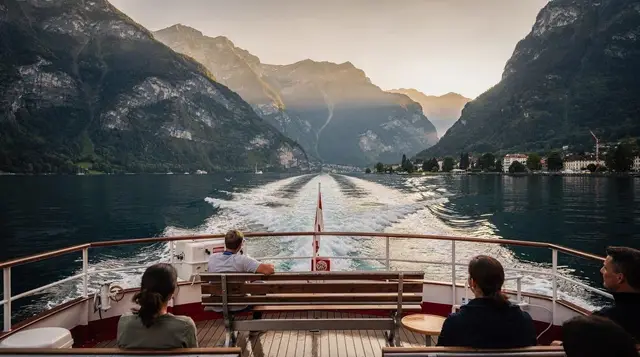
Compared to everything above the treeline, the boats are almost generous. A short hop across Lake Thun - Interlaken West to Spiez, say - runs CHF 20 to 24 second class, and a full loop of either Lake Thun or Lake Brienz costs CHF 35 to 45 for several hours of moving scenery.
If you’re doing both lakes, our two-lake cruise guide lays out the connections. It’s the one part of an Interlaken day where the price feels proportionate to the time you get for it, and it’s covered outright by the Swiss Travel Pass and the Berner Oberland Pass, which is worth checking against our pass guide before you buy anything separately.
The mountains: where the day gets expensive
This is where the receipt stops looking reasonable and starts looking alarming, until you think about what’s actually being maintained. The cheapest funiculars - Harder Kulm at eight minutes from Interlaken Ost, or the Niederhorn - sit around CHF 40 to 70 return. The Jungfraujoch, the highest railway station in Europe at 3,454 metres, costs close to CHF 220 return without a discount, a price that reflects a line blasted through the Eiger and the Mönch starting in 1896, plus year-round avalanche control and a staff that has to be paid Swiss wages to keep working at altitude in a snowstorm.
Our full Jungfraujoch guide covers ticket options in detail, and if you’d rather have someone else handle the connections, the day trip from Interlaken to the Jungfraujoch and the small-group Jungfraujoch tour both bundle the train changes into one ticket, which at least removes the risk of buying the wrong leg twice.
Grindelwald First is a different but comparable outlay, and the day trip from Zurich to Grindelwald First via Interlaken is worth pricing against doing it yourself by rail if you’re coming from further afield - the convenience premium is smaller than you’d expect once you add up individual train and cable car fares.
What I’d tell myself on that first day
Pick one lift per day, not two. Eat the Tagesteller. Use the lakes for scenery instead of a second cable car - an e-bike loop around the shoreline, like the e-bike tour past Interlaken’s lakes, ruins and viewpoints or the e-bike route to Iseltwald and Giessbach, costs a fraction of a mountain ticket and covers more ground than walking. Buy a picnic from Migros or Coop rather than eating at 2,000 metres, where a sandwich costs what a full lunch costs in town. None of this makes Interlaken cheap. It just stops the day from costing more than it needs to.
Once the maths clicks, the prices stop feeling like a trap and start feeling like what they are: a small, well-run alpine town where nobody works for less than a living wage, and where every ticket you buy is paying for a railway or a boat that has been running, on time, since long before mass tourism arrived. For the bigger picture across a whole trip rather than one day, our travel costs guide and budget guide go further than this single receipt can.
Frequently asked money questions about Interlaken
Is Interlaken more expensive than the rest of Switzerland?
Not really. Coffee, beer and a Tagesteller cost about the same in Interlaken, Bern or Lucerne. What pushes the average spend up here is the mountain railways and cable cars, which are priced per metre of altitude gained and don’t exist in flatter Swiss towns.
How much should I budget for coffee and beer in Interlaken?
Expect CHF 4.50-5.50 for a small coffee (kleiner Kaffee or Espresso) and CHF 6-7.50 for a 3-5 dl draught beer (Stange or Grosses) in an ordinary café or Beiz. Lakefront terraces on the Hoheweg add roughly a franc to both.
What is a Tagesteller and how much does it cost?
It’s the daily set lunch that most Swiss restaurants post on a chalkboard, usually meat or pasta with a side, served only at midday on weekdays. In and around Interlaken it typically runs CHF 22-28, against CHF 35-45 for the same dish ordered off the evening menu.
How much is a boat ticket on Lake Thun or Lake Brienz?
A short hop, such as Interlaken West to Spiez, costs around CHF 20-24 second class one way. A full round trip on either lake runs CHF 35-45. The Swiss Travel Pass and the Berner Oberland Pass both cover the boats, which is where they earn their price back fastest.
Why is the Jungfraujoch so expensive?
The return fare from Interlaken is close to CHF 220 without a discount, because the line was blasted through the Eiger and the Mönch between 1896 and 1912 and every metre of it still needs Swiss-wage staff, avalanche control and winter maintenance. The Good Morning ticket, bought before roughly 8.30am, cuts a chunk off that price.
Do locals actually pay these prices?
For daily coffee and lunch, yes, though many Bernese Oberland residents buy a Halbtax (half-fare) card and a regional season pass so the railways cost far less than the tourist single-ticket price. Locals also eat their main meal at midday, when the Tagesteller is cheapest.
How can I keep costs down without missing the mountains?
Book one lift ticket instead of two or three, travel up early on the Good Morning fare where offered, buy a picnic from a Migros or Coop instead of eating at altitude, and use the lake boats - covered by most travel passes - for scenery instead of a second cable car.
Lake cruises & boat tours on GetYourGuide
Verified deep-linked GetYourGuide tours. Book through these links and we earn a small commission at no cost to you.
GetYourGuide does not provide a product photo for this activity — the image shows the meeting point, photographed by us.