Interlaken vs Lucerne: which should you base yourself in?
Should I stay in Interlaken or Lucerne?
Interlaken sits closer to the Jungfrau region's mountains and is the better base for Jungfraujoch, Schilthorn, Grindelwald and Lauterbrunnen. Lucerne is a genuine old town on a lake, better for city sightseeing, museums and evening life, with its own mountains (Pilatus, Rigi) a short trip away. Trains between the two take roughly 1 hour 50 minutes via the Brunig line.
The real choice: mountains or a city on a lake
Interlaken and Lucerne turn up on almost every Switzerland itinerary, and a lot of visitors assume they are interchangeable stops on the same rail loop. They are not interchangeable as a base. Interlaken is a small, low-key town whose entire reason for existing is the mountains around it: the Jungfrau region starts at its two railway stations. Lucerne is a proper city of about 82,000 people, with a walled old town, covered wooden bridges and its own lake, and it works as a base in its own right rather than as a gateway to somewhere else.
Picking wrong does not ruin a trip, but it does waste train time. Base in Lucerne and treat the Jungfraujoch as a casual half-day add-on, and you will lose most of a day to travel alone. Base in Interlaken expecting Lucerne-style old-town wandering in the evenings, and you will find a town that mostly shuts down after dinner outside the main hotel strip on the Hoheweg.
Interlaken as a base
Interlaken sits at 568 metres between Lake Thun and Lake Brienz, with a resident population of under 6,000 (about 15,000 across the wider Bodeli area with Unterseen and Matten). It has two railway stations, Interlaken Ost and Interlaken West, and both put you within 20 to 35 minutes of Lauterbrunnen and Grindelwald, the two valleys that feed the Jungfrau region’s cable cars and cogwheel trains.
The case for Interlaken is entirely about what is on its doorstep:
- Jungfraujoch at 3,454 metres, Europe’s highest railway station, reachable via Lauterbrunnen and Kleine Scheidegg or via the Eiger Express from Grindelwald Terminal.
- Schilthorn at 2,970 metres, the revolving restaurant at Piz Gloria, reached via Stechelberg or Mürren.
- Harder Kulm, an 8-minute funicular ride directly from Interlaken Ost, no valley transfer required.
- The car-free villages of Mürren, Wengen and Gimmelwald, all under an hour away.
None of that requires an overnight elsewhere. A guest staying in Interlaken can reach the Jungfraujoch, come back for dinner, and be on a different cable car the next morning without touching a suitcase. That convenience is the entire argument for choosing Interlaken over Lucerne, and for most visitors planning a the Jungfrau Region trip, it settles the question. See our guide to how many days in Interlaken actually make sense once you count the mountain excursions you want to fit in.
What Interlaken does not offer is much of a town in itself. The Hoheweg is lined with hotels and outdoor-sports shopfronts rather than historic buildings, and once the mountain railways stop running for the day, the choice of things to do drops sharply. It is a base for going up, not a place to spend an evening exploring on foot.
Lucerne as a base
Lucerne is a different kind of town: a real Swiss city on Lake Lucerne, with the Kapellbrücke covered bridge, a compact old town of frescoed buildings, and paddle steamers leaving from a central pier rather than a jetty on the edge of town. It has more restaurants, more museums, and more to do after dark than Interlaken, and it works as a one- or two-night stop even without a single mountain excursion attached.
Lucerne’s own mountains are genuinely good, just on a different scale to the Jungfrau region:
- Mount Pilatus, reached by the world’s steepest cogwheel railway, with a return option by cable car via Kriens.
- Mount Rigi, reached by boat and cogwheel train, sometimes called the “queen of the mountains” and popular for sunrise trips.
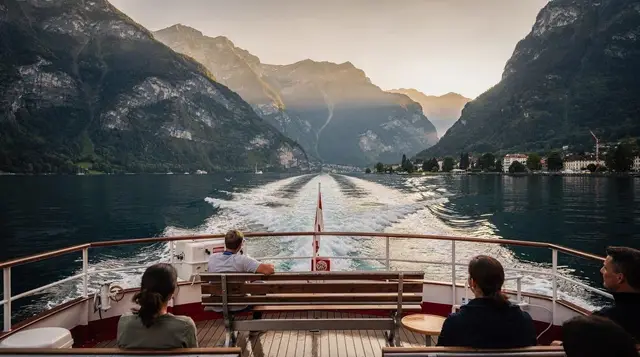
- Boat trips on Lake Lucerne itself, which are calmer and shorter than the lake cruises out of Interlaken.
Neither Pilatus nor Rigi reaches Jungfraujoch’s altitude or the glacier scenery around the Eiger, Mönch and Jungfrau, and that is the honest trade-off. Lucerne gives you a better city and a decent, lower mountain outing; Interlaken gives you a thinner town and access to the higher-altitude, more dramatic side of the Alps. Our comparison of Jungfraujoch vs Schilthorn covers the top end of what Interlaken reaches that Lucerne does not.
Distances and travel time compared
| Destination | From Interlaken Ost | From Lucerne |
|---|---|---|
| Jungfraujoch | ~2 h 20 min (via Lauterbrunnen or Grindelwald) | ~4 h round trip travel, day trip only |
| Schilthorn | ~1 h 30 min (via Lauterbrunnen/Stechelberg) | Not practical as a day trip |
| Mount Pilatus | Not practical as a day trip | ~45 min (boat) or 20 min (train) |
| Mount Rigi | Not practical as a day trip | ~1 h (boat and train) |
| Bern | ~52 min | ~1 h 30 min |
| Zurich | ~2 h 05 min | ~50 min |
| Zurich Airport (ZRH) | ~2 h 05 min | ~1 h 10 min |
| Lucerne | ~1 h 50 min (via Brunig) | – |
| Interlaken | – | ~1 h 50 min (via Brunig) |
Lucerne’s rail position is genuinely stronger for onward travel: it sits closer to Zurich and its airport, and its links to Basel and central Switzerland are more direct. Interlaken’s position is stronger for everything inside the Jungfrau region and for reaching Bern quickly. The Luzern-Interlaken Express that runs between the two is itself a scenic train worth doing for its own sake, via the Brunig Pass and along the shore of Lake Brienz.
If a private transfer suits your schedule better than the scheduled train, an Interlaken to Lucerne private day trip with driver covers the route with stops built in, rather than the fixed timetable of the regular train.
Hotel prices: what actually differs
Both towns are expensive by ordinary standards, and neither is reliably cheaper than the other. What differs is where the expensive rooms are concentrated.
| Interlaken | Lucerne | |
|---|---|---|
| Budget dorm bed | CHF 40–60 | CHF 45–65 |
| Mid-range double, 3-star | CHF 180–260 | CHF 190–280 |
| Lakefront 4-star | CHF 280–420 | CHF 300–450 |
| Peak summer surcharge | High (July–August) | Moderate, more spread across the year |
Interlaken’s prices spike harder in July and August, when the Hoheweg hotels and the mountain railways are at capacity together. Lucerne’s demand is steadier across the year because of its coach-tour and conference trade, so its price swings are smaller but its baseline rarely drops much either. For a fuller breakdown of what a day actually costs in the region, see Interlaken travel costs and Interlaken on a budget.
Which one for three days
For a three-day trip, splitting the nights rarely pays off: one change of hotel eats half a day in packing, checking out and hauling luggage to a station, and Switzerland’s train network makes day trips easy enough that a second overnight is usually unnecessary. The practical choice is to pick a base and use the other town as a single day trip.
Base in Interlaken if: the Jungfraujoch, Schilthorn or a car-free village like Wengen or Mürren is the reason for the trip. Day two goes to the high mountains, day three can be Lucerne as a return day trip, using the Brunig line or the scenic Luzern-Interlaken Express, or an e-bike tour around Interlaken’s lakes if you’d rather stay local.
Base in Lucerne if: city sightseeing, museums, and a lower-key mountain day on Pilatus or Rigi matter more than glacier scenery, or if onward travel to Zurich or its airport is part of the plan. Add Interlaken as a day trip, which a Lucerne day trip to Interlaken covers without you needing to plan your own connections, though it will not include the Jungfraujoch itself given the travel time involved.
Do both properly if: the trip is longer than three days, or if you are coming from Zurich anyway. A tour such as the two-day Lucerne, Interlaken and Jungfraujoch tour from Zurich is built around exactly this route and removes the need to book each rail leg separately. Our three-day Interlaken itinerary assumes an Interlaken base with a Lucerne day trip built in, and can be adapted the other way round if Lucerne is your base instead.
The honest verdict
Neither town is the wrong choice; they answer different questions. If the trip is built around the Jungfrau region’s high-altitude railways, Interlaken’s location advantage is large enough to outweigh its thinner evening offer, and Lucerne is best kept as a day trip. If the trip is built around Swiss city life, museums and a lake with steamers leaving from the centre, Lucerne is the stronger base, and Interlaken plus one mountain excursion works well as the day-trip side. What doesn’t work well is trying to use either town as a base for the other’s core attractions on a tight schedule: Lucerne is too far from the Jungfraujoch for a relaxed day trip, and Interlaken is too thin a town to substitute for a proper look at Lucerne’s old town.
Interlaken vs Lucerne: your questions answered
Is Interlaken or Lucerne better for first-time visitors to Switzerland?
Lucerne gives a stronger first impression of a Swiss city, with the Chapel Bridge, a walled old town and lake steamers leaving from the centre. Interlaken is smaller and less immediately picturesque, but it puts you at the foot of the Jungfrau region, which is what most first-time visitors actually came for. If mountains are the priority, Interlaken wins; if you want one classic Swiss townscape, choose Lucerne.
How long does it take to travel between Interlaken and Lucerne?
The direct route via the Brunig Pass takes about 1 hour 50 minutes from Interlaken Ost, with a change at Meiringen on some services. The Luzern-Interlaken Express is the named scenic train that covers this route with panoramic windows. Half Fare Card and Swiss Travel Pass holders travel at a discount or free respectively.
Is Lucerne cheaper than Interlaken for accommodation?
Not reliably. Both are tourist-priced Swiss cities, and central Lucerne hotels near the lake and old town often cost as much as or more than equivalent Interlaken hotels, because Lucerne draws day-trip coach groups as well as overnight guests. Budget travellers do better in either town by staying slightly outside the centre or in a hostel dorm.
Can I do the Jungfraujoch as a day trip from Lucerne?
Yes, but it is a long day. Lucerne to Interlaken Ost is around 1 hour 50 minutes, then the Jungfraujoch round trip from Interlaken takes most of a full day on its own, so combining both from a Lucerne base means an early start and a late return, with little slack for weather delays or a closed line.
Which has better restaurants, Interlaken or Lucerne?
Lucerne has more range, including proper Swiss-German restaurants in the old town away from the main tourist strip, plus a wider choice of cuisines. Interlaken’s dining is smaller and more geared to hotel guests and outdoor-sports crowds, though it has some solid fondue and raclette options.
Should I split three days between both towns?
For three days, most visitors do better picking one base and taking the other as a single day trip, rather than packing and unpacking for one extra night. Base in Interlaken and see Lucerne on a day trip if mountains are the priority; base in Lucerne and see Interlaken and one Jungfrau region excursion on a day trip if the city and the lake are the priority.
Is Lucerne worth visiting if I want mountains and I’m short on time?
Lucerne’s own mountains, Pilatus and Rigi, are real alpine excursions with cable cars, cogwheel trains and views over the lake, and both are reachable in half a day from the city. They don’t reach the scale or the glacier scenery of the Jungfraujoch or Schilthorn, but if time only allows one base, Lucerne still delivers a genuine mountain day out.
Lake cruises & boat tours on GetYourGuide
Verified deep-linked GetYourGuide tours. Book through these links and we earn a small commission at no cost to you.
GetYourGuide does not provide a product photo for this activity — the image shows the meeting point, photographed by us.