Three days in Interlaken: one summit, one valley, one hike
How this three-day plan works
Interlaken sits at 568 m between two lakes, and almost everything worth doing from here is higher up — which means almost everything worth doing is at the mercy of weather that Interlaken’s own forecast doesn’t reflect. A blue-sky morning on the Hoheweg tells you nothing about cloud sitting on the Jungfraujoch. So this itinerary is built around one rule: decide the order of the three days each morning, not in advance.
Day 1 as written below goes to the highest point, day 2 drops to the valley floor, and day 3 goes to a mid-altitude hiking area. In practice, swap days 1 and 3 freely if the forecast for the high summit only clears up on day 3 — the valley day works in almost any weather, so it’s the one to keep flexible and slot in wherever the cloud is worst. Check the Jungfrau Railways status page and the live summit webcams before 7am each day; they’re more reliable than any app forecast for a specific mountain.
Base yourself in Interlaken itself for all three nights — trains back from Lauterbrunnen (20 min) and Grindelwald (35 min) run late enough that changing hotels isn’t worth it. If this is your only visit to the region, it’s also worth reading how the total trip length compares: some visitors stretch this same route over 4 or 5 days to add Schilthorn or a lake cruise without the rush.
Day 1: the summit — Jungfraujoch
This is the expensive day, so it should be the clear-sky day. Trains for the Jungfraujoch leave from Interlaken Ost, changing at Lauterbrunnen or Grindelwald and again at Kleine Scheidegg, for a return journey of around 4–5 hours if you don’t linger. Book the first reasonable departure, around 7:30–8am, both because crowds build through the late morning and because mountain cloud tends to thicken as the day warms.
At 3,454 m, the Jungfraujoch is the highest railway station in Europe, reached through a tunnel blasted into the Eiger and completed in 1912. The Sphinx observation terrace, the Ice Palace carved into the glacier, and the view over the Aletsch Glacier are the draws; none of it is worth much if you’re inside cloud, which is why the go/no-go decision belongs on the morning, not the calendar.
Two routes get you there. Via Lauterbrunnen and the Wengernalp cog railway through Wengen is the classic, slower approach with views the whole way. Via Grindelwald and the Eiger Express gondola — running since December 2020 — cuts roughly 30–45 minutes off the journey by skipping straight to the Eigergletscher station. Either way you pass through Kleine Scheidegg, a saddle between the Eiger and the Jungfrau worth 20 minutes on its own if the light is good.
If you’d rather not build the connections yourself, a guided day trip from Interlaken to the Jungfraujoch handles the timing and the ticket in one booking, which takes some of the pressure off an early, weather-dependent start. Expect to pay roughly CHF 220–260 for the standard adult return fare from Interlaken with no discount card; the Swiss Travel Pass and Half Fare Card both cut this meaningfully, detailed in the Swiss Travel Pass guide. Bring a proper layer — summer or not, it’s routinely below freezing at the top — and sunglasses, since glare off the snow is intense.
Back in Interlaken by early evening, keep dinner simple; day 2 doesn’t need an early start.
Day 2: the valley — Lauterbrunnen
The Lauterbrunnen valley is the low-effort, low-risk day, and it works in weather that would ruin a summit trip. The train from Interlaken Ost takes about 20 minutes and drops you in the village itself, beneath the 297 m Staubbachfall, which is visible without walking anywhere.
Lauterbrunnen is known locally for its 72 waterfalls along the valley walls, and a flat walk from the village toward Stechelberg takes in several of them at an easy pace — covered step by step in the valley waterfall walk guide. The paid highlight is the Trümmelbach Falls, ten glacial cascades running inside the mountain itself, reached by a short bus or a 45-minute walk from the village; entry runs around CHF 14 for adults.
From Lauterbrunnen, the car-free villages of Wengen and Mürren are each a short cable car or train ride up the valley walls, with cars staying behind in Lauterbrunnen or Stechelberg. If cycling appeals more than walking, an e-bike route through the valley toward Isenfluh covers more ground with less climbing effort and takes in villages the train doesn’t reach.
Anyone doing the Jungfraujoch via this valley on day 1 will already have passed through part of it; day 2 is for slowing down and actually stopping. A same-day round trip like this also works as a standalone option if you’re short on time — the combined roundtrip train and Jungfraujoch ticket from Lauterbrunnen bundles both into one departure point.
Return to Interlaken by late afternoon; the walk and the falls don’t take a full day, which leaves room for Grindelwald as a half-day add-on if the weather is holding, or for resting before day 3.
Day 3: the hike — Grindelwald First
The last day goes to Grindelwald First, reached by a gondola from Grindelwald station (itself about 35 minutes from Interlaken Ost) up to 2,168 m. First sits well below the Jungfraujoch’s altitude, which makes it a reasonable fallback if the highest summit only clears on day 1 or 2 and this becomes the flex day instead.
First’s own attractions — the First Cliff Walk, First Flyer zipline, and First Glider — are worth an hour if the weather is middling, and the Grindelwald gondola and Mount First adventure package covers the return trip plus one of the activities in a single ticket. On a genuinely clear day, though, the better use of the morning is the hike to Bachalpsee, an easy-to-moderate 1.5–2 hour round trip on a well-marked path, with the lake reflecting the Wetterhorn and Schreckhorn when the wind drops — laid out fully in the Bachalpsee hike guide.
Lunch at one of the mountain restaurants near the top station or partway along the Bachalpsee path is the practical option rather than carrying food up — the mountain hut and berghaus dining guide covers what’s actually available and what it costs, which is usually more than a village restaurant but not unreasonable for the setting.
Head back down to Grindelwald and Interlaken by mid-to-late afternoon; the gondola runs until early evening in summer but stops earlier outside the main season, so check the timetable rather than assuming.
What this three days actually costs
Figures are per adult, without a discount pass, based on standard summer fares.
| Item | Approx. cost (CHF) |
|---|---|
| Interlaken–Jungfraujoch return (train/gondola) | 220–260 |
| Trümmelbach Falls entry | 14 |
| Grindelwald–First gondola return | 75–85 |
| First Cliff Walk / First Flyer (optional) | 0 / 34 |
| Bachalpsee hike | free (gondola cost only) |
| 3 nights mid-range hotel, Interlaken | 450–650 total |
| Meals, CHF 40–55/day | 120–165 total |
A regional pass changes this arithmetic considerably. The Jungfrau Travel Pass and Berner Oberland Pass can cover several of these rides for one flat fee if you’re moving on most days of the pass’s validity; it’s worth comparing against buying tickets separately before you commit, since a pass bought for a light-movement itinerary can end up costing more than point tickets.
FAQ: planning your 3-day Interlaken itinerary
Is 3 days enough for Interlaken and the Jungfrau region?
Three days covers the headline trio well: one summit, the Lauterbrunnen valley, and one hiking or cable-car area like Grindelwald First. It’s tight if you also want Schilthorn, Harder Kulm and a lake cruise — those push the trip toward 4 or 5 days.
Which day should I do the Jungfraujoch on?
Whichever day has the clearest forecast, decided the morning of, not booked weeks ahead. Check the live webcams and the Jungfrau Railways status page before 7am; above 3,000 m, cloud means you pay full price to stand inside a whiteout.
Do I need a car for this itinerary?
No. Every stop in this plan — Interlaken, Lauterbrunnen, Wengen, Grindelwald, Kleine Scheidegg, the Jungfraujoch — is reachable by train, cable car or local bus, and several of the villages don’t allow cars at all.
How much does 3 days like this cost per person?
Budget roughly CHF 350–450 for transport and lift tickets alone if bought separately, plus CHF 100–150 a day for modest meals and a mid-range hotel. A regional pass can bring the transport total down noticeably if you’re moving most days.
Is the Jungfraujoch worth the price?
It’s expensive and often overcast, but the railway itself — cut through the Eiger in 1912 — and the Sphinx observation deck at 3,454 m are genuinely unusual. Go only on a clear-forecast day; a cloudy Jungfraujoch is a costly disappointment.
What if it rains for all 3 days?
Swap the summit day for indoor options in Interlaken or Bern and keep the valley walk for a lighter-rain window — Lauterbrunnen’s waterfalls look better, not worse, after rain. See the bad-weather guide for a full backup plan.
Can I fit both Jungfraujoch and Schilthorn into 3 days?
Only by giving up the hiking day, and it makes for two long, expensive summit days back to back. Most visitors are better served picking one 3,000 m-plus summit and using the third day at a lower, cheaper viewpoint like Grindelwald First or Harder Kulm.
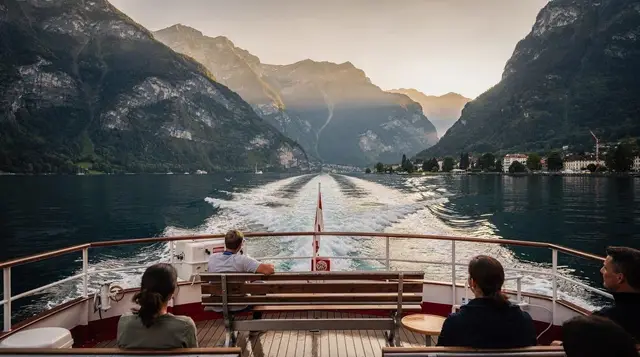
Lake cruises & boat tours on GetYourGuide
Verified deep-linked GetYourGuide tours. Book through these links and we earn a small commission at no cost to you.
GetYourGuide does not provide a product photo for this activity — the image shows the meeting point, photographed by us.