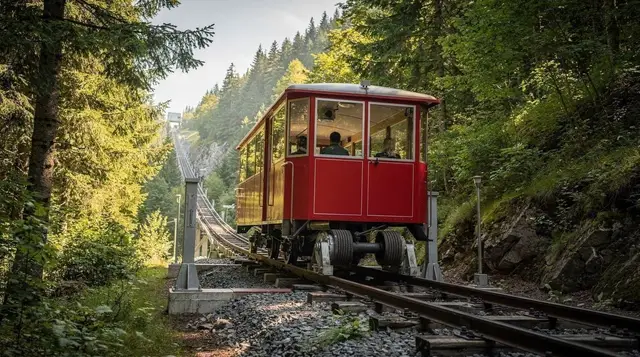
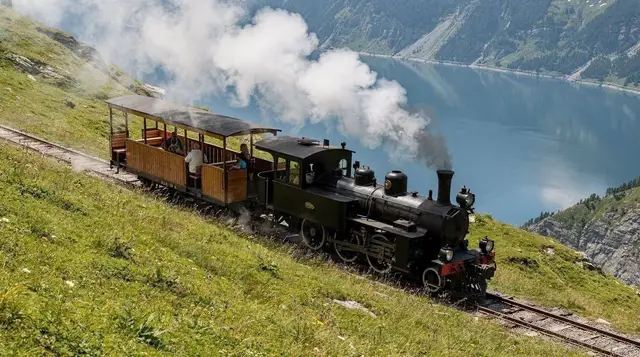
The Wengernalp Railway: Lauterbrunnen to Grindelwald by rack train
How long is the Wengernalp Railway and where does it go?
The Wengernalp Railway (WAB) is a metre-gauge rack railway running about 19 kilometres from Lauterbrunnen through Wengen to Kleine Scheidegg, then down the other side to Grindelwald. Opened in 1893, it's usually described as the longest continuous rack railway in the world. Passengers change trains at Kleine Scheidegg, since the Lauterbrunnen and Grindelwald sides operate as separate services that happen to share a station.
Most visitors ride part of the Wengernalp Railway without ever hearing its name, because it’s usually sold as a step on the way to somewhere else: the Jungfraujoch, a ski slope above Wengen, a walking trail from Kleine Scheidegg. But the line itself, opened in 1893 and still running on the same metre-gauge rack track, is worth understanding on its own terms. At roughly 19 kilometres from end to end, it’s generally cited as the longest continuous rack railway in the world, and it does something no road manages: it links the Lauterbrunnen valley to Grindelwald over the shoulder of the mountains, with nothing but a rack-and-pinion train and about 800 metres of climbing on each side.
Why there’s a train here and no road
The geography explains the railway. Lauterbrunnen sits at the bottom of a steep-walled glacial trough; Grindelwald sits in a separate valley on the other side of the ridge that carries Kleine Scheidegg. No road connects the two valleys over that ridge, and building one would have meant carving through terrain that’s avalanche-prone for half the year.
The Wengernalp Railway solved the problem in the 1890s the way Swiss engineers solved most of these problems: a rack railway, steep enough to follow the terrain directly rather than switchbacking around it, opened in stages between 1893 and 1910 as the Lauterbrunnen-Wengen-Scheidegg line and the connecting Scheidegg-Grindelwald line, later run as a single company. For background on how this fits with the region’s other cogwheel lines, see the guide to Bernese Oberland railways explained.
The rack system (a toothed centre rail that a cogwheel under the train engages) is what makes gradients of around 25 percent manageable for a train rather than requiring a genuine funicular. It’s a gentler technology than the fully cable-hauled funiculars nearby, and it means the train can stop anywhere along the line, not just at fixed stations, which matters for hikers who want to be dropped at a specific point on the trail network.
Lauterbrunnen to Wengen: the first climb
The Lauterbrunnen side of the line starts right next to the main station, and the first few minutes are deceptively gentle before the rack section engages and the train starts climbing the valley’s western wall in earnest. This is where you get the payoff for choosing this route over the road (there isn’t one anyway, since Wengen is car-free): the train climbs above the valley floor with the Staubbachfall and the sheer rock walls of the Lauterbrunnen valley opening up behind you.
Anyone who has already done the valley floor walk described in the Lauterbrunnen valley waterfall walk guide will recognise the same cliffs from a completely different angle, several hundred metres higher.
Wengen itself sits at a natural shelf on the mountainside, and the station is close to the village centre, unlike some Swiss mountain stations that require a further walk. Wengen is one of the region’s three car-free settlements alongside Mürren and Gimmelwald (Mürren is reached from the other side of the valley, via Stechelberg and the cable car to Mürren, not by this railway), and the absence of road traffic is part of what makes the WAB the village’s actual main street in effect: goods, luggage and residents all move by rail or by the small battery-electric vehicles that serve as Wengen’s local transport.
Wengen to Kleine Scheidegg: the valley-side climb
Above Wengen the train keeps climbing, now through open alpine pasture rather than forest, with the Jungfrau, Mönch and Eiger visible ahead for most of the ascent on a clear day. This stretch is the reason to sit on the right-hand side heading up: the valley views open progressively as the train gains height, culminating in the approach to Kleine Scheidegg with the three peaks lined up almost directly ahead. It’s also a working section of track for hikers, since several trails cross or run parallel to the line, including the connector described in Männlichen to Kleine Scheidegg, and it’s entirely possible to walk one direction and ride the other.
The gradient on this section is among the steepest on the whole line, and older rolling stock audibly works harder here than on the gentler stretches near Lauterbrunnen. Newer panoramic carriages, introduced in stages over the past two decades, have larger windows and are worth waiting for if one is available, though older stock still runs on many services.
Kleine Scheidegg: the change of trains
This is the point that catches people out. Kleine Scheidegg is a pass, not a town, sitting at just under 2,000 metres, and the Wengernalp Railway does not run through it as a single service. Trains arriving from Lauterbrunnen and Wengen terminate here; a separate WAB train, usually waiting on an adjacent platform, continues on to Grindelwald. The connection is timetabled to be short, but it is a genuine change, not a through-carriage, so don’t assume you can stay seated.
Kleine Scheidegg is also the junction for the Jungfrau Railway proper, the separate line that tunnels through the Eiger and Mönch to reach the Jungfraujoch at 3,454 metres. Anyone doing the Jungfraujoch as a day trip from the Lauterbrunnen side will already be riding this section of the WAB without necessarily registering it as a distinct railway; anyone arriving via the Eiger Express and Grindelwald Terminal reaches the Jungfrau Railway a stop higher, at Eigergletscher, bypassing Kleine Scheidegg on the way up (though most itineraries still pass through it on the way down or across).
Kleine Scheidegg to Grindelwald: under the north face
The descent to Grindelwald is the section that gives this guide its subtitle. For a stretch of a few kilometres below Kleine Scheidegg, the line runs almost directly beneath the Eiger’s north face, the 1,800-metre wall that has drawn and killed climbers since the 1930s. There’s no tunnel here (the Eiger’s tunnel belongs to the Jungfrau Railway, further up the mountain); the WAB stays on the surface, close enough to the base of the wall that on a clear day you can pick out the lower pitches of the climbing routes and sometimes see climbers or rescue activity with binoculars. It’s a genuinely different register of scenery from the pastoral Wengen side: steeper, greyer, more obviously mountain rather than meadow.
From here the gradient eases as the train drops into the Grindelwald bowl, arriving either at Grindelwald Grund (lower, closer to the valley floor and the Eiger Express base station) or Grindelwald’s main station, depending on the specific service. Grindelwald itself, unlike Wengen, is a full-sized car-accessible town, so this is also where the car-free feel of the journey ends.
Fares, passes and timetables
| Journey | Approx. journey time | Full fare (indicative) | With Half Fare Card | With Swiss Travel Pass |
|---|---|---|---|---|
| Lauterbrunnen to Wengen | ~15 min | CHF 10-12 | ~CHF 5-6 | Included |
| Wengen to Kleine Scheidegg | ~25 min | CHF 20-25 | ~CHF 10-12 | Included |
| Kleine Scheidegg to Grindelwald | ~35-40 min | CHF 20-25 | ~CHF 10-12 | Included |
| Lauterbrunnen to Grindelwald (full traverse) | ~1h 30 with change | CHF 40-50 | ~CHF 20-25 | Included |
Fares above are indicative and change with the annual timetable revision each December; treat them as a planning guide rather than a quote. Unlike the Jungfraujoch excursion (where the Swiss Travel Pass gives a discount rather than free travel), the WAB counts as a regular railway line for most of its length, so Swiss Travel Pass holders generally ride it at no extra cost. Details and current terms are in the Swiss Travel Pass guide. Trains run roughly every 30 minutes through the day in season, with a reduced but still regular service in winter and shoulder season.
Weather, closures and timing your ride
Like every mountain line in the Jungfrau region, the WAB can be disrupted by weather, though less often than the aerial cable cars since a rack railway isn’t grounded by high wind the way a gondola is. The bigger risk is low cloud: the entire point of the Kleine Scheidegg section is the view, and on an overcast day you’ll ride through white-out with an occasional glimpse of rock.
Check the live webcams for Kleine Scheidegg and Wengen before committing to the trip if the views matter to you, and don’t schedule this as your one clear-weather day if you’re also trying to fit in the Jungfraujoch or a viewpoint like Männlichen — save the best forecast for whichever one you can’t easily repeat. The line also closes briefly for scheduled maintenance in spring and autumn, generally for shorter windows than the aerial cableways since there’s less exposed cable infrastructure to service; check exact dates for your travel period rather than assuming the line is always running.
In winter, expect the trains to be busy with skiers and their equipment, particularly on the Wengen side where the WAB doubles as ski-lift access; see the Wengen and Lauberhorn ski guide for how the railway fits into a ski day. Early morning and late afternoon services on a powder day can be genuinely crowded, with skis stacked in the vestibules.
Making a day of it rather than a transit
Because the WAB stops on request at points along the open sections and connects to a dense network of trails, it’s easy to build a day around the railway rather than just using it to get somewhere. A common pattern is to ride up from Lauterbrunnen to Kleine Scheidegg, walk down to Wengen (a well-marked, mostly gentle descent), and ride the last stretch back into the valley, or to do the equivalent on the Grindelwald side beneath the north face.
If you’d rather stay closer to the village, a guided option like the sunset hike above Wengen that finishes with cheese fondue uses the same terrain the railway serves without requiring you to plan the connections yourself, and a private guided walk around Wengen with alpine views is a reasonable option for a first visit if you’d rather have someone else handle the timing of trains and trail junctions.
Families travelling with younger children who aren’t up for the full traverse and change at Kleine Scheidegg might do better sticking to the Lauterbrunnen-Wengen shuttle and pairing it with something at village level, such as the family-friendly farm tour in the countryside above Wengen, which avoids the altitude and the platform change entirely.
Visitors building a longer itinerary around the Swiss Travel Pass, and wanting the WAB folded into a wider private-guide plan rather than worked out train by train, can look at the customisable private-guide itinerary built around a Swiss travel pass, which can be scoped to include this line alongside other Jungfrau region connections.
How the WAB fits with the rest of the network
The Wengernalp Railway is easy to confuse with its neighbours because they share stations and, in places, track alignment philosophy without being the same company or the same kind of line. The cable cars and funiculars explained guide is the place to check the distinction if you’re not sure whether a given leg of your itinerary is a rack train, a cable car, or a funicular — it matters for luggage rules, for whether bikes are allowed, and for how weather-sensitive the service is.
In short: the WAB is a conventional (if very steep) railway on rails the whole way, which makes it one of the more weather-resilient links in the region, and one of the few in the Jungfrau area where the scenery is the point of the middle of the journey, not just the destination at either end.
For a wider view of how this line slots into a multi-day plan that also covers Grindelwald, Mürren and the lake towns, the day trips from Interlaken guide sets out several itineraries that use the WAB as one leg among others rather than the whole day.
Questions about riding the Wengernalp Railway
Do I have to change trains at Kleine Scheidegg?
Yes. The Lauterbrunnen/Wengen side and the Grindelwald side operate as separate services that share the Kleine Scheidegg station. The connection is timed, usually a short wait, but you do get off one train and board another.
Which side should I sit on for the best views?
Right-hand side going up from Lauterbrunnen, for the Lauterbrunnen valley and Jungfrau massif views. Right-hand side again going down towards Grindelwald, for the closest views of the Eiger’s north face.
Is the Wengernalp Railway the same as the Jungfrau Railway?
No. The WAB runs at the surface between Lauterbrunnen, Wengen, Kleine Scheidegg and Grindelwald. The Jungfrau Railway is the separate, mostly tunnelled line from Kleine Scheidegg (or Eigergletscher) up to the Jungfraujoch.
How much does the Wengernalp Railway cost?
Roughly CHF 40-50 one-way for the full Lauterbrunnen-Grindelwald traverse at full fare, about half that with a Half Fare Card, and included for Swiss Travel Pass holders. Fares update each December.
Can I ride it as a loop rather than a there-and-back trip?
Yes. Ride the full traverse from Lauterbrunnen to Grindelwald (or the reverse) and return to Interlaken by a different line, rather than backtracking over the same section twice.
Does the train run in winter?
Yes, year-round, doubling as ski-lift access on the Wengen side in season. It can still be disrupted by heavy snowfall, though less often than aerial cable cars are by wind.
How long does the full journey take?
About 40 minutes Lauterbrunnen to Kleine Scheidegg, then a further 35-40 minutes to Grindelwald, plus the change. Budget around 1 hour 30 minutes end to end without stops.
Scenic train tours on GetYourGuide
Verified deep-linked GetYourGuide tours. Book through these links and we earn a small commission at no cost to you.
GetYourGuide does not provide a product photo for this activity — the image shows the meeting point, photographed by us.