Bernese Oberland railways explained: BLS, Zentralbahn, BOB, WAB and JB
Who actually runs the trains around Interlaken?
BLS runs the main line to Bern and the lake boats, Zentralbahn runs the Brünig line to Lucerne, and BOB, WAB and JB (now under one holding company, Jungfraubahnen) run the narrow-gauge lines from Interlaken Ost up to Lauterbrunnen, Grindelwald, Kleine Scheidegg and the Jungfraujoch. A handful of summit lines, including the Schilthornbahn and the Brienz Rothorn Bahn, are independent companies again, which is why passes cover them differently.
A network with five names and one purpose
Stand on the platform at Interlaken Ost for ten minutes and you will see trains in at least three liveries, none of them saying “SBB”. That is normal. The Swiss Federal Railways run the trunk lines between the big cities, but almost nothing that leaves Interlaken for the mountains belongs to them. Instead you are looking at BLS, Zentralbahn, and a cluster of narrow-gauge companies that have spent the last few years merging into what is now branded Jungfraubahnen. Knowing which is which matters for two practical reasons: it explains why a Swiss Travel Pass covers one leg of your trip for free and only discounts the next, and it explains why the correct platform at Interlaken Ost is not always obvious from the departure board.
This guide sticks to what changes your journey: who operates each line, where gauge and ownership actually create a break in your ticket, and how to make the connections at Interlaken Ost without missing one. For a step-by-step account of riding to the top, see the Jungfrau railway guide; this page is about the plumbing underneath it.
BLS: the backbone from Bern
BLS is the company that gets you into the region in the first place. Despite the “national railway” look of the rolling stock, the direct trains from Bern to Interlaken Ost, and on to Spiez, Zweisimmen and eventually Montreux, are operated by BLS, not SBB. BLS also runs the boats on both Lake Thun and Lake Brienz through its BLS Schifffahrt division, so the same company that gets you off the train at Interlaken West can put you on a boat an hour later.
The Bern–Interlaken Ost run takes about 52 minutes and departs roughly twice an hour, calling at Interlaken West first. Further along the same corridor, BLS trains continue toward Spiez and Zweisimmen, from where the meter-gauge MOB line takes over for the GoldenPass line toward Montreux; that gauge change at Zweisimmen is a genuine operator handover, not just a cosmetic one, and it is one of the few places on this list where you may need to walk across a platform even with a through ticket.
Trains for Thun and Spiez also run on BLS track and are worth knowing about if you are basing a day around Lake Thun boat trips rather than the mountains.
Zentralbahn: the other way in, via Lucerne
Zentralbahn, usually shortened to zb, operates the Brünig-line service marketed as the Luzern-Interlaken Express, connecting Lucerne to Interlaken Ost in around 1 hour 50 minutes via Meiringen and Brienz. It is a genuinely unusual railway: part of the route uses ordinary adhesion track and part uses a central rack to cope with the Brünig Pass gradient, which is why the same train changes character partway through the journey without you having to change seats. Full detail on riding it, including where to sit for the views over Lake Brienz, is in the Luzern-Interlaken Express guide.
Zentralbahn is a separate company from BLS and from the Jungfraubahn group, which matters for passes: the Swiss Travel Pass covers it fully, but some of the cheaper regional Bernese Oberland passes stop at the cantonal border near Meiringen and do not extend all the way to Lucerne. If your plan is a one-day return to Lucerne, check that detail before assuming a regional pass has you covered both ways.
BOB, WAB and JB: one holding company, three different railways
This is the cluster that actually takes you up the mountains, and it is also where the corporate history gets confusing enough to be worth untangling properly.
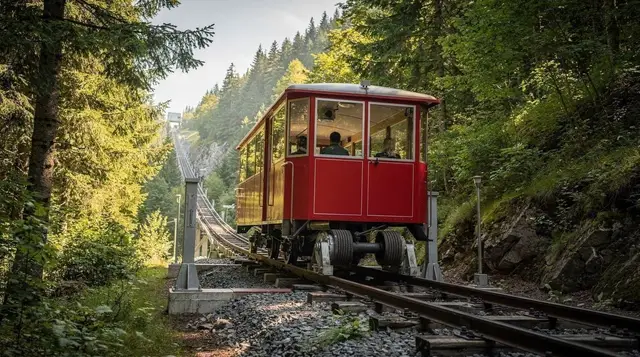
- BOB (Berner Oberland-Bahnen) is the narrow-gauge line out of Interlaken Ost. It splits at Zweilütschinen into two branches: one to Lauterbrunnen, the other to Grindelwald. BOB also owns and operates the Schynige Platte rack railway, the 1893 line up to Schynige Platte from Wilderswil, which keeps its own vintage open-sided carriages and runs as a summer-only seasonal service.
- WAB (Wengernalpbahn) is the rack railway that climbs from Lauterbrunnen through Wengen to Kleine Scheidegg, and historically also linked Grindelwald to Kleine Scheidegg from the other side. It is the line that makes Wengen’s car-free status workable at all, since without it the village would only be reachable by cable car.
- JB (Jungfraubahn) is the final, most famous stretch: Kleine Scheidegg to the Jungfraujoch at 3,454 metres, tunnelled through the Eiger and the Mönch since 1912, still Europe’s highest railway station.
In 2019, BOB and WAB were legally merged into a single operating company, and both now sit inside the same corporate group, Jungfraubahn Holding, as the Jungfraubahn itself, the Harder Kulm funicular, the Grindelwald-First gondola and the newer Eiger Express. Practically, that means one owner sets the fare structure end to end from Interlaken Ost to the summit, even though the trains themselves still run on different gauges with different rolling stock, and even though your ticket may print three different line codes on a single journey.
The Eiger Express, running since December 2020, changed the geography here: it is a modern gondola linking the Grindelwald Terminal directly to Eigergletscher in about 15 minutes, cutting out the older, slower rail route through Kleine Scheidegg entirely for anyone coming from Grindelwald. If you are starting from Lauterbrunnen or Wengen instead, you still go via Kleine Scheidegg on WAB and JB track. Both routes are covered in the Eiger Express and Grindelwald Terminal guide and the Wengernalp railway guide.
The independents: Schilthornbahn, Brienz Rothorn, Niederhorn
Not every summit around Interlaken belongs to the Jungfraubahn group, and the ones that do not are usually the ones with more idiosyncratic pricing.
Schilthornbahn runs the cable car from Stechelberg through Gimmelwald and Mürren up to Birg and the Schilthorn summit at 2,970 metres. It is a separate company, historically Jungfraubahn’s rival for the region’s cable-car tourists, and it sets its own pass discounts independently of BOB and WAB fares.
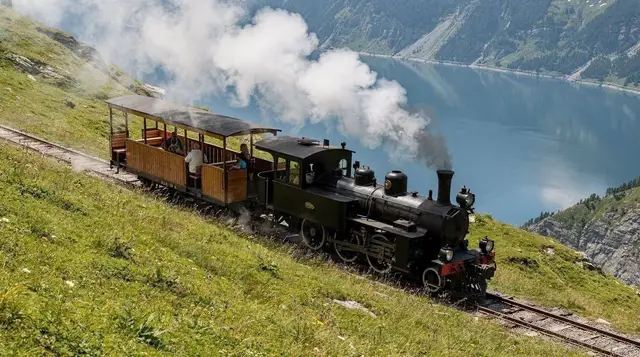
Brienz Rothorn Bahn is the most distinct of the lot: a privately owned rack railway that still runs steam locomotives on the line built in 1892, climbing from Brienz to the Brienzer Rothorn at 2,350 metres. It has no corporate relationship to the Jungfraubahn group at all, which is part of why it survived as a steam operation rather than being electrified and folded into a larger network.
The line and its timetable quirks are covered in the Brienz Rothorn steam railway guide, and one straightforward way to combine it with a lake crossing is a boat trip on Lake Brienz paired with the steam train up the Rothorn.
Niederhornbahn, the cable car up to Niederhorn from Beatenbucht on Lake Thun, is likewise independent, and Harder Kulm’s funicular, right by Interlaken Ost, is part of the Jungfraubahn group despite sitting on the opposite side of the valley from the rest of its network. A short attraction ticket covers that one directly if you only want the Harder Kulm viewpoint rather than a full pass: the Interlaken to Harder funicular ticket is sold on its own for exactly this trip.
Why a single ticket sometimes works and a pass sometimes doesn’t
The confusion almost never comes from buying an ordinary point-to-point ticket. Switzerland runs a shared national fare system across nearly all public transport, so a ticket bought from, say, Bern to Wengen is issued and priced as one product even though the journey crosses BLS, BOB and WAB track and involves a change of train at Interlaken Ost and again at Lauterbrunnen. You buy once, and the system apportions the revenue between operators behind the scenes; you never see the seams.
Passes are where the seams show. The Swiss Travel Pass gives free travel on the core network, which includes BLS, Zentralbahn, BOB and WAB as far as Kleine Scheidegg, but it only discounts, typically by 25 percent, the final Jungfraubahn climb to the Jungfraujoch, and it discounts rather than covers the Schilthornbahn’s summit section above Mürren. Independent operators like the Brienz Rothorn Bahn and Niederhornbahn set their own, separate discount rates for pass holders, which change more often than the core network’s terms because they are decided by smaller companies with their own commercial pressures.
Regional alternatives, the Berner Oberland Pass and the narrower Jungfrau Travel Pass, are usually the better value if your whole trip stays inside this valley system and you are not continuing on to Lucerne, Zurich or Geneva. They tend to follow the same pattern as the Swiss Travel Pass: free or heavily reduced travel on the regional trains and boats, a smaller discount on the highest summit sections.
Full comparisons of what each pass actually includes, updated for the current season, are in the Swiss Travel Pass guide and the Jungfrau and Berner Oberland Pass guide; check the current terms before you buy, since summit discounts are the figures most likely to shift year to year.
| Pass | Core BLS/BOB/WAB network | Jungfraujoch (JB) | Schilthorn (Schilthornbahn) | Brienz Rothorn / Niederhorn |
|---|---|---|---|---|
| Swiss Travel Pass | Free | Discount (around 25%) | Discount | Discount, varies |
| Berner Oberland Pass | Free or reduced | Discount | Discount | Often included on free days |
| Jungfrau Travel Pass | Free within region | Discount | Discount | Not usually included |
| Half Fare Card | 50% off tickets | 50% off | 50% off | 50% off |
| Single point-to-point ticket | Priced as one ticket | Priced as one ticket | Priced as one ticket | Priced as one ticket |
Where reservations, not company boundaries, cause the real trouble
A second, less obvious source of confusion is seat reservation, which is unrelated to which company owns the track. The GoldenPass panoramic services out of Zweisimmen and the Glacier Express connections reachable via Zermatt both carry compulsory reservation fees on top of an otherwise valid rail pass, and turning up without one can mean standing or waiting for the next departure.
The Jungfraubahn itself does not require seat reservations, but it does sell timed tickets in peak season specifically to manage crowding at the Jungfraujoch, which functions in practice like a reservation even though the railway calls it something else. None of this is about which operator’s brand is painted on the carriage; it is about demand management on routes that only have so many seats per hour, and it is worth planning around separately from the ownership questions above.
Making the connections at Interlaken Ost
Interlaken Ost is the interchange that ties this whole network together, and it rewards a few minutes of orientation before you arrive. BOB trains to Lauterbrunnen and Grindelwald use their own platforms on one side of the station; BLS and the occasional through service to Bern use platforms on the other; Zentralbahn’s Luzern-Interlaken Express uses a third set nearer the river; and the BLS boat pier for Lake Brienz cruises is a short walk from the main concourse. The Harder Kulm funicular’s base station sits just across the river Aare from Interlaken Ost, close enough to reach on foot in a few minutes but easy to miss if you are rushing between rail platforms.
Interchange times between BOB and WAB services at Lauterbrunnen and Zweilütschinen are generally built around a clockface timetable, so trains connect within a few minutes rather than requiring a long wait, but delays on the main BLS line from Bern can ripple through and cause a missed connection further up the valley, particularly in the last connection of the evening. If you are relying on a late train back down from Kleine Scheidegg or Grindelwald, build in slightly more margin than the timetable strictly requires, especially outside peak summer months when frequencies thin out.
For a broader view of how trains, buses and boats fit together across the whole region, including the parts of the network this guide does not cover, see trains, buses and boats around Interlaken. And if your itinerary also includes a car-free village stay, the mechanics of getting bags and buggies onto these lines are covered separately in the car-free villages guide and the luggage and lockers guide.
Booking around the network, practically
If your interest in these railways extends beyond the Jungfrau region itself, a few operators run day tours that package a scenic rail or cable-car leg with something else worth doing on the same day. A trip to the eastern end of the valley combining the Rothorn steam train with a boat crossing has already been mentioned above; further afield, the Glacier 3000 cable car ticket reaches a comparable altitude to the Jungfraujoch from the Gstaad side of the region on an entirely different, unrelated network, which is a useful contrast if you want to see how a smaller independent operator prices the same kind of summit experience.
Travellers weighing a full day away from the rail network altogether sometimes prefer a small-group car tour of Bernese Oberland villages, which trades the scheduled-railway logic covered in this guide for a fixed itinerary and a driver, or a longer rail day out toward eastern Switzerland such as the St. Gallen and Appenzell scenic railway day, which uses yet another set of regional operators outside the Bernese Oberland entirely.
None of these bookings change the underlying rule: check whether your ticket or pass is a point-to-point purchase, which will route seamlessly across every company mentioned here, or a multi-day pass, which will cover some of this network for free and discount the rest. Get that distinction right before you leave Interlaken Ost and the rest of the day looks after itself.
Scenic train tours on GetYourGuide
Verified deep-linked GetYourGuide tours. Book through these links and we earn a small commission at no cost to you.
GetYourGuide does not provide a product photo for this activity — the image shows the meeting point, photographed by us.