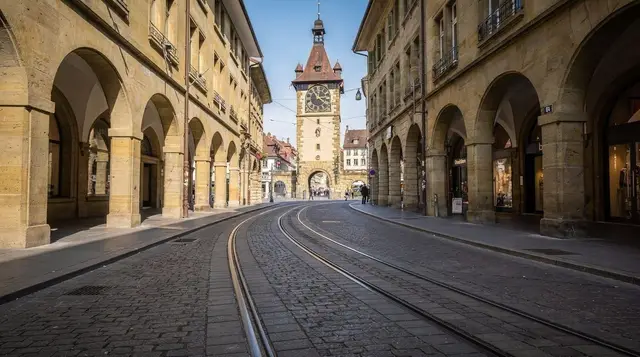
Zurich is not part of the Jungfrau region, and it shows the moment you step off the train: trams instead of cable cars, a lake instead of glaciers, and a financial district instead of a Bahnhof selling hiking maps. That contrast is exactly why it earns a place on an Interlaken itinerary. It is Switzerland’s largest city, its main airport gateway, and a genuinely different kind of day out after several days of mountains and villages.
The catch is distance. At around 2 hours each way from Interlaken Ost, Zurich is one of the longer excursions in this guide, on a par with Bern plus a bit more, and noticeably further than Lucerne. Treat it as a full day, not a half-day add-on, and you will get far more out of it.
Getting from Interlaken to Zurich
Trains leave Interlaken Ost roughly every 30 minutes throughout the day. Most connections change once in Bern, with a same-platform or short-walk transfer; a handful of early and late services run with no change at all. None of it needs reservations, which is normal for Swiss domestic rail.
| Departure station | Change | Typical journey time | One-way 2nd class (full fare) |
|---|---|---|---|
| Interlaken Ost | Bern | 2h05 | CHF 63–70 |
| Interlaken West | Bern | 2h10 | CHF 63–70 |
| Interlaken Ost | Direct (limited times) | 1h55–2h00 | CHF 63–70 |
Fares vary with a Half Fare Card, Saver Day Pass or Swiss Travel Pass; see the Swiss Travel Pass guide for which one actually pays off on a single long trip like this, and trains, buses and boats around Interlaken for how the local network feeds into the mainline. If you are arriving in Switzerland via Zurich Airport rather than day-tripping there, the logistics are covered separately in getting to Interlaken from Zurich Airport — the airport station sits on the same line, about 10 minutes past Zurich Hauptbahnhof.
Aim to catch a train that puts you in Zurich by 9:30am at the latest. Leaving any later starts eating into the afternoon, and the return journey needs to be factored in before you plan a late dinner.
Bahnhofstrasse and the Niederdorf old town
Zurich Hauptbahnhof opens directly onto Bahnhofstrasse, one of the most expensive shopping streets in Europe and, underneath the flagship stores, the roof of an underground shopping mall (Shopville) and several vaults of Swiss private banks. You do not need to buy anything to find it worth a walk: it is wide, tram-lined, and lined with chestnut trees that flower in May.
Cross the Limmat river at Bahnhofbrücke and the mood changes completely. The Niederdorf is Zurich’s old town proper: narrow cobbled lanes, guild houses converted into bars and restaurants, small independent shops, and enough street life in the evening that it doubles as the city’s main nightlife strip. During the day it is quiet and pleasant for wandering without a map. This is the part of Zurich that rewards simply walking rather than ticking off sights — see city sightseeing if you want a fuller checklist approach.
If you would rather get your bearings with someone who knows the city, a guided bike ride through the city with a local covers the river banks, the old town and the lakefront in far less time than walking, and it is a sensible way to start a day when the train has already used up the morning.
The Grossmünster and the Fraumünster’s Chagall windows
Two churches, facing each other across the Limmat, cover most of Zurich’s Reformation history and its best piece of 20th-century art.
The Grossmünster, with its twin square towers visible from most of the old town, is where Huldrych Zwingli preached and effectively started the Swiss Reformation in the 1520s. The interior is deliberately plain — Zwingli had the original decoration stripped out — but the crypt and the climb up the Karlsturm tower (a few hundred steps, no lift) give one of the better rooftop views in the city.
The Fraumünster, a short walk away, is quieter and easy to underestimate from outside. Inside, five stained-glass windows designed by Marc Chagall in 1970, in his signature saturated blues and reds, fill the choir with coloured light on a sunny afternoon. A sixth window in the transept, added later, was designed by Zurich artist Augusto Giacometti. Entry costs a few francs, photography is banned to protect the glass, and ten minutes is enough to see everything properly — it rewards a slow look rather than a long one.
| Church | Main draw | Entry fee | Time needed |
|---|---|---|---|
| Grossmünster | Reformation history, tower view | Nave free; tower small fee | 30–45 min with tower |
| Fraumünster | Chagall stained-glass windows | Small fee | 10–15 min |
The lake, the lake baths and Bauschänzli
Walk from the old town to Bürkliplatz and Lake Zurich opens up, with the Alps sometimes visible on a clear day at the far end of the water — a preview of the mountains you have just come from. Paddle steamers and regular boats run lake cruises in season; a short loop as far as the suburb of Rapperswil and back is a common half-day extension if you have more time than a single day in the city, and Rapperswil itself has a lakeside castle and a rose garden worth the detour on its own.
From late May to September, Zurich’s public bathing spots (Badis) along the lake and the Limmat open for the season. Seebad Utoquai and Frauenbad Stadthausquai are two of the better-known central ones, with wooden platforms, changing cubicles and, at Frauenbad, a women-only afternoon slot on certain days. Entry is a few francs or free depending on the site, and locals use them the way other cities use a park — as an after-work routine, not a tourist activity, which is part of the appeal.
a free-to-book lakeside walk with a panoramic cable-car photo stop covers this stretch of shoreline with a local guide if you would rather not navigate it solo, ending at a viewpoint over the lake and city rooftops.
Bauschänzli, an island beer garden just off Bürkliplatz, is the obvious stop for a drink with a view before heading back to the station — cheap by Zurich standards, seasonal, and usually busy on a warm evening.
The Uetliberg: Zurich’s local mountain
Zurich has its own miniature version of an alpine excursion. The S10 suburban train runs from Zurich Hauptbahnhof to Uetliberg summit station in about 20 minutes, climbing to 870 metres with no cable car and no queue. From the top, a short walk leads to a lookout tower and the start of the Planetenweg (planet trail), a ridge path scaled to the solar system that runs along to the neighbouring peak of Felsenegg, from where a cable car descends to Adliswil for the train back into the city.
On a clear day the views stretch across the city and lake to a long line of Alpine summits on the horizon — a genuinely good payoff for 20 minutes on a commuter train. On a hazy or overcast day, you get a pleasant wooded walk and no view at all, so it is worth checking the forecast before committing the two to three hours the round trip takes.
a guided hike up to the Uetliberg ridge handles the route-finding and adds context on the geology and the city’s water-catchment forest if you prefer not to work it out from a map at the summit kiosk.
Museums: the Kunsthaus and the FIFA World Football Museum
Zurich’s museums and art scene is led by the Kunsthaus, one of Switzerland’s largest art museums, holding major Swiss collections (Alberto Giacometti, Ferdinand Hodler) alongside Monet, Munch and a substantial modern and contemporary wing added by architect David Chipperfield in 2021. A single focused visit needs a minimum of two hours; art enthusiasts can easily spend a full afternoon.
For something completely different, the FIFA World Football Museum sits near Zurich Enge station on the lake’s western shore, in the same city where football’s governing body is headquartered. Exhibits cover the history of the World Cup, including actual trophies from past tournaments, and the museum is aimed squarely at football fans rather than general sightseers — a good option if travelling with someone who has had enough of churches and stained glass for one day.
Neither museum is a quick stop; picking one, not both, is the realistic plan within a single day trip.
Zurich versus the other big day trips from Interlaken
Zurich is one of several “big city” options from Interlaken, and it is worth being honest about how it compares before committing a full day to it.
| Destination | Journey time (one way) | Best for | Note |
|---|---|---|---|
| Zurich | ~2h05 | City sightseeing, art, lake, football museum | Longest of the city day trips |
| Basel | ~2h00 | Museum density, easy Rhine Falls add-on | See Basel’s art museums |
| Lucerne | ~1h50 (via Brünig) | Lake, old town, Mount Pilatus | Shortest of the three; see the Lucerne day trip guide |
| Bern | ~52 min | Compact old town, short trip | Manageable as a half-day |
If time is tight, Lucerne or Bern deliver more per hour spent travelling. Zurich earns its place when you specifically want its combination of a big-city old town, a proper lake-swimming culture, and internationally significant art and football museums in one visit — and when you are prepared to give it a genuinely full day rather than squeeze it in. The full spread of options, including less obvious ones, is laid out in day trips from Interlaken.
If what you really want is mountains rather than a city, Zurich is also a starting point for an organised mountain excursion to Titlis. That makes more sense for travellers based in Zurich than for those coming from the Oberland, who can reach the same area directly; see Engelberg and Titlis and the Mount Titlis guide before deciding.
Combining Zurich with the Rhine Falls
Some visitors try to bolt the Rhine Falls onto a Zurich day, since Schaffhausen is only about 40 minutes further north by train. It can be done, but it turns an already long day from Interlaken into a very long one — realistically a 6am start and a late return. It works better as a separate excursion, ideally paired with Basel rather than Zurich, since Basel sits closer to Schaffhausen on the map even though the direct rail times are similar. The Rhine Falls day trip guide and the Rhine Falls destination page cover the logistics if you want to attempt the combination anyway.
Budgeting a day in Zurich
Zurich is not the place to economise on a Swiss trip; it is consistently ranked among the world’s most expensive cities. A realistic, non-extravagant day looks something like this, on top of the train fare covered separately in the Interlaken travel costs guide:
| Item | Typical cost (CHF) |
|---|---|
| Coffee and pastry | 10–12 |
| Simple lunch (bakery or bratwurst stand) | 15–20 |
| Sit-down lunch | 25–35 |
| Fraumünster entry | 5 |
| Kunsthaus or FIFA Museum entry | 18–26 |
| Lake bath entry (Badi) | 0–8 |
| Coffee or drink at Bauschänzli | 6–9 |
A frugal version, eating on your feet and skipping the paid museum, comes in around CHF 40–50 for the day. Add a proper sit-down meal and one museum and it climbs towards CHF 80–100, before the train.
A practical one-day plan
For a single visit that fits the roughly 8–10 hours available between trains:
- Arrive at Zurich Hauptbahnhof, walk Bahnhofstrasse towards the lake.
- Grossmünster and Fraumünster (Chagall windows), about an hour together.
- Lunch in the Niederdorf.
- Either the Kunsthaus or the FIFA Museum (pick one), or the Uetliberg round trip if the weather is clear and you would rather have the view than the art.
- A walk or swim at a lakeside Badi in summer, or Bauschänzli for a drink in any season.
- Back to Zurich Hauptbahnhof for the return train to Interlaken Ost.
A more detailed hour-by-hour version of this route, including opening hours and a wet-weather backup order, is set out in Zurich in one day from Interlaken.
Zurich day trip FAQ
Is Zurich worth a day trip from Interlaken?
Yes, but budget the whole day. It is about 2 hours each way by train, so realistically you get 8–10 hours in the city. That is enough for the old town, the two big churches, a walk or swim by the lake, and one museum, but not for much more.
How do I get from Interlaken to Zurich?
Direct and connecting trains run roughly every half hour from Interlaken Ost, most changing once in Bern, for a total journey of about 2h05. There is no need to book seats in advance; a Swiss Travel Pass or Half Fare Card covers or discounts the fare.
Is the Swiss Travel Pass worth it for a Zurich day trip?
If Zurich is your only long excursion of the trip, a single Saver Day Pass is usually cheaper than a multi-day Swiss Travel Pass. The pass earns its cost when you are combining Zurich with other long train days, since it also covers city trams and museum entry in many places.
What are the Chagall windows and where are they?
They are five stained-glass windows Marc Chagall designed for the Fraumünster church on Münsterhof, installed in 1970 when the artist was in his eighties. Entry to see them costs a few francs, photography is not permitted, and the church is a five-minute walk from Zurich Hauptbahnhof.
Is Zurich expensive?
Yes, even by Swiss standards. A coffee and pastry easily runs to CHF 10–12, a simple lunch CHF 25–35, and museum entry CHF 15–26. The lake baths and a walk along the Limmat and Bahnhofstrasse cost nothing, which is how most day-trippers keep the budget under control.
Can I swim in the lake in Zurich?
Yes, from late May to September the public Badis (bathing areas) along Lake Zurich and the Limmat are open, free or near-free, and busy with locals on warm afternoons. Bring your own towel; changing cabins are basic rather than luxurious.
Should I visit Zurich or Basel as a day trip from Interlaken?
Zurich suits travellers who want a compact old town, a lake and a well-known art museum in one visit. Basel suits those prioritising museums specifically, since it has the country’s densest concentration of them, plus easy onward access to the Rhine Falls.
Is the Uetliberg worth the trip up?
On a clear day, yes. The S10 train reaches the summit station in about 20 minutes from Zurich Hauptbahnhof, and the ridge path along the ‘planet trail’ gives views over the city, the lake and, in good visibility, a long line of Alpine peaks. In cloud or haze it is a pleasant walk with no view, so check the forecast first.