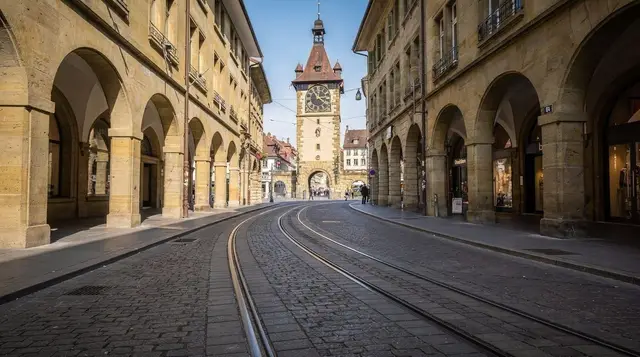
A city built around its art
Basel sits where Switzerland, Germany and France meet, split down the middle by the Rhine into Grossbasel on the left bank and Kleinbasel on the right. It is Switzerland’s third-largest city, but it punches well above its size in art: the Kunstmuseum holds the oldest public art collection in the world, the Fondation Beyeler draws visitors who would otherwise never come to this corner of the country, and Museum Tinguely turns the riverside into a display of clattering, self-destructing machines. Add a genuinely old old town, a red sandstone cathedral, and a summer tradition of floating down the Rhine in your clothes, and Basel is a different kind of Swiss day out from the lakes and peaks around Interlaken.
It is not a mountain excursion and it is not close. Treat it as a deliberate art-and-city day, not something to bolt onto a trip to Zurich or the Rhine Falls without checking the train schedule first.
Getting to Basel from Interlaken
Trains from Interlaken Ost to Basel SBB take about 2 hours, typically with a change in Bern (itself worth a stop on the Bern old town walking guide if you want to break the journey). Services run roughly hourly through the day, and there is no need to reserve seats on Swiss domestic trains. A standard second-class return costs around CHF 120 to 140 without a pass; if you are already carrying a Swiss Travel Pass or a Half Fare Card, check the Swiss Travel Pass guide for what your pass actually covers on this route, since regional passes bought for the Jungfrau region do not extend this far.
Because of the distance, a Basel day trip eats most of a day: leave Interlaken by 8am to 9am and you will have five to six hours in Basel before the return trip. If you are flying in or out of Zurich, the guide to getting to Interlaken from Zurich airport covers routing Basel in either as a stopover, since it sits on the same north-south rail corridor.
For anyone who would rather not manage the connections themselves, a private English-speaking driver covering Basel and onward to Zurich in a single day removes the train timetable from the equation entirely, at a cost that only makes sense for a small group splitting the fare.
Fondation Beyeler: the reason many visitors come
The Fondation Beyeler sits in Riehen, a suburb about 20 minutes by tram (line 6) from central Basel, and it is often the single reason art travellers detour to this city at all. Architect Renzo Piano’s low glass-and-stone pavilion was built specifically to house the private collection of gallerists Ernst and Hildy Beyeler: major works by Monet, Picasso, Rothko, Giacometti and Cézanne, shown in daylight-lit rooms that open directly onto a landscaped park with views towards the Black Forest. The museum also runs a heavyweight temporary exhibition programme, so check what is showing before you go, since a major loan show can justify the trip on its own.
Admission is around CHF 32 for adults, with reductions for students and free entry for under-18s, which is standard across most Basel museums. Unlike the Kunstmuseum and Museum Tinguely, the Fondation Beyeler opens daily, including Mondays, which makes it the more reliable choice if your one Basel day happens to fall at the start of the week. Budget at least two hours, more if the current exhibition is a major one.
Kunstmuseum Basel: the oldest public collection in the world
The Kunstmuseum’s collection dates to 1661, when the city bought the Amerbach Cabinet, a private collection that had been assembled a century earlier — making this arguably the oldest public art collection anywhere. The main building on St. Alban-Graben holds Old Masters through to early 20th-century work, with a strong run of Holbein and Konrad Witz alongside German Expressionists and a serious Picasso holding. A separate Neubau across the street handles contemporary and rotating exhibitions.
Admission for the permanent collection runs around CHF 26, though the museum offers free entry on the first Sunday of every month, which is worth timing a visit around if your dates line up and you can tolerate the larger crowds that come with it. The Kunstmuseum closes on Mondays, so build that into any itinerary that also includes Museum Tinguely, which shares the same closing day.
Museum Tinguely: machines that move
On the Kleinbasel bank of the Rhine, Museum Tinguely is dedicated entirely to Jean Tinguely, the Swiss sculptor known for kinetic assemblages built from scrap metal, motors and found objects that clank, spin and occasionally seem to fall apart while running. The building itself, by architect Mario Botta, sits in a small riverside park and is compact enough to see properly in 90 minutes to two hours.
It is a different register from the Kunstmuseum or Fondation Beyeler — noisier, more playful, and genuinely engaging for children who might otherwise tune out in a gallery of paintings, which makes it worth pairing with the Basel art museums day trip guide if you are trying to sequence all three in one visit.
Admission is around CHF 18. Like the Kunstmuseum, it closes on Mondays.
The old town: red Rathaus, Münster and the Pfalz
Basel’s Altstadt does not need a museum ticket to be worth the walk. The Marktplatz is dominated by the Rathaus, a 16th-century town hall painted a deep ochre-red with an elaborately gilded and frescoed facade that is one of the most photographed buildings in the city; step into the inner courtyard, also frescoed, which most visitors on the square never bother to do.
From there it is a short walk up to the Basel Münster, a red sandstone cathedral with two mismatched spires and a checkerboard-tiled roof, standing on the site of a Roman-era settlement. Behind it, the Pfalz is a terrace built into the old city walls with an open view down onto the Rhine and Kleinbasel on the far bank — free, uncrowded, and one of the better places in the city to get your bearings before deciding what else to fit in.
The old town’s narrow lanes reward wandering rather than a fixed route; it is small enough that getting slightly lost costs you ten minutes, not an hour.
Crossing the Rhine on the cable ferries
Basel runs four small passenger ferries across the Rhine that use no engine at all: a cable is strung across the river, and the current itself pushes the boat across at an angle, guided by the ferryman adjusting the cable’s tension. Each has its own name and personality — the Ueli, Wilde Maa, Leu and Vogel Gryff — and each connects a different pair of landings on the two banks. The crossing takes a couple of minutes and costs a small coin fee (CHF 1.60 as of recent seasons, cash only, paid to the ferryman on board). It is a genuinely functional piece of transport, not a tourist novelty, and it is one of the more memorable few minutes you will spend in the city for the price of a coffee’s worth of change.
Swimming in the Rhine: a Basel summer tradition
From roughly June to September, once the water has warmed past the snowmelt chill of spring, Basel residents swim in the Rhine as a matter of routine, not spectacle. The standard method is the Wickelfisch, a fish-shaped waterproof bag sold at kiosks near the Mittlere Brücke for around CHF 20 to 25: you seal your clothes and phone inside, trap air to keep it afloat, and either tow it while you swim or drift with the current holding onto it. The river’s flow does the work — swimmers typically enter upstream and let the current carry them down to one of several marked exit points and ladders along the bank, rather than swimming laps against the flow.
Water quality is monitored and generally good, but the current is genuinely strong and stronger than it looks from the bank; stick to the sanctioned entry and exit points, do not swim during high water after heavy rain, and never do this with small children unsupervised. Non-swimmers can watch from the Rhine promenade on a warm evening and get most of the atmosphere without the current.
Museum prices and opening days
| Museum | Adult admission | Closed | Typical visit |
|---|---|---|---|
| Fondation Beyeler | ~CHF 32 | Open daily | 2+ hours |
| Kunstmuseum Basel | ~CHF 26 (free first Sunday) | Mondays | 2–3 hours |
| Museum Tinguely | ~CHF 18 | Mondays | 1.5–2 hours |
Planning a day (or two) from Interlaken
| From Interlaken Ost | Journey time | Notes |
|---|---|---|
| Basel SBB | ~2 hours | Usually one change, in Bern |
| Basel, via Bern stopover | ~2 hours + stop | Break the trip in Bern’s old town |
| Basel to Zurich (onward) | ~1 hour | Common combined-day routing |
A single day covers the old town plus one museum comfortably; two museums is possible if you move briskly and skip a sit-down lunch. Staying overnight turns it into a genuinely relaxed trip — you get an evening on the Rhine promenade and, in summer, a swim, plus the option of both the Kunstmuseum and Fondation Beyeler the next morning before the train back.
If Basel is one stop on a longer loop rather than a there-and-back day, it slots naturally into a wider circuit through Zurich, Winterthur, Stein am Rhein and Aarau, broadly following the route in the grand tour of Switzerland from Interlaken. Basel is also the easiest base from which to add the Rhine Falls, roughly 50 minutes further north by train, if art alone is not enough water for one trip.
Basel and the wider region
Basel pairs naturally with the region’s other art stop, Bern’s Zentrum Paul Klee — the guide to Zentrum Paul Klee and Bern’s museums is worth reading if you are trying to decide which city gets your one museum day. For a broader comparison of Swiss art cities generally, see Basel’s art museums covered as a dedicated day trip.
If your itinerary already includes Zurich, a combined Basel and Zurich day tour with chocolate tasting and a lake cruise covers both cities without you managing separate train tickets. Travellers based in Basel who want to see the Bernese Oberland’s other side can instead book a day tour from Basel to Thun, the Beatus Caves and a lake cruise, which works in the opposite direction to this guide for anyone starting their Swiss trip in Basel rather than Interlaken.
Beer drinkers passing through should note Rheinfelden, 20 minutes from Basel by train and home to the Feldschlösschen brewery; a guided brewery tour and tasting at Feldschlösschen is a straightforward add-on for a second half-day in the area. And for visitors doing this route in reverse — flying into Basel and working towards the Bernese Oberland — a private day trip up to the Jungfraujoch departing from Basel covers the region’s signature excursion without first relocating to Interlaken.
Frequently asked questions about visiting Basel
How long does it take to get from Interlaken to Basel?
Around 2 hours by train from Interlaken Ost, usually with one change in Bern. Trains run at least hourly, and a same-day return is straightforward if you leave Interlaken by mid-morning.
Is Basel too far for a day trip from Interlaken?
It is workable but tight. With roughly 2 hours each way, you get about 5 to 6 hours in Basel itself, enough for the old town plus one major museum such as the Kunstmuseum or Fondation Beyeler, not both in real depth.
Which Basel museum should I choose if I only have time for one?
For a broad, deep collection spanning Holbein to Picasso, choose the Kunstmuseum in the city centre. For a single-artist-scale but architecturally striking visit with a garden, choose the Fondation Beyeler in Riehen, a short tram ride out of town.
Can I really swim in the Rhine in Basel?
Yes, from roughly June to September when the water has warmed up and the current is manageable. Locals use a waterproof bag called a Wickelfisch to float their belongings while they swim or drift with the current; buy one near the Mittlere Brücke before you get in.
Are Basel’s museums open on Mondays?
Many are not. The Kunstmuseum and Museum Tinguely both close on Mondays, and the Fondation Beyeler is one of the few major exceptions that opens seven days a week. Check the specific museum before building a Monday itinerary around it.
Is Basel expensive compared to Zurich?
Broadly similar. Museum admission runs CHF 18 to 32, a simple lunch is CHF 20 to 30, and a coffee is CHF 4.50 to 5.50. Basel does not undercut Zurich on price, but you are not paying a premium for being in a smaller city either.
Do I need a car to get around Basel?
No. The old town is walkable, trams cover the rest of the city, and the four Rhine ferries cross the river on foot. Many hotels issue a BaselCard that gives free public transport for the length of your stay.
What’s the best time of year to visit Basel?
The museums work in any season, so weather-driven planning matters less here than in the mountains. If river swimming and outdoor terraces are part of the appeal, aim for June to September; spring and autumn suit museum-focused visits with fewer crowds.