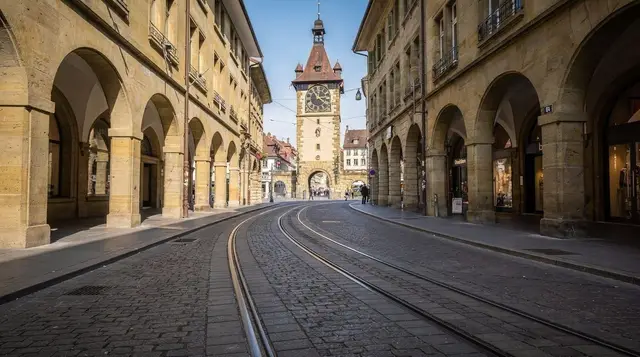
Winterthur is not on the standard Interlaken day-trip circuit, and honestly, the travel time explains why: it sits on the far side of Zürich, roughly two and a half hours from Interlaken Ost even with clean connections. What earns it a place in this guide is narrower and more useful than “worth seeing” — it is one of the better answers in the whole region to the question of what to do when the weather in the Bernese Oberland has closed in for the day. Two serious museums, a walkable old town, and almost none of it depends on the sky cooperating.
Why Winterthur shows up in a Jungfrau region guide
Switzerland’s sixth-largest city grew rich on engineering rather than tourism — Sulzer’s factories built diesel engines, turbines and railway locomotives here for over a century — and that industrial wealth is the reason Winterthur ended up with an outsized collection of museums for a place its size. Textile and machinery money paid for the Oskar Reinhart art collections; municipal ambition and Swiss engineering culture together produced the Technorama, one of the country’s best science museums. None of it has anything to do with mountains, which is exactly the point on a day when the Jungfraujoch is fogged in and the Schilthorn cable car has stopped for wind.
If you are staying in Interlaken specifically to be near the peaks, Winterthur is not a rival attraction — treat it as a fallback for a genuinely bad-weather day, or as a stop on a longer loop that already includes Zürich or Basel.
Getting there from Interlaken
There is no direct train. The standard route runs Interlaken Ost to Bern, Bern to Zürich HB, then a regional connection on to Winterthur — two changes, occasionally reducible to one depending on the timetable. Journey planning tools will sometimes route you via a faster InterCity that shaves ten minutes off the Zürich leg; it rarely changes the total by more than a few minutes.
| Leg | Approximate time |
|---|---|
| Interlaken Ost to Bern | 50 min |
| Bern to Zürich HB | 1 h |
| Zürich HB to Winterthur | 20–25 min |
| Total, door to door | Around 2 h 30 |
A Swiss Travel Pass or Half Fare Card covers the whole route, and there is no reason to book ahead — Swiss trains run on a fixed clockface schedule and seats are rarely an issue outside peak commuter hours into Zürich. If you are also weighing up airport transfers, the same Zürich HB interchange is the one used on the route from Zürich Airport.
Technorama: around 500 exhibits, almost all hands-on
The Technorama is Switzerland’s national science centre, and it is built on a simple idea: visitors operate the exhibits themselves rather than reading a label next to a case. Across several halls you can trigger a tornado in a glass cylinder, run water experiments in an outdoor channel, test reaction times, and watch (or start) chain reactions built from marbles and dominoes. It comfortably fills three to four hours, longer with children who want to repeat their favourite exhibits.
Adult admission runs to around CHF 36, with reduced tickets near CHF 20 for children aged 4 to 15 and family tickets that undercut paying separately. The museum sits about 3 km from Winterthur’s old town and is reachable by local bus in around ten minutes, or a 35–40 minute walk if the weather allows it. Note that the Technorama is usually closed on Mondays outside school holiday periods — check before building a day around it, the same caution that applies to any rainy-day plan that hinges on a single indoor attraction.
a guided walk through Winterthur’s old town is a reasonable way to get your bearings quickly before or after the Technorama, especially if you are trying to fit both into a single day without wasting time working out where things are.
The Oskar Reinhart collections
Oskar Reinhart, a textile trader’s son who never married and ploughed his fortune into art instead, left Winterthur two separate collections that are still shown at two separate addresses.
Am Römerholz, his former villa on a hill outside the centre, holds the paintings he kept for his own use: Cézanne, Renoir, van Gogh, Manet and a run of earlier old masters, hung in the domestic rooms much as he arranged them. It is reached by local bus from the station or Hauptbahnhof area, and entry runs to roughly CHF 18.
Am Stadtgarten, in the old town itself, houses the works Reinhart donated outright to the city and canton — mostly Swiss, German and Austrian painters, including a strong holding of Ferdinand Hodler and Oskar Kokoschka. Entry here is typically closer to CHF 12–15, and combined tickets covering both sites are usually available if you plan to see both in one day.
Between the two, allow at least three hours if art is the main reason for the trip, less if you are treating one of them as a shorter stop between the Technorama and the old town.
Walking the old town
Winterthur’s centre is compact and closed to general traffic, which makes it one of the more pleasant Swiss old towns to cover without watching for cars. Marktgasse and the parallel Obertor–Untertor axis are lined with arcaded buildings dating largely from the 15th to 18th centuries, a legacy of the town’s medieval market rights. The Stadthauspark, laid out around a neoclassical building by the German architect Gottfried Semper, gives the old town a proper green centre rather than just streets.
Under an hour covers the core on foot; add another hour if you are stopping into shops or the smaller museums along the way, including the Fotomuseum Winterthur and Kunstmuseum Winterthur, both a short walk from Marktgasse and both worth a look if photography or 20th-century Swiss art interests you specifically.
The Sulzerareal: industrial Winterthur repurposed
The former Sulzer engineering works, once the reason Winterthur had money for museums at all, now form the Sulzerareal — a district of converted factory halls a short walk north of the old town, holding start-ups, restaurants, a cinema and event spaces alongside surviving industrial architecture. It is less immediately picturesque than the old town and more interesting if you have any curiosity about how a 19th-century Swiss industrial town remade itself once the factories wound down.
A guided tour of the Sulzerareal puts the industrial history in context in a way that is hard to piece together just by walking through — the buildings alone do not explain what Sulzer actually built here or why the site’s transformation matters to the city today.
Eating in Winterthur
The old town has a reasonable spread of options without straying into anything exceptional. Expect CHF 20–28 for a lunchtime main at an ordinary café or bistro around Marktgasse, and CHF 35 upwards at a sit-down restaurant in the evening — broadly in line with prices in Zürich, a little below what you would pay in central Basel. Bakeries and the covered market stalls near the station are the cheaper route if you are trying to keep the day’s budget under control, an approach that works the same way it does back in Interlaken.
Making a full day of it
A realistic single day looks like: arrive mid-morning, spend the first half at the Technorama or one Reinhart site, lunch in the old town, then the second collection or a walk through Marktgasse and the Sulzerareal before the last comfortable train back. Trying to fit both Reinhart sites, the Technorama and a proper old-town walk into one day from Interlaken is possible but tight — something usually gets rushed.
If Winterthur is only one stop on a longer loop, it slots naturally alongside a one-day Zürich visit, given the 20-minute train link between the two. Pairing it with the Rhine Falls in the same day is more ambitious — factor in an extra change and around 40 minutes each way, and the day stops being relaxed.
For travellers who want the falls without the extra rail time, a short boat trip right under the Rhine Falls is a better use of limited time than trying to see everything at once. A gentler variant, if Basel is also on the itinerary, is a walk along the Limmat riverside as part of a wider Zurich–Baden route rather than adding a third city to the same day.
Why this is the rainy-day answer
Interlaken’s outdoor activities — the free things to do, the lake cruises, the mountain excursions — all depend on weather that the Bernese Oberland does not reliably provide, especially in shoulder season. Winterthur’s appeal is precisely that almost none of it does: the Technorama is indoors by design, the Reinhart collections are indoors by definition, and even the old town’s arcades give some cover from drizzle.
It will not replace a clear day on the Jungfraujoch or a hike above Grindelwald, and nobody should pretend it does. What it does well is turn an otherwise wasted, sodden day into one with a science museum, two art collections and a decent lunch to show for it — which is more than can be said for waiting out the rain in Interlaken itself.
For families specifically weighing up rainy-day options with children, the Technorama is a stronger bet than most museum alternatives in the region simply because so much of it is designed to be touched rather than observed — a point worth remembering when comparing it against the more look-but-don’t-touch museums closer to Interlaken and covered in the wider family guide for the area.
Travellers building a longer Swiss circuit that already passes through Zürich and Basel can also see where Winterthur fits into the broader route in the Grand Tour of Switzerland itinerary, or browse the full set of day trip options and destination pages for other ways to fill a difficult-weather day.
Frequently asked questions about visiting Winterthur
Is Winterthur worth visiting from Interlaken?
Only if you are combining it with something else, since it is roughly two and a half hours from Interlaken each way. It works well tacked onto a Zürich stop, or as a base if you are already spending a night in the Zurich region. As a standalone return trip from Interlaken it eats most of a day in transit alone.
How do I get from Interlaken to Winterthur?
Take the train from Interlaken Ost, changing at Bern and again at Zürich HB, then a regional or S-Bahn service on to Winterthur — around 2 h 30 in total with typical connections. A Swiss Travel Pass or Half Fare Card covers the route, and the walk from Winterthur station into the old town takes about five minutes.
What is the Technorama and how much does it cost?
The Technorama is a hands-on science centre with roughly 500 exhibits covering physics, biology and mechanics, most of which visitors operate themselves. Adult admission runs to around CHF 36, with reduced rates near CHF 20 for children aged 4 to 15, and a family ticket usually works out cheaper than paying individually.
Are the Oskar Reinhart collections in one building?
No — the foundation runs two separate sites in Winterthur. Am Römerholz, a short bus ride from the centre, holds the Impressionist and old master works Reinhart kept for himself; Am Stadtgarten, in the old town, shows the Swiss, German and Austrian art he donated to the city. Each charges its own entry fee, typically CHF 12 to CHF 18.
Is Winterthur good with children on a rainy day?
Yes, more than most Swiss towns of its size. The Technorama is built for children to press, pull and climb on the exhibits rather than just look, and it can absorb three to four hours without anyone getting bored. The old town’s arcaded streets also give some shelter for a shorter walk between museum visits.
Can I combine Winterthur with Zürich or the Rhine Falls in one day?
Winterthur to Zürich HB is about 20 minutes by train, so pairing the two in a single day from Interlaken is possible but long — expect to be travelling or sightseeing for 12 hours or more. The Rhine Falls at Neuhausen add a further change and roughly 40 minutes each way, which turns the day into a genuine marathon rather than a relaxed outing.
Is Winterthur’s old town pedestrian-only?
The core around Marktgasse and Untertor is closed to general traffic and easy to cover on foot in under an hour, though it rewards a slower pace. Arcaded facades from the 15th to 18th centuries line the main streets, and most of the shops, cafés and the Stadtgarten museum sit within this small area.