The Rhine Falls are not subtle. At Neuhausen am Rheinfall, near Schaffhausen in the north of Switzerland, the entire Rhine narrows and drops over a 150-metre-wide, 23-metre-high limestone step at up to 600 cubic metres of water a second in spring meltwater — enough to make it, by volume, the largest waterfall in Europe. It is a genuinely long trip from Interlaken, the best part of three hours each way, so it belongs on the itinerary mainly if you are already spending a day in Zurich or Basel and can build it in rather than treating it as a stand-alone excursion.
The scale of it: width, drop and flow
The falls formed around 14,000 to 17,000 years ago, after the last ice age rerouted the Rhine over a band of hard limestone that the softer rock around it had already eroded away. The result is not a single high drop like an alpine cascade, but a wide, churning wall of water: 150 metres across, a 23-metre fall, and a noise you can hear from the platforms before you see the water.
Flow varies a great deal by season. Spring snowmelt from the Alps pushes the average up towards 600 cubic metres per second, sometimes higher in a wet year, which is when the falls look their most dramatic and the spray reaches furthest up the viewing platforms. By late summer flow has usually eased off, and in a cold, dry winter it can drop to a fraction of that — the falls are still worth seeing, just quieter and with less spray. The Rhine at this point is doing what it has done since the ice age: nothing here is engineered or turned on for visitors, which is part of why the flow number is worth checking before you commit to a long train ride.
The two riverbanks: which side to visit
The falls sit between two cantons, and the two banks feel different enough that most visitors end up doing both.
| Bank | Canton | What is there | Access |
|---|---|---|---|
| Schloss Laufen (south) | Zurich | Fischetz platform at water level, castle courtyard, restaurant, funicular | Laufen-Uhwiesen or Schloss Laufen station |
| Neuhausen am Rheinfall (north) | Schaffhausen | Schlössli Wörth restaurant at the waterline, park, free clifftop paths | Neuhausen Rheinfall station |
Schloss Laufen gives you the closest approach to the water. From the castle courtyard, paths and a short funicular lead down to the Fischetz platform, which sits almost at spray height a few metres from the main curtain of falling water — in high flow you will get genuinely wet, not just misted. It is the single best vantage point at the falls and the one most photographs are taken from.
Neuhausen am Rheinfall, on the opposite bank, is quieter and mostly free. The Schlössli Wörth restaurant building sits right at the water’s edge with a terrace looking across at the rock and the far bank, and a set of paths along the clifftop give wide views without an entry fee. It is also where most of the boat crossings start.
Seeing both sides means crossing the river, which is where the boats come in.
The boat to the middle rock
A cluster of small passenger boats run constantly in season, criss-crossing the basin below the falls and linking Schloss Laufen, Neuhausen and the rock that sits in the middle of the falls themselves. The crossing between the two banks takes only a couple of minutes; the boat trip out to the rock and back, with a stop to climb the steps to the small platform on top, is the one most visitors pay for, at roughly CHF 8 to 10 return.
Life jackets are provided and the ride is short and low-key rather than a proper cruise, but standing on the rock with the full width of the falls on either side is the closest most people will get to being inside the waterfall. Queues build up around midday in high season, so an early or late visit avoids the wait.
a short boat tour of the Rhine Falls basin, including the crossing to the rock is the simplest way to book the crossing in advance rather than queuing at the jetty.
For a longer look at the water beyond this one stop, the guide to boat trips on Lake Lucerne and the paddle steamers of the Bernese Oberland cover the more leisurely lake cruises closer to Interlaken, which are a different experience from this short, choppy river crossing.
Schloss Laufen: the castle above the falls
Schloss Laufen dates back to medieval times, with the current building largely from the 12th to 17th centuries, and it sits directly above the Fischetz platform on the south bank. Part of the castle now houses a youth hostel, and there is a restaurant with a terrace looking out over the falls — a reasonable stop for lunch if you time it before the midday coach-tour rush. Entry to the platforms and funicular is ticketed, with adult tickets typically in the CHF 5 range; the castle courtyard itself and the clifftop paths around it are free to walk.
The funicular down to Fischetz saves a fairly steep set of stairs and is worth the small extra fee if you are travelling with children, older relatives, or simply do not want to climb back up in wet clothes.
Schaffhausen and the Munot
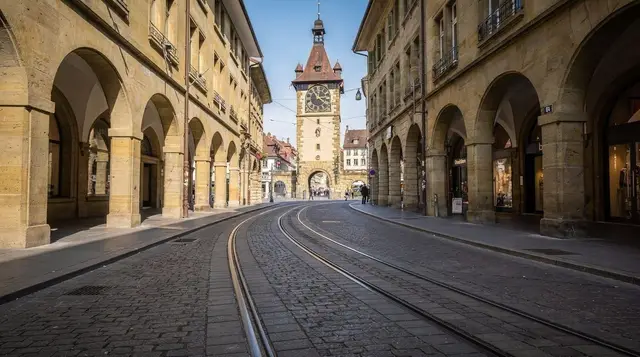
Schaffhausen’s old town is a 10 to 15 minute onward journey from Neuhausen am Rheinfall by local train or bus, and it is worth the extra hour or two if you have the time. The old town is one of the better-preserved in German-speaking Switzerland, with oriel windows, painted facades and a compact core that takes about an hour to walk end to end.
Above the town stands the Munot, a circular 16th-century fortress built by forced labour after Schaffhausen left the old Swiss defensive alliances exposed to attack. It is free to enter, reached by a walkable ramp inside the structure rather than stairs, and the flat roof gives a wide view over the old town’s rooftops and down to the Rhine. Schaffhausen still keeps the tradition of a night watchman sounding a horn from the tower each evening in summer. Combining the falls with Schaffhausen and the Munot turns a two-hour stop into a comfortable half-day.
a half-day trip from Zurich that combines the Rhine Falls with historic Schaffhausen covers both in one booking if you would rather not plan the local connections yourself.
For more on the town itself, see the destination pages for Schaffhausen’s neighbour Winterthur and the fortified river town of Stein am Rhein further upstream, which pairs well with a Rhine Falls day if you have a car or are prepared to add another train leg.
Getting there from Interlaken
There is no way to dress this up: the Rhine Falls are a long day trip from Interlaken, not a quick add-on. The standard route runs from Interlaken Ost to Zurich HB, then a connecting regional or InterCity train towards Schaffhausen, getting off at Neuhausen Rheinfall (for the north bank) or continuing one stop further to Schloss Laufen station (for the south bank and the castle).
| Leg | Approx time |
|---|---|
| Interlaken Ost → Zurich HB | About 2h05 |
| Zurich HB → Neuhausen Rheinfall / Schloss Laufen | About 40–50 minutes |
| Total, one way | About 2h50–3h |
That puts a round trip at 5.5 to 6 hours of travel alone, which is why most people treat this as part of a Zurich or Basel day rather than a dedicated Interlaken excursion. If Zurich is already on your itinerary, see the one-day Zurich guide from Interlaken and slot the falls in as a half-day detour from there rather than routing back through Interlaken twice. If you are travelling in via Zurich Airport, the falls also work well as a first or last stop before or after Interlaken, since Neuhausen Rheinfall sits on the same rail corridor.
A Swiss Travel Pass covers the train legs and the local boat crossing to the rock is a small out-of-pocket extra; check the overview of trains, buses and boats around Interlaken if you are stitching this into a wider itinerary and want to see how it fits with other passes.
If the logistics of trains and connections feel like more hassle than the sight is worth, a private tour to the Rhine Falls with hotel pick-up removes the planning at the cost of a higher price than doing it independently by train.
What it costs: a day at the Rhine Falls
Switzerland is expensive and the Rhine Falls area is no exception, though the falls themselves are cheaper to see than most Interlaken-area excursions because the best viewpoints are free or low-cost.
| Item | Approx cost (CHF) |
|---|---|
| Return train, Interlaken Ost–Neuhausen Rheinfall (2nd class, no pass) | 100–130 |
| Fischetz platform and funicular, Schloss Laufen | 5–6 |
| Boat to the middle rock, return | 8–10 |
| Lunch at Schlössli Wörth or Schloss Laufen restaurant | 25–35 |
| Coffee or snack | 6–10 |
Add up a return train fare without a discount pass, the platform and boat, and a modest lunch, and a solo day trip lands somewhere around CHF 130 to 180 all in — most of it the train. A Swiss Travel Pass or Half Fare Card brings the transport cost down noticeably if you are already planning to use one elsewhere on your trip; see the guide to travel costs around Interlaken for how that trades off against a single long-distance trip like this one.
Best time to visit
May and June bring the fullest flow, fed by alpine snowmelt, and the longest daylight for photography — but they also bring the biggest coach-tour crowds around midday. Arriving before 10am or after 4pm avoids most of the crush at the Fischetz platform and the boat jetty. Late summer and early autumn have a gentler flow but noticeably lighter crowds and can be the more relaxed choice if the volume of water matters less to you than having space on the platforms. Winter flow is much lower and the falls rarely freeze fully, so it remains an option, though some of the seasonal boat services reduce their schedule or stop running in the coldest months — check ahead if a winter visit depends on the boat crossing.
Combining the falls with Basel or Zurich
Because of the travel time from Interlaken, the Rhine Falls make more sense bolted onto a Zurich or Basel day than visited alone. From Zurich, the falls and Schaffhausen together are a comfortable half-day round trip. From Basel, the connection runs up the Rhine and takes a little longer, but it lets you frame the day around the river itself — Basel’s old town and museums in the morning, the falls in the afternoon.
a city tour covering the essentials of Basel’s old town is a reasonable way to use the Basel half of that combination if you are short on planning time. For the museums themselves, see the day trip guide to Basel’s art museums.
If you are building a longer trip around Interlaken with several day trips like this one, the seven-day itinerary with day trips and the general day trips from Interlaken guide both help sequence the long-distance ones like the Rhine Falls against shorter, closer options so you are not doing back-to-back three-hour train days.
The scenic trains category and day trips category list the alternatives if the Rhine Falls turn out not to fit your schedule. It is also worth reading the common mistakes first-time visitors make before committing a full day to a single far-flung sight, since the travel time here catches out a fair number of people who assume everything in Switzerland is close to everything else.
Compared with the closer, higher, alpine sights around Interlaken, the dedicated Rhine Falls day trip guide sets out fuller sample schedules for pairing this with Schaffhausen, Zurich or Basel depending on where you are starting from.
Rhine Falls FAQ: sides, boats and getting there from Interlaken
How do you get from Interlaken to the Rhine Falls?
By train from Interlaken Ost to Zurich HB (about 2h05), then a connecting train towards Schaffhausen, getting off at Neuhausen am Rheinfall or Schloss Laufen station. Total journey time is roughly 2h50 to 3 hours each way, so budget most of a day.
Which side of the Rhine Falls should you visit, Schloss Laufen or Neuhausen?
Schloss Laufen, on the south bank in canton Zurich, has the closest platforms to the water and the castle itself. Neuhausen am Rheinfall, on the north bank in canton Schaffhausen, has the Schlössli Wörth restaurant at the waterline and easier free viewpoints. Doing both, connected by the boat, gives the fullest picture.
Can you go right up to the Rhine Falls?
Yes. The Fischetz platform below Schloss Laufen puts you a few metres from the main curtain of water and gets wet with spray in high flow. A separate boat also lands passengers on the rock in the middle of the falls, with a viewing platform on top.
How much does it cost to visit the Rhine Falls?
The main viewpoints on both banks are free to walk to. The Fischetz platform and the funicular down from Schloss Laufen cost a small entry fee, and the boat to the middle rock costs around CHF 8 to 10 return. A half-day visit with boat, castle platforms and a coffee typically runs CHF 30 to 50 per adult before travel.
Is the Rhine Falls worth visiting if you have already seen the Jungfraujoch or Trümmelbach Falls?
It is a different kind of sight: not high or alpine, but wide, loud and close-up, and it is the largest waterfall in Europe by average water volume. It is worth the long train ride mainly if you are already heading to Zurich or Basel and can fold it into that trip rather than treating it as a stand-alone excursion from Interlaken.
What is the water flow at the Rhine Falls and when is it strongest?
Average flow is a few hundred cubic metres per second, rising to around 600 cubic metres per second during spring snowmelt, typically May and June, and dropping to a fraction of that in a dry winter. The falls run year-round and rarely freeze over completely.
Can you combine the Rhine Falls with Schaffhausen’s old town?
Yes, and most visitors should. Schaffhausen’s old town is a 10 to 15 minute onward train or bus ride from Neuhausen am Rheinfall, with the Munot fortress a short walk above it, and the whole add-on takes about half a day.