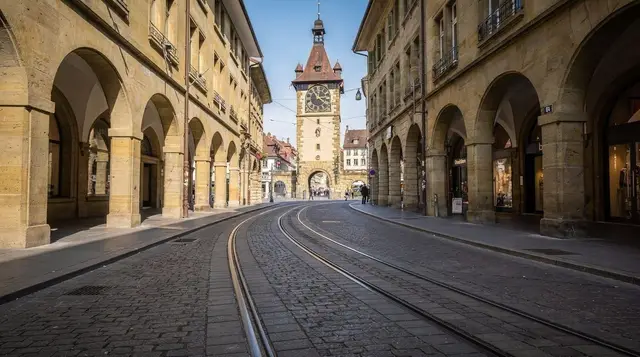
A town that painted its houses for four centuries
Stein am Rhein sits at the point where the Rhine leaves the Untersee, the western arm of Lake Constance, and narrows again on its way to the Rhine Falls and Schaffhausen. The old town is small enough to cross on foot in ten minutes, and almost every building on the Rathausplatz and the adjoining Understadt carries an oriel window, a coat of arms, or a full facade of painted figures.
Houses such as the Weisser Adler, the Roter Ochsen and the Sonne were repainted between the 16th and 19th centuries by owners competing for the most striking front, and the town has kept restoring them rather than letting them fade. It is one of the most photographed street scenes in Switzerland, and also one of the most crowded on a fine Saturday, when coach groups fill the square between 11:00 and 15:00.
None of this is a secret: Stein am Rhein appears on the express itineraries of tour buses running between Zurich, the Rhine Falls and Lake Constance, so the Rathausplatz can feel like a stage set with a rotating audience rather than a lived-in town centre. Arrive before 10:00 or after 16:00, particularly outside July and August, and the same square is close to empty, with residents cycling across the cobbles and the cafés setting up for a quieter local trade.
The Rathausplatz and the town hall
The Rathausplatz is the working heart of the old town, not a preserved shell: the 16th-century town hall (Rathaus) still houses the municipal offices, and its ground floor holds a small local history collection that opens only on request in summer. The square’s fountain, the Chnabenbrunnen, dates from 1521 and is still fed by a natural spring rather than the mains. Look up at the painted houses and you will find biblical scenes, Swiss confederate symbols, and, on the Haus zum Weissen Adler, a depiction of William Tell — a reminder that these facades were civic advertising as much as decoration, each owner staking a claim to taste and status in the years after the town’s medieval fortifications came down.
A short walk from the square, the Untertor and the remains of the town wall mark where Stein am Rhein’s fortified core ended; beyond it, the riverside promenade runs along the Rhine towards the bridge, with a clear view across to the Klosterhof, the walled precinct of the abbey.
Kloster St. Georgen: an abbey turned museum
Kloster St. Georgen (the Abbey of St George) is a Benedictine monastery founded in the 11th century and dissolved during the Reformation in 1525; its buildings were bought by the town and have survived largely intact, which is unusual for a Swiss abbey of this age. The complex is now a museum run by the canton of Schaffhausen, with a Romanesque cloister, a set of monastic living rooms with original 16th-century wood panelling, and a collection of late-medieval and early Renaissance panel paintings, several by local painter Thomas Schmid.
The abbey church, next to the museum, is plainer than the painted houses outside its gate and free to enter. The museum itself charges around CHF 8 for adults and is closed on Mondays and through the winter months (typically November to March), so check before building a visit around it outside the main season. Even when the museum is shut, the cloister courtyard and the abbey gardens along the Rhine are usually accessible and worth the short detour off the Rathausplatz.
The Rhine at its most deceptive
The stretch of river in front of the old town looks placid, wide and almost lake-like, because it effectively is one: this is the last calm water before the Rhine narrows and accelerates towards Schaffhausen and the Rhine Falls a few kilometres downstream. The colour is a pale green-grey rather than the bright turquoise of Lake Brienz, a result of the different glacial and lake sediment feeding it upstream through Lake Constance. Swimming is popular with locals from the grassy banks near the bridge in summer, though the current picks up quickly away from the shallows and there is no supervised lido in the old town itself.
The covered wooden bridge connecting Stein am Rhein to the district of Burg on the opposite bank gives the clearest view back at the painted facades, and is where most of the postcard photographs are taken from, particularly in the early morning light before the crowds arrive.
Getting there from Interlaken
There is no direct train. From Interlaken Ost, the standard routing runs via Bern or Zurich, then Zurich HB, then Winterthur, before a regional connection to Stein am Rhein; total journey time is close to 2 hr 45 min each way, with one or two changes depending on the connection. An alternative routes via Schaffhausen, useful if you are combining the visit with the Rhine Falls, adding roughly ten minutes but landing you a short walk from the boat pier instead.
| From Interlaken Ost | Approx. time | Typical changes |
|---|---|---|
| Via Zurich HB and Winterthur | ~2 hr 45 min | 2 |
| Via Zurich HB and Schaffhausen | ~2 hr 55 min | 2 |
| Via Bern and Zurich HB | ~2 hr 50 min | 2 |
A Swiss Travel Pass covers the entire route, including the regional trains at the Winterthur or Schaffhausen end; without one, a same-day return from Interlaken costs roughly CHF 140–160 second class if bought without a Half Fare Card. Given the distance, most visitors staying in the Jungfrau region treat Stein am Rhein as a stop on a longer day out to Zurich, Winterthur or the Rhine Falls, rather than a dedicated round trip.
The boat to Schaffhausen
Between April and October, passenger boats run along the Rhine between Stein am Rhein and Schaffhausen, a journey of around 1 hr 10 min downstream (slightly longer heading upstream against the current). It is a slower, more scenic alternative to the ten-minute train, passing riverside villages, vineyards on the slopes above Eschenz, and the point where the current visibly speeds up before Schaffhausen. Boats also run the other direction from Stein am Rhein across the Untersee towards Konstanz, on the German side of the lake, for travellers with more time and the right documents for a short border crossing.
Fares are separate from rail tickets, generally not covered in full by a Swiss Travel Pass outside a discount, and the timetable thins out considerably in spring and autumn, so check the current schedule rather than assuming an hourly service.
a Zurich day tour that combines Stein am Rhein with the Rhine Falls and a Rhine boat cruise bundles the train, the town and the boat leg into one organised day, which removes the timetable-matching that makes an independent trip fiddly on a first visit.
Combining Stein am Rhein with the Rhine Falls, Zurich or Winterthur
Because of the distance from Interlaken, almost nobody visits Stein am Rhein in isolation. The most common pairing is the Rhine Falls, a 15–20 minute onward train or boat connection via Schaffhausen; between the two, allow a full day from Interlaken rather than trying to add a third stop.
a private day trip pairing the Rhine Falls with Stein am Rhein is the more efficient option if you would rather not manage three separate tickets and two changes on your own.
Travellers based in or passing through Zurich have an easier calculation: Stein am Rhein is under an hour by direct regional train from Zurich HB, which is why it appears on so many Zurich-based day tours. If you are routing through Zurich anyway — flying in or out of the airport, or spending a day in the city before or after the Jungfrau region — it is a far more efficient add-on there than as a standalone trip from Interlaken.
a Zurich-based day covering the Lindt chocolate factory, the Rhine Falls and Stein am Rhein covers exactly that combination in one outing, which suits a Zurich stopover better than an Interlaken base.
Winterthur, a regional rail hub on the Zurich–Stein am Rhein line with its own old town and art museums, works as a third stop for travellers with a full day and a Swiss Travel Pass, though it adds complexity rather than simplifying it if you are travelling from Interlaken and back in a single day.
Walking the old town on limited time
For visitors who have made the long trip from Interlaken and want to use the time on the ground efficiently rather than wandering, a 60-minute guided walk through the old town with a local covers the Rathausplatz facades, the abbey precinct and the riverside promenade in the time it takes to find a decent coffee independently, which matters when the return train schedule is the tightest part of the day.
Fitting the trip into a stay in Interlaken
Stein am Rhein sits at the far edge of what is sensible from an Interlaken base, so it helps to decide early whether it deserves a day of your stay. The day trips from Interlaken guide lays out the alternatives side by side, and how many days in Interlaken helps you judge whether you have a spare day at all. If your time is short, the Interlaken in one day plan and the one-day itinerary show what you would be giving up.
Travellers with a longer stay can slot the Rhine into a wider loop: the seven days with day trips itinerary and the grand tour of Switzerland from Interlaken both treat the north-east of the country as an optional extension rather than a core stop.
Nearby places that make the long journey worthwhile
The most natural companion is the Rhine Falls, and the Rhine Falls day trip guide covers how to reach them and what to expect on arrival. On the way, Zurich is the usual rail hub, and Zurich in one day from Interlaken is useful if you would rather spend the morning in the city. Winterthur is the other practical stop on the line.
If the distance puts you off, the same appetite for old towns and lakeside scenery can be met much closer to home. Bern and its old town walking guide offer arcaded streets and fountains within easy reach, while the Thun old town and castle guide describes a smaller, lake-side alternative on the doorstep of the Oberland.
Tickets and logistics before you go
Rail is the main cost of the day, so read the Swiss Travel Pass guide before buying point-to-point tickets, and compare it with the Jungfrau and Berner Oberland pass if the rest of your stay is spent in the mountains. If you arrive by air, the Zurich airport to Interlaken guide explains the first leg, and the trains, buses and boats around Interlaken overview gives the wider picture of how the network fits together. Our notes on luggage and lockers are worth a glance if you are changing hotels around the trip, and Interlaken travel costs puts the day into the context of your whole budget.
Practicalities
The old town itself is largely car-free at its centre, with parking available at the edges near the railway station and along the riverside; this is not one of the officially car-free Jungfrau region villages like Wengen or Mürren, but through-traffic is limited by the narrow medieval street plan rather than a formal ban. Public toilets, cash machines and a small tourist information point are all on or just off the Rathausplatz.
| Item | Approx. cost |
|---|---|
| Return train, Interlaken–Stein am Rhein (2nd class, no discount card) | CHF 140–160 |
| Kloster St. Georgen museum entry | CHF 8 |
| Rhine boat, Stein am Rhein–Schaffhausen (one way) | CHF 20–25 |
| Coffee and pastry on the Rathausplatz | CHF 8–12 |
| Lunch at a riverside restaurant | CHF 25–40 |
The main tourist trap is less a specific overpriced attraction than the effect of the coach groups: restaurants directly on the Rathausplatz charge a premium for a view that a two-minute walk down a side street gets close to for free. Late April, May, September and early October give the best odds of photographing the facades without a tour group standing in front of them; the abbey museum’s Monday and winter closures are the detail that most often catches visitors out.
Stein am Rhein questions answered
How do I get from Interlaken to Stein am Rhein?
There is no direct train. Expect around 2 hr 45 min each way from Interlaken Ost, changing at Zurich HB and then Winterthur, or via Schaffhausen if you plan to see the Rhine Falls on the same trip. A Swiss Travel Pass covers the whole route.
Is Stein am Rhein worth a day trip from Interlaken?
The old town and abbey can be covered in two to three hours, but the round trip from Interlaken takes close to six hours of travel. Most visitors combine it with the Rhine Falls or route it through a Zurich stopover rather than treating it as a stand-alone destination from the Jungfrau region.
What is there to see at Kloster St. Georgen?
A Romanesque cloister, monastic living rooms with original 16th-century panelling, and a collection of late-medieval panel paintings. Entry costs around CHF 8 for adults; the museum closes on Mondays and typically through the winter months.
Can I take a boat from Stein am Rhein to Schaffhausen?
Yes, between April and October. The crossing takes about 1 hr 10 min downstream and is slower but more scenic than the direct train, which takes around ten minutes. Fares are separate from rail tickets and the timetable thins outside peak summer months.
Are the painted houses in Stein am Rhein original?
The facades have been repainted repeatedly since the 16th century rather than preserved as a single original layer; the town has maintained the tradition of decorating its houses rather than freezing them at one historical moment, which is why the paintwork still looks vivid rather than faded.
When is the Rathausplatz least crowded?
Before 10:00 or after 16:00, and outside July and August. Coach tour groups typically arrive mid-morning and clear out by mid-afternoon, so early or late visits give a much closer look at the buildings without a crowd in every photo.
Is Stein am Rhein car-free like Wengen or Mürren?
No. It is not one of the Jungfrau region’s car-free resort villages; it has a normal road network with parking at the edge of the old town. Traffic through the medieval core is limited by the narrow streets rather than by an official ban on vehicles.
Can I combine Stein am Rhein with Zurich in one day from Interlaken?
Yes, more comfortably than visiting Stein am Rhein alone. Zurich HB to Stein am Rhein is under an hour by direct regional train, so travellers routing through Zurich — for the airport, a stopover, or a city day — can add Stein am Rhein far more efficiently than those making the full return trip from Interlaken.