Interlaken in one day: the order that works
What's the best order for one day in Interlaken?
Start at the Höhematte at first light before the paragliders and tour buses arrive, then choose Harder Kulm on a clear morning or a lake cruise if cloud sits low. Spend the afternoon along the Aare between the two lakes, and pick one thing to skip rather than rushing all of it. Reaching a summit like the Jungfraujoch or the Schilthorn genuinely needs its own day.
Interlaken itself is small enough to see properly in a day, if you accept from the start that a day here means the town and one nearby high point, not the Jungfraujoch and the Schilthorn as well. Most people arrive with a list built from postcards and try to fit all of it into 24 hours; what actually works is a fixed order that respects the weather and the last cable car home. This is that order.
Why the sequence matters more than the list
Interlaken sits on a narrow strip of land between Lake Thun and Lake Brienz, with the Aare river running through the middle and the Höhematte as the town’s open lung. Nothing here is far from anything else, which is exactly why people overpack the day: it looks doable on a map. The problem is timing, not distance. Harder Kulm rewards a clear morning and punishes a hazy one; the Aare walk is best done without a hard deadline; and the last funicular or boat back has a fixed time regardless of how your afternoon went. Fix the order and the day works. Improvise it and you’ll spend the evening in Interlaken Ost trying to work out if you missed the last car.
Wake up at the Höhematte
Start here, before the Höhematte fills with day-trippers and the paragliding operators start their morning flights. The 14 hectares of protected meadow between the Hoheweg’s grand hotels is Interlaken’s centrepiece and its paragliding landing strip, so an early walk across it, ideally around 7.30am to 8.30am in summer, gets you the Jungfrau massif framed at the far end without a crowd in the foreground. Walk the loop, cut through to Unterseen and Matten on the old town side for a coffee among the 17th-century houses on Untere Gasse, and you’ve covered the town’s best free view before most hotel breakfasts finish serving.
If mornings interest you as a way to see the town properly rather than just pass through it, a guided walk covers the same ground with the history attached.
a private walking tour of Interlaken’s old town and lakeside streetsThis is also the moment to decide the rest of your day, because the next decision depends entirely on what the sky is doing.
The weather call: Harder Kulm or a lake cruise
This is the fork in the day, and it should be made by looking up, not by following a plan made the night before.
If the sky is clear: take the funicular to Harder Kulm from Interlaken Ost. The ride takes about eight minutes and climbs to 1,322 metres, putting both Lake Thun and Lake Brienz and the Jungfrau, Mönch and Eiger in a single panorama that no valley-floor viewpoint in Interlaken can match. Go up before 10am if you can; midday brings coach groups and a queue for the viewing platform. For a fuller sense of what else the platform offers and how it compares with other viewpoints, see the Harder Kulm guide and Interlaken’s other viewpoints.
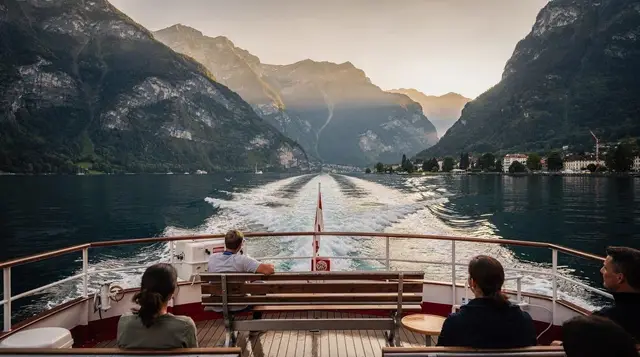
If cloud sits low or the funicular is closed for wind: don’t force it. A summit view in mist is a wasted fare. Head instead to the Interlaken West pier for a cruise on Lake Thun, or Interlaken Ost for Lake Brienz; both run frequent departures and both work in overcast weather since the interest is at water level, not up in the cloud. The Lake Thun boat trips guide and Lake Brienz boat trips guide cover timetables and which stops are worth getting off at; if you can’t decide between the two lakes, the two-lakes cruise guide explains the combined option.
Either choice takes two to three hours door to door, including travel, the activity itself, and getting back to town for lunch.
| Option | Time needed | Works best when | Cost (approx.) |
|---|---|---|---|
| Harder Kulm funicular | 2–2.5 hours return | Clear sky, low wind | CHF 38 return (adult, no pass) |
| Lake Thun cruise (short loop) | 2–3 hours | Overcast, still want scenery | From CHF 30 depending on stops |
| Lake Brienz cruise | 2–3 hours | Overcast, prefer the turquoise water | From CHF 30 depending on stops |
Prices swing with distance travelled and whether you hold a Swiss Travel Pass, Half Fare Card or the Interlaken guest card, all of which discount or cover these routes; check current fares before you go rather than trusting last year’s numbers.
For travellers who’d rather cover ground on two wheels than on foot or water, an e-bike route reaches several of the same viewpoints and villages in a single loop.
a guided e-bike tour through the lakes and villages around InterlakenLunch, then the Aare in the afternoon
Come back down to Interlaken Ost or West by early afternoon and eat before doing anything else; restaurants around the Höheweg get slow between 12.30pm and 1.30pm. The Interlaken restaurant guide and, if the morning’s activity already cost more than expected, eating cheap in Interlaken both cover realistic options rather than the tourist-menu places directly on the Höheweg.
The afternoon belongs to the Aare. The stretch of river between the two stations, past the Höhematte and the Marienschlucht side, is flat, shaded in places, and the water itself is the attraction: glacial silt gives it a turquoise-to-jade colour that photographs better than it sounds. Walk it slowly rather than treating it as a route between two points.
If you want a longer version of the same walk, it extends towards Bönigen at the Lake Brienz end; the easy flat walks around Interlaken guide has the full set of options at this pace. Travellers with more energy left in the day sometimes extend towards the Aare Gorge and Reichenbach Falls near Meiringen, though that is realistically a separate half-day rather than an add-on to this one.
If the outdoor sports Interlaken is known for interest you more than another walk, this is also the time slot they usually fill, either as a half-day booking or as tomorrow’s plan if you’re staying a second night.
a half-day trip out to the waterfalls and valleys around InterlakenParagliding over the Höhematte, canyoning, and rafting are all based here and covered in more depth for anyone extending beyond a single day; see paragliding in Interlaken if the flights you watched at breakfast have you curious.
Pacing the day so it never feels like a checklist
The temptation on a single day is to treat every stop as something to complete. Resist it. The three anchors of this plan, the meadow in the morning, the high point or the water in the middle, and the river in the afternoon, each work because they leave slack around them. If the coffee in Unterseen runs long, let it; if the view from the top is better than expected, stay another quarter of an hour. The only fixed points are the return times of the funicular or the boat, so check those before you commit to the next stop, not after.
Keep a short list of fallback ideas for the gaps. A quiet half hour can go to the Touristik Museum and Interlaken history if a shower arrives, and the Interlaken in bad weather guide has more options for days when the cloud refuses to lift. Anyone on a tight budget will find that most of what this itinerary asks for costs nothing: the meadow, the river path and the old streets are free, which the free things to do in Interlaken guide lays out in full.
Getting around without friction
Everything in this plan is close enough that you rarely need more than your feet, the funicular and the boat. The two stations, Interlaken West and Interlaken Ost, sit at either end of the town, and the walk between them is part of the day rather than a chore. For the occasional longer hop, trains, buses and boats around Interlaken explains how the local network fits together, and the Swiss Travel Pass guide helps you work out whether a pass changes the arithmetic of the day.
If you arrive by train with bags, deal with them first. The luggage and lockers guide covers where to leave them, so you can walk onto the Höhematte unburdened rather than dragging a case across the grass. Travellers coming from the airports can plan the transfer with the Zurich airport or Geneva airport guides, then slot this day in once they are settled.
Who this day suits, and who it doesn’t
This order suits first-time visitors who want a real feel for the place without a punishing schedule. Families can follow it almost unchanged, since the meadow, the boat and the river path all work with children; the Interlaken with kids guide adds ideas for keeping younger travellers engaged. Solo travellers will find the walk and the cruise easy to enjoy at their own speed, as the solo travel in Interlaken guide describes.
It suits less well anyone whose main goal is a high-altitude summit or an adrenaline activity. If that is you, treat this plan as the gentle second day of a longer stay and look at the Interlaken one-day itinerary or the two-day version to see how the pieces stack up over more time. Those who only have an evening and a morning should keep the Höhematte and the river and drop everything else, which is a better trade than rushing all of it.
What to give up, and why that’s fine
The single biggest mistake in a one-day Interlaken plan is trying to also fit in a mountain excursion that needs a day of its own. Two in particular get added on far too often:
- The Jungfraujoch. The round trip from Interlaken Ost, via either Lauterbrunnen and Kleine Scheidegg or Grindelwald and the Eiger Express, takes most of a full day on its own once you count the connections and time at altitude. Bolting it onto a Höhematte-and-Harder-Kulm morning means arriving late, leaving early, and seeing the glacier through someone else’s shoulder. The Jungfraujoch guide lays out why it needs its own dedicated day.
- The Schilthorn and Lauterbrunnen. Equally worth doing, equally not compatible with the rest of this itinerary. Lauterbrunnen’s waterfalls and the Schilthorn’s cable car both involve enough travel time from Interlaken that adding either turns an achievable day into a rushed one where you’re checking your watch on the Aare instead of enjoying it.
If you’re weighing which of these deserves the extra day, how many days in Interlaken and day trips from Interlaken both help decide where to spend it. A one-day visit that skips a summit and does the town properly beats a one-day visit that rushes both and enjoys neither.
An evening option, if you’re staying the night
Assuming you’re not catching a train out immediately, the Höheweg and the streets around it have a modest but real shopping and evening scene, covered in the Interlaken shopping guide; it’s also worth knowing which souvenir shops sell overpriced Swiss Army knives at tourist markup versus the genuine article, a point the tourist traps guide addresses directly. If you’re deciding where to base yourself for a second day added onto this one, where to stay in Interlaken covers the Höheweg hotels against quieter options in Unterseen and Matten.
For a wider view over the water rather than another walk, the guided lakes-and-ruins e-bike route covers ground a walking day can’t reach, useful if you’re staying a second day and want a different pace.
an e-bike route past the lakes, ruins and viewpoints around InterlakenInterlaken in one day, frequently asked
Can you really see Interlaken in one day?
You can see the town itself comfortably in a day: the Höhematte, the old streets of Unterseen, the Aare, and either Harder Kulm or a boat trip. What you cannot do in a day is add a high-altitude excursion like the Jungfraujoch or Schilthorn on top of it without an exhausting 5am start and a late return.
Should I go to Harder Kulm or take a boat if I only have one day?
Choose whichever the weather rewards. Harder Kulm needs clear air to be worth the return fare, since the view is the entire point; on a hazy or overcast morning a lake cruise on Lake Thun or Lake Brienz still delivers scenery from water level regardless of cloud base.
What time does the Harder Kulm funicular stop running?
Last descent varies by season, typically around 9.30pm to 10.30pm in summer and considerably earlier in shoulder season, with a spring and autumn closure for maintenance. Check the current timetable at the valley station before you go up, since missing the last car means a long walk down.
Is one day in Interlaken enough to also do the Jungfraujoch?
Not comfortably. The round trip to the Jungfraujoch from Interlaken Ost takes most of a day on its own, including the train changes at Grindelwald or Lauterbrunnen and Kleine Scheidegg, so pairing it with the Höhematte, a summit, and the Aare in the same 24 hours means seeing all of it badly.
Where is the best walk along the Aare in Interlaken?
The stretch between Interlaken West and Interlaken Ost, running past the Höhematte and the Marienschlucht side, gives the easiest flat walking with the clearest water. For something longer with the same turquoise colour, the path continues out towards Bönigen at the Lake Brienz end.
Do I need a car for a one-day Interlaken itinerary?
No. Everything in a single-day plan sits within Interlaken, Unterseen and Matten, all walkable or a short funicular or boat ride apart. A car adds parking costs and no time saved for this particular day.
What should I skip if I only have one day?
Drop Lauterbrunnen and its waterfalls, or drop the Schilthorn and Piz Gloria. Both are excellent but both are half-day trips in their own right by the time you add travel time, and trying to bolt one onto a Höhematte-Harder Kulm-Aare day usually means rushing the Aare walk to catch a train.
Lake cruises & boat tours on GetYourGuide
Verified deep-linked GetYourGuide tours. Book through these links and we earn a small commission at no cost to you.
GetYourGuide does not provide a product photo for this activity — the image shows the meeting point, photographed by us.