Aare Gorge and Reichenbach Falls: the walk, both entrances, and the funicular
How long does the Aare Gorge walk actually take?
Walking the full 1,400m of boardwalks and tunnels one-way through the Aareschlucht takes 45–60 minutes at an unhurried pace with stops for photos. Budget 1.5–2 hours if you go end to end and back, and add another hour if you continue to Reichenbach Falls.
What the Aare Gorge actually is
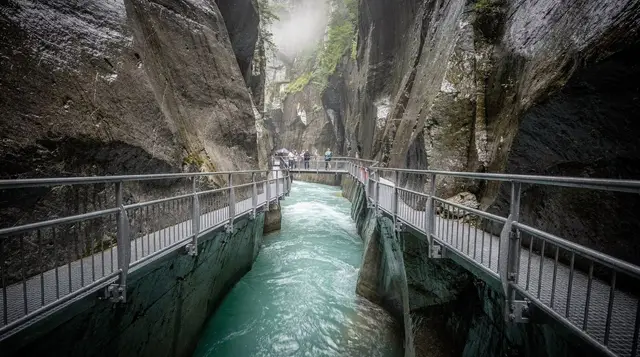
The Aareschlucht is a limestone gorge cut by the Aare river between Meiringen and Innertkirchen, at its narrowest barely a few metres wide with rock walls rising 50–200m overhead. A continuous run of boardwalks, galleries and short tunnels — 1,400m in total — has been built along and into the rock since the 1880s, so you can walk the length of it without touching the riverbed.
It is not a hike in the usual sense: there is almost no elevation gain, the surface is decked throughout, and the whole point is proximity to the water rather than a view from above. That makes it one of the easier and more reliable outings from Interlaken when the high mountain railways are shut in for their spring or autumn maintenance windows, since the gorge sits at valley level and does not depend on a lift.
The gorge has two entrances at opposite ends, and which one you use changes the logic of the whole day.
The two entrances compared
| Aareschlucht West | Aareschlucht Ost | |
|---|---|---|
| Location | Alpbach, a short walk from Meiringen | Near Innertkirchen, on the Grimsel/Susten road |
| Best for | Arriving by train via Meiringen | Arriving by car from the Grimsel Pass or Susten Pass |
| Onward walk | 15–20 min into Meiringen and Reichenbach Falls | Longer return to Meiringen; less convenient without a car |
| Parking | Limited, roadside near the entrance | Larger car park at the entrance |
Most people coming from Interlaken use the west entrance, because it lines up with the train to Meiringen and with the Reichenbach Falls funicular afterwards. The east entrance at Innertkirchen makes more sense if you are already driving the Grimsel or Susten passes and want to break the journey, or if you are doing the Rosenlaui valley by bike and looping back through the gorge on the way home — see the Rosenlaui e-bike route for that variant.
There is no shuttle bus between the two entrances. If you walk through from one side to the other, the road distance back round is roughly 4km, so plan for a taxi, a bus, or simply doubling back through the gorge the way you came, which is what most visitors do.
Getting there from Interlaken
Trains run from Interlaken Ost on the Brünig line towards Meiringen and on to Lucerne; the journey to Meiringen takes around 20–25 minutes, with departures roughly hourly and sometimes twice hourly in high season. From Meiringen station it is a 20–25 minute walk to the west entrance of the gorge, or a short local bus ride in season. If you are combining this with Lucerne as a day trip, Meiringen sits on the same line, so the gorge and the falls can be slotted in on the way through rather than as a separate outing.
a half-day trip out from Interlaken that takes in the wild valleys and waterfalls around Meiringen if you would rather not work out train and bus timings yourself, particularly useful on a day when you also want to see the Rosenlaui side of the valley.
How long it actually takes
Walking the full 1,400m one-way, stopping for photographs at the narrower sections and the two or three spots where the water is visible directly beneath the decking, takes 45–60 minutes. Most visitors walk in, then walk back the same way, which makes it 1.5–2 hours in the gorge itself. Add a coffee stop at either entrance kiosk and it becomes a comfortable half-morning. This is markedly shorter than the time people often budget for it, because photographs of the gorge suggest something more strenuous than it is — there are no steps to speak of and the gradient is flat.
If you plan to continue to Reichenbach Falls afterwards, add:
- 15–20 minutes walking from the west entrance into central Meiringen
- 10–15 minutes on to the funicular’s valley station
- 7 minutes on the funicular itself
- 20–30 minutes at the top platform and surrounding paths
That makes the gorge-plus-falls combination a realistic 3–3.5 hour outing door to door from the west entrance, not counting travel to and from Interlaken.
Reichenbach Falls and the 1899 funicular
The Reichenbachfall-Bahn opened in 1899 and is one of the older funiculars still running in Switzerland, climbing a short but steep line to a platform in front of the upper Reichenbach Falls. The ride takes about seven minutes and the falls themselves — a series of drops totalling roughly 250m — are genuinely loud and cold with spray at close range, a different kind of impressive from the enclosed intimacy of the Aareschlucht. The funicular runs seasonally, broadly May to October depending on the year and on maintenance schedules; it is not a winter operation.
This is the location, fictionally, where Arthur Conan Doyle had Sherlock Holmes and Professor Moriarty fall to their supposed deaths in “The Final Problem”, published in 1893 — six years before the funicular itself existed. A memorial plaque near the platform marks the spot, and Meiringen has built a small tourism identity around the connection, including a Sherlock Holmes museum in the town. For the full story rather than the short version here, see the dedicated Sherlock Holmes in Meiringen guide.
a combined day tour from Lucerne or Zurich that covers both the falls and the gorge is worth considering if you are based further afield and want the pairing without arranging your own trains.
What it costs
Expect to pay an entrance fee at whichever Aareschlucht gate you use, generally in the region of CHF 8–10 for an adult and roughly half that for children, with a small family reduction; the exact figure is set by the operator and revised most years, so treat this as a planning range rather than a fixed price. The Reichenbach Falls funicular charges separately, with a return fare typically in the range of CHF 15–20 for an adult.
Neither is covered by the Swiss Travel Pass, though holders sometimes get a modest discount — check current terms at the gate rather than assuming. Combined, the gorge plus falls plus the return train from Interlaken realistically runs to CHF 60–80 per adult for the day once travel is included, which is worth weighing against a half-day guided tour if the saving in planning time matters more to you than the saving in francs.
Meiringen itself
Meiringen is a working valley town rather than a resort, with a permanent population, an airbase nearby, and a high street that serves locals as much as visitors. It sits at the junction of the routes to the Grimsel and Susten passes and to the Brünig line towards Lucerne, which makes it a natural hinge point rather than a destination in its own right.
If bad weather closes in on the higher mountains, Meiringen and its gorge are a reliable fallback — see what to do in Interlaken when it rains for other low-level options on the same logic. For lunch, the town has straightforward Swiss cafés rather than destination restaurants; if you want a proper meal with a view, save it for Interlaken’s restaurant scene on the way back.
When to go and what to avoid
The gorge is at its most dramatic with high water in late spring, when snowmelt fills the Aare, though spray levels also rise correspondingly and the boardwalks can feel damper underfoot. Late summer and early autumn bring lower water and a calmer, quieter visit. Avoid the immediate aftermath of heavy rain in the surrounding mountains, since operators will close sections without notice if water levels spike — check the operator’s own status page on the day if you have travelled specifically for this.
Outside the roughly April-to-October operating season, both the gorge and the funicular are shut, and there is no substitute walk along the same route, so this is one to check against the wider pattern of when mountain railways and seasonal attractions open and close before building a winter itinerary around it.
Combining it with the rest of the valley
The Aareschlucht and Reichenbach Falls sit at the eastern end of a valley that also holds Rosenlaui, the Grimsel and Susten passes, and the Brünig line towards Lucerne, so it rewards being built into a bigger day rather than visited in isolation.
- an e-bike day out into the Rosenlaui valley above Meiringen, which passes close to the gorge’s east entrance and suits anyone who wants more distance covered than the gorge walk alone provides.
- a day trip from Zurich that links the Aare Gorge with Grindelwald and the lakes, useful if you are staying near Zurich rather than in Interlaken itself.
- For a lower-effort waterfall alternative closer to Interlaken, see the Giessbach Falls and shore path on Lake Brienz, which can be reached by the historic funicular there and paired with a boat crossing — see the Lake Brienz boat trips guide for timetables.
- Hikers who prefer proper elevation gain rather than a level boardwalk should look instead at the best day hikes from Interlaken or, for something gentler than a mountain trail but longer than the gorge, the easy flat walks around Interlaken.
- If you are staying multiple days and want the gorge folded into a longer plan, the six-day Interlaken hiking itinerary uses Meiringen as one of its lower-effort days between bigger mountain outings.
- For the wider context of day trips out of Interlaken, including how this one compares against Lucerne, Bern or Zermatt in terms of time and cost, see day trips from Interlaken.
Practical notes before you go
- The gorge closes for the season roughly late October to early April; the funicular follows a similar seasonal pattern. Confirm current dates directly with the operator before travelling outside June–September.
- Wear shoes with grip. The decking is treated but stays damp with spray, and some sections have low headroom in the tunnel portions.
- The walkways are not stroller-friendly on the narrower boardwalk stretches; a baby carrier works better than a pushchair.
- Neither the gorge entry nor the funicular fare is bundled into the Swiss Travel Pass — budget for both separately and check for any partner discount at the ticket window.
- If arriving by train, check the Brünig line timetable connections in advance, since services are typically hourly rather than continuous.
FAQ: the Aare Gorge and Reichenbach Falls
Which entrance to the Aare Gorge should I use, west or east?
The west entrance (Aareschlucht West, at Alpbach near Meiringen) is the one most visitors use and the one served by bus and on foot from Meiringen station. The east entrance (Aareschlucht Ost, near Innertkirchen) sits at the other end of the gorge and is more useful if you are arriving by car from the Grimsel or Susten direction, or if you want to walk through and finish in Meiringen rather than double back.
Can you walk through the Aare Gorge in one direction and out a different way?
Yes. Buy a ticket at either entrance and it covers the full length; most people walk in from one end and back out the same way, but you can walk through to the opposite entrance if you have arranged transport at both ends, since there is no shuttle between them and the road distance is around 4km.
Is the Aare Gorge open all year?
No. It closes over winter, typically from around late October to early April, because meltwater and ice make the walkways unsafe and the operator uses the closed season for maintenance. Check the current dates before travelling outside summer.
How do you get from the Aare Gorge to Reichenbach Falls?
From the west entrance of the Aareschlucht it is a level walk of 15–20 minutes into Meiringen, then a further 10–15 minutes on foot to the valley station of the Reichenbachfall-Bahn funicular, which climbs to a viewing platform in front of the falls in about seven minutes.
Is the Reichenbach Falls funicular the same one from the Sherlock Holmes stories?
The funicular itself opened in 1899, a few years after Arthur Conan Doyle sent Holmes and Moriarty over the Reichenbach Falls in “The Final Problem” (1893), so it was not there for the fictional event. It is, however, the genuine historic line still used today to reach the platform above the same falls, and a Holmes memorial plaque marks the spot.
Is the Aare Gorge suitable for children or people who dislike heights?
Children generally manage it well since the walkways have solid railings throughout, though pushchairs cannot be used on the narrower boardwalk and tunnel sections. Anyone genuinely uneasy with heights or enclosed spaces should know that some stretches are cut into rock overhangs with the river visible directly below through gaps in the decking.
What should I wear or bring to the Aare Gorge?
Solid, non-slip footwear, since the boardwalks stay damp with spray even in dry weather, plus a light layer, since the gorge is noticeably cooler than Meiringen in summer. A cash or card float for the entrance fee and a torch are not needed; the tunnel sections are lit.
Hiking & nature tours on GetYourGuide
Verified deep-linked GetYourGuide tours. Book through these links and we earn a small commission at no cost to you.
GetYourGuide does not provide a product photo for this activity — the image shows the meeting point, photographed by us.