Cycling and e-bike routes around Interlaken
What's the best cycling route around Interlaken?
The signposted loop around Lake Thun and Lake Brienz is the classic ride from Interlaken, roughly 60 km if you do both shores, or 25-30 km if you pick one lake. E-bike rental runs about CHF 45-65 for a full day from shops in Interlaken, Bönigen and Iseltwald, and SBB trains carry bicycles in marked carriages for a supplementary ticket.
Why Interlaken is easy cycling country
The Bodeli, the flat strip of land between Lake Thun and Lake Brienz where Interlaken, Unterseen and Matten sit, is about as flat as Swiss geography gets. Both lakeshores have paved or well-packed gravel paths, road signs for cyclists are consistent, and the distances between towns are short enough to do without an e-bike if you’re reasonably fit. The mountains are the draw for most visitors, but the valley floor itself is a genuinely good place to cycle, and it’s underused compared with the trains and boats.
That said, this isn’t the Netherlands. Paths narrow to shared lanes with cars in places, gravel sections near Iseltwald can be uneven after rain, and the wind funnelling down from the mountains picks up by early afternoon most summer days. None of that rules cycling out; it just means the easy, flat reputation needs a few caveats before you commit a whole day to it.
The two-lake loop: the classic ride
The route most rental shops will point you to runs from Interlaken along the north shore of Lake Brienz to Bönigen, Ringgenberg and on to Brienz, then either loops back the same way or continues to Iseltwald and the Giessbach falls on the south shore before returning to Interlaken. Doing the Brienz side alone is about 25-30 km round trip and manageable on a standard bike in half a day. Adding Lake Thun’s shore towards Spiez roughly doubles that, which is why most people treat it as an e-bike day rather than a regular-bike one.
| Segment | Distance (one way) | Surface | Suits |
|---|---|---|---|
| Interlaken to Bönigen | 3 km | Paved lane | Any bike, families |
| Bönigen to Iseltwald | 9 km | Mixed paved and gravel | E-bike or fit cyclists |
| Interlaken to Ringgenberg (north shore) | 6 km | Paved | Any bike |
| Interlaken to Spiez (Lake Thun south shore) | 18 km | Paved, some rolling hills | E-bike recommended |
| Full two-lake loop | 55-65 km | Mixed | E-bike, full day |
Those distances are for the shore roads, not the Alpine climbs. Nobody is expected to cycle up to the Schilthorn or the Jungfraujoch; those routes belong to trains and cable cars, and the roads that do exist up there are steep, narrow and largely closed to casual cyclists anyway.
National cycling routes through the Bodeli
Switzerland’s national cycling network runs a signposted route, Route 8, the Aare Route, along the river between Lake Brienz and Lake Thun, right through the middle of Interlaken. It’s marked with the standard red-and-white SwitzerlandMobility signs at junctions, so you can join it at any point in town without needing a dedicated map, and it connects onward towards Thun and eventually Bern if you wanted to keep going. For most visitors it’s less a route to complete than a reliable backbone: if you’re ever unsure which lane to take out of town, following the Route 8 signs towards the lake you want is a safe default.
Renting an e-bike: shops, prices and what you get
Rental shops cluster around Interlaken Ost and Interlaken West stations and along the Höheweg, with smaller outposts in Bönigen and Iseltwald in peak season. Pricing is fairly consistent across operators.
| Bike type | Half day | Full day | Notes |
|---|---|---|---|
| Standard bike | CHF 18-25 | CHF 25-35 | Helmet usually included |
| E-bike (city/trekking) | CHF 30-40 | CHF 45-65 | Battery range 50-80 km |
| E-mountain bike | CHF 40-55 | CHF 60-80 | For gravel and unpaved sections |
| Child seat / trailer | CHF 8-15 | CHF 10-20 | Book ahead in summer |
These are typical ranges, not fixed prices, and they shift a little from one shop and one season to the next, so it’s worth confirming the current rate when you book rather than assuming last year’s figure holds. A deposit, usually by credit card hold, is standard, and you’ll want ID. Most shops don’t take reservations for walk-up single-day rentals in shoulder season, but in July and August, especially for e-bikes, calling or booking online the day before avoids arriving to an empty rack.
If you’d rather not plan your own route, a guided option removes the guesswork: a guided e-bike outing that covers Lake Thun’s ruins and viewpoints in one loop bundles the bike, a set route and some local commentary into a single half-day booking. For the Lake Brienz side, a guided e-bike route out to Iseltwald and the Giessbach falls covers the prettiest and least obvious stretch of shore path without you having to work out the gravel sections alone.
Taking your bike on Swiss trains
If you want to cycle one way and take the train back, or start your ride somewhere other than Interlaken, SBB carries bicycles in marked carriages, but you need a separate bicycle ticket in addition to your own fare. This applies to e-bikes too; there’s no exemption for electric models except folding e-bikes small enough to fit in a bag, which travel as ordinary luggage.
Bike space is limited and not reservable on regional trains, so on the Interlaken-Lucerne line via the Brünig or on busy Saturday trains in summer, it pays to check the marked carriage position on the platform display and be ready to board early. If you’re relying on a Swiss Travel Pass for your own travel, note that the pass itself doesn’t cover the bicycle supplement, which is a separate ticket bought at the same time.
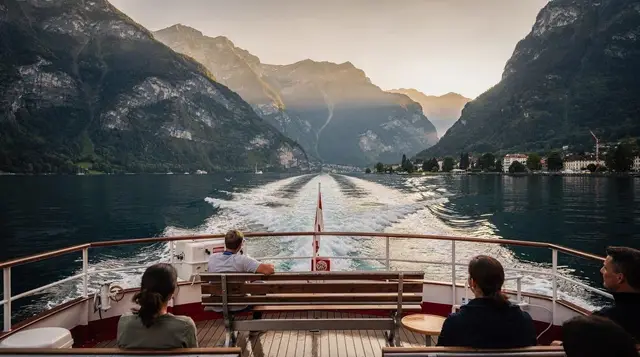
Boats are the other option: BLS’s Lake Thun and Lake Brienz ferries generally accept bicycles for a small supplement, space allowing, which is a pleasant way to cut a return leg short if the wind has turned against you or the legs have given out. For a broader view of how trains, buses and boats fit together around the two lakes, see the guide to trains, buses and boats around Interlaken, and for lockers to store panniers or spare gear while you ride, see luggage and lockers.
Route ideas from Interlaken
Interlaken to Bönigen and back. A short, flat 6 km round trip along Lake Brienz’s edge, mostly on a dedicated lane. Good for a first hour after arriving, or with children too young for anything longer.
Interlaken to Iseltwald and Giessbach. The most rewarding shore ride, following the Lake Brienz boat trips guide route by land instead of water. The gravel stretch near Iseltwald slows things down, and the final approach to the Giessbach falls funicular involves a short, steep push. Riding one way and returning by the Lake Brienz boat, which takes bicycles for a supplement, is a popular compromise.
Interlaken to Spiez along Lake Thun. Longer and hillier than the Brienz side, at around 18 km one way, with a couple of short climbs around headlands. Worthwhile for the views back towards the Bernese Alps, but this is where an e-bike earns its rental fee.
Full two-lake loop. Combining both shores in one long day, roughly 55-65 km depending on the exact route taken. Realistic only with an e-bike and a reasonably early start; on a standard bike it’s a two-day trip for most people, or a one-lake choice.
If you’d rather have someone else handle logistics and route-finding on the harder Lake Thun side, an e-bike day tour that starts in Lucerne and finishes in Interlaken effectively turns the transfer between the two towns into the ride itself, which is a reasonable way to combine a day trip from Lucerne with cycling rather than doing both separately.
Practical tips: surfaces, gradients and weather
The valley floor is flat, but wind is the real variable. Afternoons in the Bernese Oberland regularly bring a headwind funnelling up from Lake Thun towards the mountains, so riding the harder, more exposed Thun-side leg in the morning and saving the sheltered Brienz side for later in the day is a small trick that makes a real difference.
Gravel sections, mainly on the Iseltwald stretch, turn greasy after rain, and standard road tyres struggle there; e-mountain bikes or trekking bikes with wider tyres cope better. Bring a light rain layer regardless of the forecast, since weather here changes faster than it does at lake level in most other places, a pattern covered in more detail in the guide to Interlaken in bad weather.
None of the shore routes described here require technical mountain-biking skill, and this guide deliberately stays off the steep Alpine roads and forest tracks that belong to hiking and to the region’s more serious mountain-bike trail network. If you’re looking for the harder gradients and gravel of the high valleys instead of the lakeside, that’s a different, more specialised trip than the one covered here.
For a broader sense of what else counts as adventure sports around Interlaken, or to fold cycling into a longer stay, the two-day Interlaken itinerary has room for a half-day ride alongside the town’s other activities. Cyclists heading in from outside the region typically arrive via the airport guides, such as getting to Interlaken from Zurich airport, before picking up a bike locally rather than bringing one from home.
One last stop worth building a ride around, rather than driving to, is Ballenberg, the open-air museum east of Brienz. It’s a longer outing by bike than the shore loops above, best combined with the train for one leg, but it turns a museum visit into a full day out on two wheels instead of a bus transfer there and back.
Questions about cycling and e-bikes near Interlaken
How much does it cost to rent an e-bike in Interlaken?
Expect roughly CHF 45-65 for a full day and CHF 30-40 for a half day, depending on the shop and the battery range of the model. A standard, non-electric bike is cheaper, typically CHF 25-35 for a full day. Helmets are usually included; a second battery or a child seat costs extra.
Can I cycle around both Lake Thun and Lake Brienz in one day?
On an e-bike, yes, though it makes for a full day of around 60 km with stops. On a standard bike most visitors find one lake plenty, since the return legs along both shores add up with photo stops, ferry connections and lunch.
Do I need to book train tickets for my bicycle in advance?
You don’t need to book ahead, but you do need a separate bicycle ticket alongside your own ticket, and space in the marked bike carriage is first-come, first-served. On busy summer weekends and during school holidays, arrive early or pick a quieter departure, since carriages fill fast.
Is the Lake Brienz cycle path suitable for children?
The stretch between Interlaken and Bönigen is flat, mostly on quiet lanes, and works well for children on their own bikes. Beyond Bönigen towards Iseltwald the path narrows and climbs in short sections, which suits e-bikes or confident young riders better than very young children.
Which national cycling route passes through Interlaken?
National Route 8, the Aare Route, follows the river between the two lakes and runs directly through the Bodeli. It’s signposted with the standard red-and-white SwitzerlandMobility markers, so you can join or leave it at any point without a separate map.
Are e-bikes allowed on Swiss trains without a bike ticket?
No. E-bikes take up the same rack space as a standard bicycle and need the same supplementary bicycle ticket. Folding e-bikes stored in a bag are the exception and travel free like ordinary luggage, but few rental shops offer folding models.
Where can I return a rental e-bike if I don’t want to cycle back?
Some Interlaken rental shops allow one-way hire with a return at a partner location in Brienz, Thun or Spiez for an extra fee, but this has to be arranged when you book, not on the road. Without that arrangement, plan a route that loops back to your starting shop, or use the train with a bicycle ticket to bring the bike back.
Lake cruises & boat tours on GetYourGuide
Verified deep-linked GetYourGuide tours. Book through these links and we earn a small commission at no cost to you.
GetYourGuide does not provide a product photo for this activity — the image shows the meeting point, photographed by us.