Interlaken in two days: town, lakes and one day up high
Two days is the minimum for Interlaken to feel worthwhile rather than rushed, and it forces a choice most visitors don’t think about until they’re standing at Interlaken Ost checking a weather app: which day gets the high mountain, and which gets the town and the lakes. Get that order wrong and you can spend CHF 220 riding a train into a white-out. This plan treats the two days as swappable, tells you what to watch for the night before, and gives you a fallback if neither day cooperates.
Day 1: Interlaken, the lakes and Harder Kulm
Start on the Höheweg, the avenue that runs between Interlaken’s two stations and past the Hohematte, the 14-hectare protected meadow where paragliders land all day in good weather. It’s free to watch, and worth ten minutes even if you’re not the one jumping. The town itself is walkable in under an hour end to end, so don’t over-plan the morning — wander Interlaken itself, check out the Hoheweg’s grand hotels, and get a coffee before deciding which lake to prioritise.
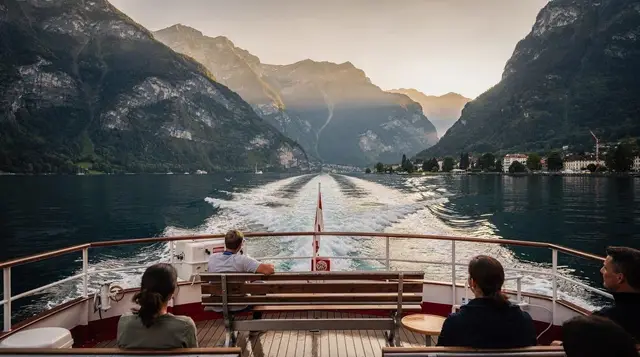
You have two lakes and, realistically, time for a proper visit to one of them plus a look at the other from the shore. Lake Thun is the more developed side, with boat stops at Spiez, Oberhofen and Thun itself, castles visible from the water. Lake Brienz is the more strikingly turquoise of the two — glacial flour suspended in the water does that — with Iseltwald and Giessbach Falls as the standout stops. If you only have a half-day, a single loop on either lake by paddle steamer covers the essentials; the two-lake cruise guide breaks down which combined boat-and-rail loop fits into an afternoon without doubling back on yourself.
In the afternoon, take the funicular up to Harder Kulm from the base near Interlaken Ost — it’s an 8-minute ride and one of the few viewpoints here you can fit in without dedicating a whole day to it. At 1,322 m you get the classic view down the Bödeli, the strip of land between the two lakes where Interlaken, Unterseen and Matten sit, with the higher peaks — Eiger, Mönch, Jungfrau — lined up behind on a clear evening.
It’s also, notably, one of the few viewpoints that can still deliver on a partly overcast day, since low cloud often sits below 1,300 m even when it blankets the higher summits. Full details, opening dates and the funicular timetable are in the Harder Kulm guide; the destination page for Harder Kulm covers the walking descent option if you’d rather come down on foot than ride back.
If you’d rather cover more ground than a walking pace allows, an e-bike tour around Interlaken’s lakes and ruins gets you to viewpoints and both shorelines in one afternoon, which is useful if the weather forecast for Day 2 looks uncertain and you want to bank the town-and-lakes day properly rather than split it.
End the day back on the Höheweg or in Unterseen’s old town for dinner — it’s quieter than the main tourist strip and a five-minute walk from Interlaken West.
Day 2: Jungfraujoch, Europe’s highest railway station
This is the big-ticket day. At 3,454 m, the Jungfraujoch is the highest railway station in Europe, reached by a line opened in 1912 that tunnels through the Eiger itself. From Interlaken Ost you have two route options: via Lauterbrunnen and the rack railway up to Kleine Scheidegg, or via Grindelwald and the Eiger Express cable car to the Eigergletscher station, which opened in December 2020 and cuts around 30 minutes off the Grindelwald route. Either way, the final stretch from Kleine Scheidegg to the Jungfraujoch runs through tunnel, so the views come at the top, not on the way up.
The Jungfraujoch guide and the Jungfrau Railway guide cover both routes in detail, including where the Ice Palace and Sphinx observation terrace sit once you arrive; the Eiger Express writeup is worth reading if you’re routing via Grindelwald rather than Kleine Scheidegg.
Budget the whole day for this — round trip travel time alone is around 4–5 hours, and you’ll want at least 2–3 hours at the top to see the Ice Palace, the Sphinx terrace and, conditions permitting, step onto the snow.
| Ticket type | Approx. adult return from Interlaken | Notes |
|---|---|---|
| Standard return | CHF 220–230 | Full-price, any train |
| Good Morning ticket | CHF 180–190 | First departures only, book ahead |
| With Half Fare Card / Swiss Travel Pass | 25% off standard fare | Discount, not free |
Prices move year to year, so treat these as a planning range rather than a quote — check the current fare before you book. In July, August and the Christmas–New Year period, book at least a day ahead; Jungfrau Railways caps how many people go up, and same-day tickets can sell out by mid-morning.
For a straightforward first visit, a day trip from Interlaken to the Jungfraujoch handles the connections for you. If you’d rather go with a smaller group and a guide who can point out what you’re looking at from the Sphinx terrace, a small-group tour from Interlaken covers the same route with more context along the way.
Pacing the two days
The easiest mistake on a short stay is to pack every hour. Day 1 works best when it has slack in it: a long coffee on the Höheweg, a boat you can miss without consequence, a viewpoint you reach with light still in the sky. Day 2 is the opposite, a single objective with a fixed timetable, so it pays to go to bed early the night before and keep the evening before it free of anything ambitious.
If you want to know how the town fits around the mountains, the one-day itinerary shows a compressed version of Day 1, and the guide to Interlaken in one day gives the reasoning behind each stop. Both are useful if you decide to move the lakes to the morning and add something else to the afternoon.
Pack for the mountain day even if the morning in town is warm. The altitude, weather and what to pack guide explains why the summit can feel like a different season from the valley, and it is the quickest way to avoid carrying the wrong layers. Leave the bulk of your luggage behind too; the luggage and lockers page covers what is possible at the stations if you are arriving or leaving on the same day.
Small things that make the plan work
Eat before you climb. On the mountain day, a proper breakfast in town makes the early departure easier, and a packed snack means you are not forced into the first restaurant you see at the top. For lunch and dinner on Day 1, Interlaken restaurant guide and the page on eating cheap in Interlaken help you choose between a sit-down meal and something lighter.
Keep your tickets and timetable simple. Both days rely on trains, funiculars and boats, so a single look at the trains, buses and boats guide before you arrive saves a lot of guessing at the station. If you plan to walk down from Harder Kulm, tell yourself in advance that the funicular is the fallback, not a failure.
Treat the evenings as part of the trip. After a day on the lakes, there is no need to rush. A walk along the river in Unterseen, a drink with a view, or an early night all suit this itinerary. The bars with a view guide is there for the evening you want something a little more special without leaving town.
Which day should be the summit day?
Don’t fix this in advance. Check the Jungfrau Railways webcam page and the mountain forecast — not the Interlaken valley forecast, which can read blue sky while the summit sits in cloud — the evening before each day. If Day 1 looks clearer than Day 2, swap: do Jungfraujoch first and save the lakes and Harder Kulm, which don’t depend on visibility, for whichever day is greyer. Harder Kulm in particular is forgiving of marginal weather since it’s low enough to sit under the cloud base more often than not; Jungfraujoch at 3,454 m has no such margin — above the treeline, cloud is cloud, and there’s no partial view to salvage.
The guide to when mountain railways open and close also matters here: lines close for scheduled maintenance in spring and autumn, and some cable cars close in high wind regardless of season, so confirm the line is actually running before you commit a day to it. If you’re travelling in the shoulder season, the best time to visit guide has month-by-month notes on which weeks tend to have the most stable high-mountain weather.
If both days are cloudy
This happens more than the postcards suggest, particularly outside July and August. Two options, and neither involves paying for a summit you won’t see:
Keep Harder Kulm, drop Jungfraujoch. As above, Harder Kulm’s lower altitude means it clears more often than the high peaks. It won’t give you the glacier views, but it’s a functioning consolation prize rather than a wasted train fare.
Reroute to town and indoor options, and try the summit on a future trip or extend a day. The rainy-day guide and the Interlaken viewpoints guide both cover what’s worth doing when the peaks are out of the question — museums, spa afternoons, the town itself. If you have any flexibility at all, this is also where an Interlaken three-day itinerary earns its keep: a third day gives you a genuine second shot at the Jungfraujoch instead of gambling the only mountain day you have.
One more option if a clear summit view matters enough to you: an overnight stay at 3,600 m on the Jungfraujoch puts you above the valley cloud layer for sunset and sunrise, which sidesteps the single-day gamble entirely — at a materially higher cost, and only worth it if you’re committed to seeing it properly rather than ticking it off.
Practical planning
Getting around. Everything in this itinerary runs off Interlaken’s two stations, and neither day requires a car — see the Swiss Travel Pass guide for whether a pass pays for itself over two days versus buying tickets individually; for two days with one Jungfraujoch trip, it usually doesn’t, since the pass discount on Jungfraujoch fares is 25%, not free travel.
Where to stay. Base yourself in Interlaken itself rather than a satellite village for a two-day trip — it keeps both stations within walking distance and avoids adding a connection to either day. The where to stay guide breaks down the trade-offs between staying near Interlaken West (closer to the Höheweg and shops) versus Interlaken Ost (closer to the mountain trains and Harder Kulm).
Rough budget per person, mid-range. Two nights’ accommodation aside, expect roughly CHF 60–90 for Day 1 (lake boat fare, Harder Kulm return, lunch and dinner) and CHF 250–280 for Day 2 once the Jungfraujoch ticket, a hot drink at the top and meals are added in. The mountain day is where the budget goes; the town-and-lakes day is comparatively cheap.
If two days turns out too tight once you’re here — a common realisation, since the Bernese Oberland has more worth seeing than most itineraries admit — the Jungfrau region highlights, three days itinerary adds Grindelwald or Lauterbrunnen without restructuring the two days above, and the shorter one-day Interlaken itinerary shows what to cut if you end up with only one day instead of two.
Lake cruises & boat tours on GetYourGuide
Verified deep-linked GetYourGuide tours. Book through these links and we earn a small commission at no cost to you.
GetYourGuide does not provide a product photo for this activity — the image shows the meeting point, photographed by us.