Interlaken in one day
Interlaken rewards an early start more than almost anywhere else in Switzerland, because its single best free view — from Harder Kulm — is also the one most likely to be swallowed by cloud if you leave it until afternoon. This plan puts the mountain first, brings you back down to the flat, walkable centre for the middle of the day, and finishes on the water. It is built to avoid the classic mistake of crossing the Bodeli three or four times over the course of a day, and it includes the version to run instead if the forecast is against you.
Everything here is doable without a car and without booking anything more than a few hours ahead, which matters in a town where the mountain railways and boats set the pace rather than the roads.
Day 1: Harder Kulm, the Höhematte and a lake
Morning: Harder Kulm before the haze builds
Start at Interlaken Ost, a five-to-ten-minute walk from most central hotels, and take the Harder Kulm funicular as close to opening as you can manage — the first or second car of the day if you’re staying nearby. The ride takes eight minutes, climbing 1,167 vertical metres in that short span, and the queue at the base station grows quickly once the tour buses arrive around mid-morning.
At the top, 1,322 m above the valley floor, the payoff is the two-lake panorama: Lake Thun to one side, Lake Brienz to the other, with Interlaken laid out on the strip of land between them and the Jungfrau, Mönch and Eiger filling the skyline beyond. The viewing platform with its steel railings is the postcard shot, but it’s worth the short walk around to the restaurant terrace as well, where the crowd thins. Clear morning air, before any afternoon haze or cloud builds over the peaks, gives the sharpest view of the season — this is the single best reason to do Harder Kulm first, not last.
Budget 60–90 minutes at the top including the walk to the viewpoint and back. There’s a restaurant if you want a coffee, though it’s priced for the view rather than the food. See the full Harder Kulm guide for opening dates, since the line closes for a few weeks of maintenance most springs and autumns, and for a comparison against other in-town viewpoints, the Interlaken viewpoints guide is useful if you have a second day to spare.
If you’d rather not manage the funicular timing yourself, a guided option such as the private day trip that combines Harder Kulm with Grindelwald folds the summit into a longer half-day with a driver, which suits anyone continuing on to the high mountains the same afternoon rather than following the lake plan below.
Midday: the Höhematte and the Aare
Back at valley level by late morning, walk from Interlaken Ost towards the centre along the Höheweg, Interlaken’s grand promenade lined with 19th-century hotels built for the first wave of British and German alpine tourists.
It runs directly alongside the Höhematte, 14 hectares of protected meadow that has stayed undeveloped since the town’s earliest tourism era — partly because it doubles as the landing field for the paragliders you’ll see circling down from the Beatenberg and Schilthorn launch sites most afternoons with good weather. Anyone tempted to try it themselves rather than just watch should look at the paragliding guide for what a tandem flight actually costs and requires.
From the meadow, cut down to the Aare, the glacier-fed river that connects the two lakes and cuts through the middle of town in a channel of startling turquoise-green. The stretch near the Höhematte and the Schadaupark end is calm and shallow enough that locals swim it in summer, letting the current carry them downstream — worth trying if it’s warm enough and you’ve got a dry bag for your things, though the water is genuinely cold even in August since it’s fed by glacial meltwater.
There’s no cost to any of this: walking the Höheweg, sitting in the meadow, and following the riverside paths are free, which the free things to do guide covers in more depth if you want to extend the midday stretch instead of moving straight to a lake.
Lunch options cluster around the Marktplatz and Höheweg; expect to pay CHF 22–35 for a main course at a sit-down restaurant, or half that for a bakery sandwich or a stand selling raclette or bratwurst — reasonable ways to eat well without the full restaurant markup that catches out a lot of first-time visitors to Switzerland.
Afternoon: choose a lake
Pick one lake rather than trying to see both — the boats run at their own schedule and doubling back for a second cruise eats the rest of your day for a diminishing return.
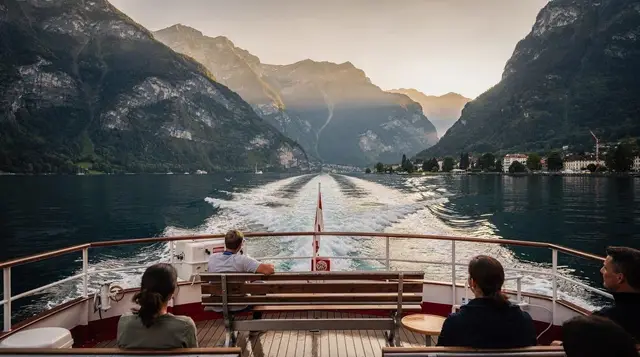
Lake Brienz, reached from Interlaken Ost where you started the day, has the more dramatic colour: a deep, opaque turquoise from suspended glacial silt that photographs better than almost anywhere else in the region. A short cruise out towards Iseltwald or the Giessbach falls and back takes roughly 90 minutes to two hours depending on the route, with fares in the CHF 30–45 range for a return trip; the Lake Brienz boat trips guide has the current timetable and stop list.
For a more active version of the same afternoon, the e-bike route out along the Brienz shore to Iseltwald and the Giessbach falls covers similar ground at your own pace rather than the boat’s.
Lake Thun, reached instead from Interlaken West, has a gentler, more classically alpine look, with the towns of Spiez and Thun and their waterfront castles visible from the deck. It suits anyone who’d rather see a bit of built Switzerland alongside the scenery; the Lake Thun boat trips guide breaks down the paddle steamer schedule specifically, since the older steamers run a more limited timetable than the modern boats. If you’re weighing the two before committing, the Lake Thun versus Lake Brienz comparison sets them side by side.
Either way, water temperature in both lakes stays cool even in high summer, and swimming spots exist on both shores if you want to finish the day in the water rather than just on it — the swimming guide lists the better public spots.
If cycling appeals more than a boat, the cycling and e-bike routes guide covers flat paths around both shores, and an e-bike run that stitches lake, river and viewpoint together — such as the guided e-bike tour linking Interlaken’s lakes, ruins and viewpoints — is a reasonable way to compress a version of this whole day into a single guided outing if you’d rather not plan the logistics yourself.
If it rains: the wet-weather version
Harder Kulm is the first casualty of bad weather — there is no view in cloud, and the open platform at the top gets cold and exposed in wind and rain, so don’t attempt it. Swap the whole order:
- Morning: the Touristik-Museum der Jungfrau-Region for local history, or the covered arcades near the Marktplatz for shopping and coffee.
- Midday: a covered lake cruise — the enclosed lower decks on both Lake Thun and Lake Brienz boats keep you dry and the views are often still decent below cloud level on the lake surface itself, even when the summits are hidden.
- Afternoon: a train to Bern or Lucerne, both under two hours from Interlaken Ost, trades the mountains for museums and old-town streets that work regardless of weather.
The full rainy-day guide and the broader bad-weather guide both go into more contingency options, including which mountain railways sometimes still run above the cloud layer — occasionally the summit is clear while the valley is grey, the inverse of the usual pattern, so it’s always worth checking the live webcams before writing off a peak entirely.
The order that avoids doubling back
The logic behind this itinerary is entirely about which station you’re near and when. Harder Kulm’s base station sits at Interlaken Ost, and so does the Lake Brienz pier — which is why pairing them, in that order, means you never have to walk the length of town twice. If you choose Lake Thun instead, you’ll cross from Ost to West between the mountain and the meadow, which is still only a 15–20 minute walk but is worth planning for rather than discovering by accident with your bags.
The mistake worth naming directly: doing the Höhematte and Aare first, then Harder Kulm at 2 or 3pm, then trying to fit in a lake afterwards. By early afternoon in summer, haze frequently softens the long views from the summit, and rushing a boat departure at the end of the day tends to mean missing it. Front-load the mountain, and the rest of the day has slack built into it.
Costs at a glance
| Item | Approx. cost (CHF) | Notes |
|---|---|---|
| Harder Kulm funicular, return | 38 | ~19 with Half Fare Card; free on some regional passes |
| Lake Brienz cruise, return | 30–45 | Depends on route and stop |
| Lake Thun cruise, return | 30–45 | Paddle steamers run a reduced timetable |
| Lunch, sit-down restaurant | 22–35 | Per main course |
| Lunch, bakery or stand | 8–15 | Sandwich, raclette or bratwurst |
If a single day here has whetted your appetite rather than settled it, the two-day Interlaken itinerary adds a full day up at Jungfraujoch or Schilthorn, and how many days in Interlaken is a straight answer to the question of when one day genuinely isn’t enough — which, for most visitors weighing up the region rather than just the town, it isn’t.
For a longer version that folds in the car-free villages, the two lakes and villages itinerary is the natural next step, and anyone flying into Zurich should see the Jungfraujoch guide or the day trip up to the Jungfraujoch from Interlaken before deciding whether the high mountain belongs on day two.
Frequently asked questions about a one-day Interlaken itinerary
Is one day enough to see Interlaken?
One day is enough to get a proper feel for the town itself — Harder Kulm, the Höhematte, the Aare and one lake shore. It is not enough for the high mountains: Jungfraujoch, Schilthorn and Grindelwald First each need most of a separate day on their own.
What time should I go up Harder Kulm?
The first or second departure of the day, generally by 9am in summer. The funicular runs roughly every 25 minutes from around 8:35am to as late as 10pm in July and August, shorter hours in shoulder season, and closes for a few weeks each spring and autumn for maintenance.
How much does the Harder Kulm funicular cost?
The return trip is around CHF 38 for an adult without a discount card, roughly half that with a Half Fare Card, and free with some regional passes. Check current fares before you go, since Bernese Oberland Bahnen revises them most winters.
Can I do Harder Kulm and a lake cruise in the same day?
Yes, and it is the natural pairing described in this itinerary: Harder Kulm departs from Interlaken Ost, and Lake Brienz boats leave from the same station, so you can go straight from the summit to the pier without crossing town.
What should I do in Interlaken if it rains?
Skip Harder Kulm — there is no view in cloud, and the platform gets genuinely unpleasant in wind and rain. Spend the morning at the Touristik-Museum or wandering the covered arcades near Marktplatz, then take a covered lake cruise or head to Lucerne or Bern by train, both under two hours from Interlaken Ost.
Do I need a car for this itinerary?
No. Everything in this plan — Harder Kulm, the Höhematte, both lakes — is reachable on foot or by the funicular and boats that leave from Interlaken’s two stations. A car adds parking costs and nothing useful for this particular day.
Which lake should I choose in the afternoon, Thun or Brienz?
Lake Brienz is the more striking colour, a turquoise fed by glacial silt, and its boats leave from Interlaken Ost where you’ll already be after Harder Kulm. Lake Thun has more towns and castles along its shore and departs from Interlaken West. Either works; choose Brienz if you want the shorter walk back from the funicular.
Lake cruises & boat tours on GetYourGuide
Verified deep-linked GetYourGuide tours. Book through these links and we earn a small commission at no cost to you.
GetYourGuide does not provide a product photo for this activity — the image shows the meeting point, photographed by us.