Solo travel in Interlaken
Is Interlaken good for solo travel?
Yes. Interlaken has a long-established backpacker scene built around a handful of social hostels, and most of its signature activities (rafting, paragliding, canyoning, e-bike tours) are run as small group trips that put solo travellers together with strangers by default. Hiking solo is fine on marked white-red-white trails in good weather if you tell someone your route.
Why Interlaken works for solo travellers
Interlaken has run a backpacker economy since the 1990s, long before “solo travel” was a marketing category. The town sits between two lakes and under a wall of 4,000-metre peaks, which means most visitors are here for the same handful of things: mountains, water, and adrenaline sports, all of which are naturally organised into small groups you can join without knowing anyone.
That combination — cheap dorm beds, a concentrated activity industry, and a walkable centre between Interlaken Ost and Interlaken West — is what makes the town easier alone than most Swiss destinations. Zermatt or Zurich are pleasant to explore solo but do not hand you a ready-made social scene the way Interlaken’s hostel row does.
The flip side is cost. Switzerland’s prices do not bend for a party of one, and this guide is built around the specific frictions of travelling alone here: which beds put you around other people, which activities take single bookings by default, what to do about a solo dinner, and how to hike safely without a companion to notice if something goes wrong.
Hostels and their social life
Interlaken’s hostel cluster sits mostly around the Hoheweg and the lanes behind it, an easy walk from both stations. The social scene is not evenly spread — a few hostels are built for it, and several exist purely as budget beds.
Balmer’s Herberge, on Hauptstrasse in Matten, is the town’s original backpacker institution: a bar, a shop, a laundry, and a noticeboard of activity sign-ups that has been the default first stop for solo travellers for decades. It is loud, it is social by design, and it is not the place to book if you want an early night.
Backpackers Villa Sonnenhof, run by the same Lienhard family group as Balmer’s, sits in a converted 19th-century villa above the town with better views and a calmer register, but still runs a bar and communal kitchen that draws people together in the evening. It is the middle option between full party hostel and silent guesthouse.
Smaller, quieter hostels around Unterseen and the Bodeli trade the built-in social life for a better night’s sleep — worth it after two or three big activity days, less useful on your first night if meeting people is the point. Full pricing and a room-by-room comparison sit in the where to stay in Interlaken guide; expect a dorm bed from roughly CHF 35–45 in shoulder season and CHF 45–60 in July and August, on top of Switzerland’s already high baseline costs (see the Interlaken travel costs guide).
A practical habit that works regardless of hostel: eat the free or cheap communal breakfast if one is offered, and use the kitchen at least once. Both put you in a room with other travellers on their own schedule, which is where most hostel friendships actually start — not in the bar at midnight.
| Hostel | Character | Typical dorm price (CHF) |
|---|---|---|
| Balmer’s Herberge | Loud, highly social, bar and shop on site | 35–55 |
| Backpackers Villa Sonnenhof | Social but calmer, better views | 40–60 |
| Smaller Unterseen/Matten hostels | Quiet, budget-focused | 30–45 |
Group activities: the easiest way to meet people
Interlaken’s adventure sports industry is built around van pickups and shared departures, which means a solo booking rarely means a solo experience. This is arguably the single best reason to travel alone here rather than somewhere more geared to couples and families.
Rafting trips run as full-boat groups by default — you are paired into a boat with whoever else booked that slot, guided by an instructor who keeps the group together. The rafting and raclette combination on the Lütschine is a good example: a few hours on the water followed by a shared meal, which does the social work of a hostel bar without the late night. Canyoning works the same way — small guided groups of six to ten people descending a gorge together — and both are covered in more depth in the canyoning in the Bernese Oberland guide.
Tandem paragliding off the Beatenberg or Schilthorn launch sites is inherently a one-on-one flight with a pilot, so it needs no group to work, but the waiting area at the top and the landing on the Hohematte tends to be full of other solo flyers comparing notes; see the paragliding in Interlaken guide for launch sites and pricing.
Skydiving is similar: the flight itself is tandem with an instructor, but the day is spent with a small cohort waiting for a weather window together. The skydiving flight over the Alps runs this way, with jumpers hanging around the airfield in Reichenbach or Bex for a few hours before their slot.
E-bike tours are the lowest-key group option and a good choice on a day when you want scenery without full-day adrenaline. The wild valleys and waterfalls e-bike morning tour and the standalone e-bike rental both work solo — rental if you want your own pace along Lake Brienz or out to Iseltwald, guided if you would rather have company and a fixed route. Cycling routes and rental logistics are detailed in the cycling and e-bike routes guide.
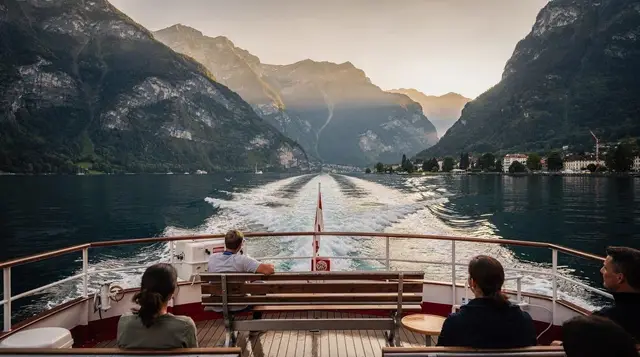
What does not need a booked activity to work socially: the two-lake boat cruises. Deck seating on the Lake Thun and Lake Brienz paddle steamers is shared and unstructured, and striking up a conversation over the view is normal rather than intrusive.
Hiking alone safely
This is the area where solo travel in the Jungfrau region carries genuine risk if handled carelessly, because the terrain changes faster than most visitors expect.
The trail network is graded and marked with a system worth understanding before you set off. Yellow signs and yellow diamond markers indicate standard walking trails, requiring no special equipment. White-red-white markers indicate mountain trails (“Bergwanderweg”) — steeper, sometimes exposed, needing proper boots and reasonable fitness but no climbing skill. Blue-white-blue markers indicate Alpine routes requiring rope, crampons, or glacier experience; these are not solo-hiker territory unless you already have that experience.
Most of what a first-time solo visitor will walk — routes covered in the best day hikes from Interlaken guide, the Bachalpsee hike, or the walk along the Lauterbrunnen valley floor — sits on yellow or white-red-white trails and is reasonable to do alone in good weather.
A few rules that matter more when there is no one to notice if you do not turn up:
- Tell someone your planned route and expected return time — a hostel reception desk, a message to a contact at home, or both. This is the single most useful habit and costs nothing.
- Check the weather forecast for the specific altitude you are hiking to, not the forecast for Interlaken itself; conditions at 2,000 metres can be entirely different from the valley floor, and cloud can close in within twenty minutes.
- Carry a charged phone and know the two emergency numbers: 112 for general emergencies, REGA on 1414 for Alpine and mountain rescue specifically. Coverage is decent on the main trails around Grindelwald and Lauterbrunnen but patchy in side valleys.
- Turn back rather than push on if the weather deteriorates or a trail feels harder than expected — there is no one to help you reassess, so build in your own margin.
- Via ferrata routes, such as the one linking Mürren and Gimmelwald, require a harness, via ferrata set, and helmet, and are better attempted with a guide or at least one other person even if you are experienced — a fall with no one nearby is a genuinely different situation from a fall on a walking trail.
None of this should discourage solo hiking here; it is one of the region’s best solo activities precisely because trails are well marked and well used, so you are rarely more than an hour from another hiker on the popular routes. It just rewards being deliberate about who knows your plan.
Eating alone
Solo dining in Interlaken is unremarkable in practice, though the town’s restaurant pricing makes it worth having a strategy rather than defaulting to a sit-down meal every night.
Restaurants along the Höheweg and around the two stations are used to solo diners, particularly given the volume of independent travellers passing through; nobody will comment on a table for one. Bar-height seating at pubs — several with terraces facing the Hohematte and the paragliders landing on it — is the least self-conscious option if you would rather not sit at a table alone, and doubles as a place to start a conversation with someone else doing the same thing. The full picture of where to eat and what things cost is in the Interlaken restaurant guide.
Self-catering is the more significant lever for a solo trip, not just socially but financially. A restaurant main in Interlaken commonly runs CHF 25–40, and a solo traveller pays that per meal with no one to split a shared plate or a bottle of wine with — the exact multiplier effect that makes solo travel in Switzerland cost more per day than travelling as a pair. Migros and Coop supermarkets near both stations sell prepared meals, bread, and cheese at a fraction of restaurant prices, and most hostel kitchens are genuinely usable rather than a token stovetop. The eating cheap in Interlaken guide breaks down specific supermarket and bakery options.
On a mountain, communal seating changes the dynamic entirely. Berghaus and mountain hut dining — at Männlichen, Schynige Platte, or the huts along hiking routes — is typically long shared tables rather than individual seating, and solo travellers routinely end up in conversation with whoever is next to them over rösti or soup. It is one of the more reliable places in the region to meet other hikers, covered in the mountain huts and berghaus dining guide.
Evenings, nightlife and your first night
The first evening is usually the hardest part of travelling alone, and Interlaken makes it easier than most places. If you arrive tired, a walk along the river and a simple dinner is a perfectly good start; the town is compact enough that you will find your bearings within an hour. If you would rather meet people straight away, the hostel bars and the pubs near the Höheweg are where most solo travellers end up, and the Interlaken nightlife guide explains which spots suit a quiet drink and which are built for a late night.
Not every evening needs to revolve around a bar. A sunset walk to a viewpoint, a seat on a lakeside bench, or a slow evening with a book are all easy here, and the viewpoints guide lists good places to watch the light change on the peaks without needing a companion. For something warmer and communal, a shared fondue or raclette table is a classic way to spend an evening; the fondue and raclette guide covers where solo diners are welcome and how to order for one.
A small habit that helps: decide each morning whether you want a social day or a quiet one. Booking a group activity for one day and keeping the next free for a solo walk or a lake cruise gives the trip a rhythm, and it stops you feeling obliged to be sociable all the time.
Choosing the right day trips alone
Travelling alone gives you freedom that groups rarely have: you can change plans at the station, follow the weather, and stay longer somewhere that surprises you. Interlaken is a good base for this, because so many excursions run on regular timetables rather than fixed tours. The day trips from Interlaken guide sets out the main options, and the best mountain excursions guide helps you choose between them when the forecast is uncertain.
If the weather turns, you do not need to organise anything for anyone else. Switch to a museum, a boat trip or a wellness afternoon, and see Interlaken in bad weather for ideas that work well alone. Solo days also suit slower pursuits such as the easy flat walks around Interlaken, where you can stop whenever you like and nobody needs to keep pace with you.
If you want to plan the whole stay at once, the Interlaken three-day itinerary is a sensible framework that you can adjust to your own energy, mixing one group adventure with quieter days at your own speed.
Costs and logistics specific to solo travel
The absence of anyone to split costs with is the real financial difference between solo and group travel here, more than any solo-specific surcharge. A private hotel room costs the same whether one or two people sleep in it, which is why hostel dorms are disproportionately better value for solo travellers than for couples. Taxis and private transfers carry the same logic — a fare from Interlaken Ost to a trailhead is the same for one person as for four.
Where solo travellers do come out ahead: transport passes. The Swiss Travel Pass and the Jungfrau Travel Pass price per person regardless of group size, so a solo traveller pays exactly what anyone else pays for the same unlimited travel on trains, buses, and boats around the Bodeli and up into the Jungfrau region — there is no group discount being missed. Buying one of these on arrival, rather than individual tickets for each excursion, is one of the more effective ways to bring the daily budget down; the full cost breakdown is in the Interlaken on a budget guide.
The most common mistake solo travellers make here is treating Interlaken purely as a one-night stopover between the Jungfraujoch and the next city on a rail pass. Staying two or three nights, using at least one full day for a group activity and one for a solo hike, gets far more out of both the social side and the mountains than rushing through — a pattern also flagged in the common mistakes first-time visitors guide.
Lake cruises & boat tours on GetYourGuide
Verified deep-linked GetYourGuide tours. Book through these links and we earn a small commission at no cost to you.
GetYourGuide does not provide a product photo for this activity — the image shows the meeting point, photographed by us.