Canyoning in the Bernese Oberland
Which canyons can you canyon near Interlaken, and how hard are they?
Operators run three main canyons from the Interlaken area: Saxeten (beginner-friendly, the classic first trip), Chli Schliere near Adelboden (mid-level, more jumps and slides), and the Grimsel canyons (harder, glacier-fed water and bigger abseils for those with some experience). The season runs roughly May to September, and every trip supplies a wetsuit, helmet and harness.
Why Interlaken became a canyoning hub
Interlaken’s adventure sports industry grew up around the terrain the town happens to sit in: two lakes, a ring of mountains dropping straight off glaciers, and rivers carrying that meltwater down through narrow limestone gorges. Canyoning, which means descending a river gorge on foot, by swimming, sliding and abseiling rather than walking around it, took off here in the 1990s alongside bungee jumping and river rafting, and the region is still one of the handful of places in the Alps where a first-timer can book a canyon the same day they arrive.
That popularity has a darker footnote. In July 1999, 21 people died in the Saxeten canyon when a flash flood swept through during a commercial trip, one of the worst accidents in the history of adventure tourism. The disaster led to Switzerland tightening regulation of canyoning operators: guides now need recognised qualifications, canyons are managed under safety plans agreed with cantonal authorities, and operators monitor water levels and weather far more conservatively than they did in 1999.
The canyon reopened for commercial trips in 2001 under stricter conditions and remains the most-run beginner canyon in the region. It’s worth knowing this history not to be put off, but because it explains why a cautious operator who postpones or reroutes a trip for weather is doing exactly what the system is designed to make them do.
The three canyons: Saxeten, Chli Schliere and Grimsel
Operators based in and around Interlaken run trips to a handful of canyons within roughly 30 to 90 minutes’ drive, and most itineraries fall into one of three groups.
Saxeten sits above Interlaken itself, a short drive up the valley behind Wilderswil. It’s the standard introductory canyon: shorter abseils, smaller jumps with easy opt-outs, and pools calm enough for nervous swimmers to be talked through them. Trips typically last two to three hours of canyon time plus transfers, making it a genuine half-day activity that leaves the rest of the day free.
Chli Schliere, near Adelboden in the Lenk and Simmental area, is the step up. It has a longer approach, more sustained sections of moving water, bigger jumps (with alternatives for those who’d rather climb down), and a couple of committing abseils down waterfalls. Operators generally ask for a reasonable level of fitness and comfort in water rather than prior canyoning experience, but this is not a first-canyon trip for most people.
The Grimsel canyons, on the pass road towards the Grimsel and Susten routes, are glacier-fed and colder, with a harder, more technical character: bigger drops, stronger current, and less margin for hesitation. These are usually marketed at participants who’ve done at least one canyon before, or who arrive with some climbing or via ferrata background. Group sizes tend to be smaller here too, which matters when the water is moving with real force.
A comparison of what to expect:
| Canyon | Difficulty | Typical duration | Who it suits |
|---|---|---|---|
| Saxeten | Beginner | 2-3 hours in canyon | First-timers, families with older children |
| Chli Schliere | Intermediate | 3-4 hours in canyon | Confident swimmers wanting more jumps and slides |
| Grimsel canyons | Advanced | 3-5 hours in canyon | Those with prior canyoning or climbing experience |
Booking a local canyoning trip from Interlaken usually means Saxeten by default unless you specify otherwise, so check which canyon is included before paying.
a half-day canyoning trip departing directly from Interlaken is the simplest way to try Saxeten without arranging your own transport, and it’s the trip most operators point beginners towards first.
Levels and what a day actually involves
Canyoning trips are graded loosely rather than on a formal international scale that tourists would recognise, so it’s more useful to know what a typical day involves than to chase a number.
A standard half-day runs like this: meet at the operator’s base (often in Interlaken or Matten), get fitted for a wetsuit, helmet and harness, then transfer by minibus to the canyon entry point.
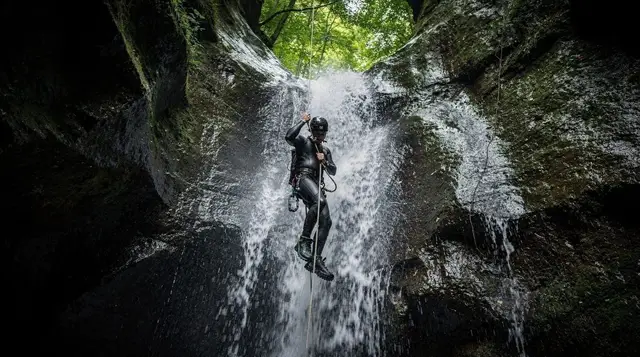
A guide briefs the group on the specific hazards of that canyon that day, which changes with water level, before the group works down the gorge together, alternating between walking on rock ledges, swimming pools, sliding down smooth water-carved chutes, jumping from ledges of 2 to 8 metres (always with a walk-around option), and abseiling short pitches, sometimes down the face of a waterfall. Guides stay with the group throughout, usually one guide for every four to six clients on easier canyons and tighter ratios on harder ones.
Nobody is forced to jump. A well-run trip treats every jump as optional, with guides checking in individually rather than applying peer pressure, and there is almost always a scramble-down alternative for anyone who’d rather not. Fitness requirements are modest for Saxeten: you need to be able to swim, walk over uneven wet rock, and manage moments of cold and exposure without panicking. Chli Schliere and the Grimsel canyons ask more of your stamina and nerve, mostly because the sections are longer and the water moves with more force.
Minimum ages vary by operator and canyon, commonly 12 or 14 for Saxeten and higher for the harder canyons; there’s usually also a minimum swimming ability and sometimes a weight range tied to harness and buoyancy equipment. Pregnant women and anyone with certain heart conditions or a fear of confined, dark, or fast-moving water should think carefully before booking, and a good operator will ask about this at the point of booking rather than leaving it to be discovered mid-canyon.
The wetsuit and what’s actually supplied
Every legitimate canyoning operator in the region supplies the technical kit: a full wetsuit (commonly 5mm neoprene, sometimes with a shorty vest layered over the torso for extra warmth), a helmet, a climbing harness, and often neoprene canyoning shoes or socks designed to grip wet rock. You don’t need to own or bring any of this, and being asked to supply your own wetsuit or harness for a commercial trip would be a red flag rather than normal practice.
What you bring yourself: swimwear to wear underneath the suit (not just underwear), a full change of clothes for afterwards, a towel, and closed shoes for the walk to and from the canyon if the operator doesn’t provide separate approach footwear. Long hair should be tied back and kept clear of harness buckles. Contact lenses are generally fine; glasses are risky given the swimming and should be left behind or secured with a strap if you need them for the drive.
Glacier-fed water in this part of the Bernese Oberland typically sits between 8 and 14 degrees Celsius even at the height of summer, cold enough that hypothermia risk, not drowning, is often the more relevant hazard for well-supervised groups. The wetsuit is what makes a two-to-four-hour trip tolerable rather than miserable, and a well-fitted one matters: too loose and cold water flushes through constantly, too tight and it restricts movement on the climbing sections. Ask to have the fit checked before setting off if something feels wrong.
Season and why timing matters more than in most sports
The canyoning season in the Bernese Oberland runs roughly from May to September, with June through August the most dependable window. Outside that, canyons are either closed by operators or running at reduced capacity because conditions are unpredictable.
Water levels are driven by snowmelt and rainfall in ways that don’t map neatly onto “summer is best.” A warm spell in May or June can send meltwater surging through glacier-fed canyons like those near the Grimsel, raising both the volume and the force of the water beyond what’s safe for a commercial trip. Conversely, a canyon that’s calm and clear in July can turn brown and swollen within hours of a heavy Alpine thunderstorm, which are common on summer afternoons.
Operators check gauges and weather forecasts before every departure and will reschedule, switch to a different canyon, or cancel outright if conditions look wrong. This happens more often than newcomers expect, and it should be read as the system working, not as poor planning; a company that never cancels for weather is one to be wary of, not reassured by.
Late-season trips in September can be excellent, with lower water and clearer visibility once the summer melt has eased, though the water is no warmer for it. If your dates are flexible, a settled weather week in July or August, away from the tail end of a heatwave, tends to give the most consistent conditions.
How to spot a serious operator
Canyoning sits in a category of activity where the difference between operators matters more than the marketing suggests, because the consequences of a poorly run trip are severe rather than merely disappointing. A few concrete things to check before booking:
Guide qualifications. Guides working commercially in Switzerland should hold a recognised canyoning qualification, often through Swiss mountain guide or canyoning-specific certification bodies. It’s reasonable to ask a company directly what qualification their guides hold; a straightforward, specific answer is a good sign, and a vague one is not.
Group-to-guide ratios. Ratios of roughly four to six clients per guide are typical for beginner canyons; anything markedly larger, especially for intermediate or advanced routes, increases the time it takes a guide to notice and respond to a problem.
Equipment condition. Wetsuits, harnesses and helmets should look and feel properly maintained, not visibly perished or held together with tape. It’s fair to look over your kit before setting off.
A real safety briefing. Expect a proper briefing at the canyon entrance covering that day’s specific hazards, not a generic script recited at the office. Guides who check water levels and adjust the plan on the day, including turning back or switching canyons, are demonstrating competence rather than incompetence.
Insurance and cancellation terms. A legitimate operator carries liability insurance and has a clear weather cancellation or rescheduling policy, usually a full refund or free date change rather than a forfeited booking.
Reviews that mention safety specifics. Generic five-star reviews about how “fun” a trip was tell you less than reviews mentioning how a guide handled a nervous member of the group, or how a trip was rerouted for water levels.
For those coming specifically for canyoning rather than adding it to a broader Interlaken stay, a canyoning day trip with return transfer from Zurich bundles the transport into the booking, which is worth it given how much of a canyoning day is otherwise spent arranging lifts to and from the canyon entrance.
Prices and what’s included
Canyoning is priced in the mid-to-upper range of Interlaken’s adventure sports menu, below tandem paragliding but generally above rafting for a comparable half-day.
| Trip type | Typical price (CHF, per person) | What’s usually included |
|---|---|---|
| Saxeten half-day | 120-150 | Wetsuit, helmet, harness, guide, transfer from Interlaken |
| Chli Schliere / intermediate | 150-190 | As above, plus longer transfer to Adelboden area |
| Grimsel / advanced canyons | 180-220 | As above, smaller groups, sometimes lunch included |
| From Zurich with return transfer | 200-260 | Coach transfer both ways plus the canyon package |
Photos taken by the guide are sometimes bundled in, sometimes a separate purchase of CHF 20 to CHF 40; ask before the trip rather than being surprised afterwards. Prices climb in July and August and around weekends, and popular Saxeten departures can sell out a few days ahead in peak season, so booking at least a few days in advance is worth it if your dates are fixed.
Pairing canyoning with the rest of an adventure-focused stay
Interlaken’s flat, glacier-carved valley and the Hohematte’s role as a paragliding landing strip mean canyoning rarely sits alone on a visitor’s itinerary. Rafting on the Lütschine or Aare rivers is the natural companion activity, using similar cold-water skills but without the abseiling and confined spaces of a canyon; see the guide to rafting on the Lütschine and Aare for how it compares. Those who want a taste of both water and raclette in one outing sometimes book a rafting trip on the Aare that finishes with a raclette meal, which turns an afternoon activity into most of a day out.
For something in the air rather than the water, a tandem paragliding flight over Interlaken and the Hohematte is the classic pairing on a different day of the same trip; see the paragliding guide for conditions and pricing. Those chasing more height and speed can look at skydiving and scenic flights, bungee and canyon swings, or the via ferrata routes above Mürren and Gimmelwald, all run by broadly the same cluster of adventure operators based around town.
It’s worth building in a rest day between a demanding canyon and another physically taxing activity; cold-water exposure and the adrenaline of jumps and abseils are more tiring than they look on a highlight reel, even for people who consider themselves fit. If the aim is a broader Bernese Oberland itinerary that mixes adventure sports with sightseeing, a small-group day tour to the Swiss villages of the Bernese Oberland on a quieter day works well either side of a canyon trip; those wanting a car-based overview of the wider region can also look at a small-group tour taking in the Bernese Oberland’s villages by car as a lower-intensity alternative for a rest day.
Practical notes before you book
Check the specific canyon named in a listing rather than assuming; “canyoning near Interlaken” can mean Saxeten, Chli Schliere, or occasionally a Grimsel route depending on the operator and the season, and the difficulty and price differ substantially between them. Confirm the minimum age and any weight or fitness restrictions if you’re booking for a family or a mixed-ability group, since these vary by operator rather than being fixed by law. Ask what happens if the trip is cancelled for water levels or weather: a full refund or a free rebooking on a later date in your stay is standard from established companies.
Bring a curious rather than nervous mindset to the swimming and jumping sections, but take seriously any moment a guide asks you to sit out a jump or take the walk-around option; that’s a judgement call about that specific person on that specific day, not an insult.
Combined with Lauterbrunnen’s waterfalls and the Aare Gorge near Meiringen, canyoning is one more way the region’s water and rock come together, and for many visitors it ends up the single most memorable few hours of an Interlaken trip built otherwise around trains, cable cars and viewpoints. Check the best time to visit and pack accordingly, since what to pack for an alpine trip and what you need for a canyon overlap only partially.
Canyoning near Interlaken: frequently asked questions
Do I need experience to go canyoning near Interlaken?
No. The Saxeten canyon is designed as an introductory trip and takes complete beginners, usually from age 12 or 14 depending on the operator. Chli Schliere and the Grimsel routes ask for reasonable fitness and comfort with jumping into water, but still don’t require prior canyoning experience with a qualified guide.
What does the canyoning wetsuit actually look like, and is it warm enough?
Reputable operators issue a full wetsuit (often 5mm, sometimes with a shorty layer on top), neoprene socks, a helmet and a climbing harness. Glacier-fed water in the Bernese Oberland sits around 8 to 14 degrees Celsius even in summer, so the suit is doing real work, not a formality. Bring swimwear to go underneath and a change of clothes for afterwards.
How much does canyoning cost from Interlaken?
Half-day trips to Saxeten typically run from around CHF 120 to CHF 150 per person. Chli Schliere and other mid-level canyons cost more, often CHF 150 to CHF 190, partly because of the longer transfer to Adelboden. Photos are sometimes included, sometimes a paid extra, so check before booking.
When is the canyoning season in the Bernese Oberland?
Most operators run from May to September, with June to August the reliable core. Water levels and clarity depend on snowmelt: late spring can mean cold, high, murky water in glacier-fed canyons, while a hot summer can also swell the flow. Operators cancel or switch canyons when conditions are unsafe, which is a sign they know what they’re doing, not a reason to distrust them.
Is canyoning near Interlaken safe?
It carries real risk, like any activity involving moving water, height and rock, but Switzerland tightened regulation after the 1999 Saxeten tragedy that killed 21 people on a commercial trip. Guides must hold recognised qualifications and canyons are subject to safety plans agreed with cantonal authorities. Choosing an established operator with visible certification, briefed safety procedures and a guide-to-client ratio that isn’t stretched thin matters more than the price on the booking page.
Can I go canyoning if I can’t swim well?
You should be a competent, confident swimmer. A wetsuit and buoyancy help, but canyons involve swimming through pools, sometimes in a current, and being calm in water is part of what keeps a group moving safely. Tell the operator in advance if you’re a weak swimmer; some will place you differently in the group or advise against a particular canyon.
What should I bring on a canyoning trip?
Swimwear to wear under the wetsuit, a towel, a full change of clothes and shoes for after, and something to tie back long hair. Old trainers that can get wet are sometimes accepted in place of the neoprene shoes some operators supply, but check first. Leave valuables at your accommodation; some operators offer a drybox for phones and keys but won’t guarantee it against a hard fall.
Can I combine canyoning with other adventure sports in one trip to Interlaken?
Yes. Many visitors pair canyoning with rafting on the Lütschine or Aare, or with an adrenaline activity like paragliding over the Hohematte, on separate days of the same trip. Doing two water- or height-based activities back to back is tiring rather than dangerous, but a rest day between a big canyon and a via ferrata or bungee is worth building into the itinerary.
Adventure & outdoor activities on GetYourGuide
Verified deep-linked GetYourGuide tours. Book through these links and we earn a small commission at no cost to you.
GetYourGuide does not provide a product photo for this activity — the image shows the meeting point, photographed by us.