Rafting the Lütschine and the Aare: which river, when, what to bring
Should I raft the Lütschine or the Aare near Interlaken?
The Lütschine is glacier-fed white water, grade III to III+, run from roughly May to September when snowmelt keeps the flow up. The Aare is calmer and more scenic, runnable for more of the year, and better suited to families or anyone who wants a float rather than a fight. Most operators run one or the other, not both, so the choice is usually made for you by which trip you book.
Two rivers, two very different rides
Interlaken sits between two rivers that could not be more different on the water. The Lütschine drains the glaciers above Grindelwald and Lauterbrunnen, arrives in town cold, fast, and the colour of wet concrete, and is the river behind most of the white-water rafting trips sold in Interlaken. The Aare, which leaves Lake Thun and eventually reaches Bern, is warmer, wider, and slower moving, and is used for the calmer float-and-splash trips as well as the well-known open-water swims through Bern itself.
Almost no operator runs both on the same day, so in practice the decision has usually already been made by whichever trip you book: a “rafting Interlaken” tour is the Lütschine, an “Aare” tour is the calmer river, often starting near Thun or Bern rather than in Interlaken. It is worth knowing the difference before you book, because the two trips suit different people and different tolerances for cold water.
Lütschine white water: what the grade actually means
Commercial rafting on the Lütschine runs at grade III to III+ on the international scale, which is genuine white water: continuous rapids, standing waves, and short stretches where the raft can flip if a crew is out of sync. It is not a scenic float. Guides run swim-testing and a safety briefing on a calm stretch before the group hits the first rapids, and everyone paddles, no passengers.
The water itself is glacial meltwater funnelled down from the Grindelwald and Lauterbrunnen valleys, and it sits at roughly 8 to 12°C even in the height of summer. Every splash is cold, and most trips include at least one deliberate stop for guides to let strong swimmers float a calm section, which is bracing rather than pleasant. If you dislike cold water, the Lütschine is the wrong choice regardless of how confident a paddler you are.
the Lütschine white-water trip run directly from Interlaken is the standard version: pickup in town, kitting up at the put-in near Lauterbrunnen, roughly 1 to 1.5 hours of paddling, and a return transfer.
Aare: gentler water, a longer season
The Aare rafting trips sold to visitors staying in Interlaken usually start with a transfer to a put-in near Thun or further along toward Bern, and cover grade I to II water: long calm glides interrupted by mild riffles, with the occasional deliberate splash rather than a genuine white-water fight. The river is fed by Lake Thun, so it arrives noticeably warmer than the Lütschine, and on a hot July afternoon some operators build in a swim stop.
This is the trip to choose if you want scenery and a paddle rather than an adrenaline hit, or if you are travelling with anyone nervous about cold glacier water. It also runs for more of the year than the Lütschine, since it does not depend on snowmelt timing in the same way, though ice and high winter flow still rule out the depths of winter.
a private Aare rafting day trip that includes onward transfer to Bern suits visitors based in Zurich who want to combine the river with a look at the capital, rather than staying in the Interlaken area.
Water levels and the glacier-melt calendar
Both rivers are read off gauge stations, and both change meaningfully through the season, but for opposite reasons.
| Period | Lütschine | Aare |
|---|---|---|
| Early May | Often still too low or too cold to run | Runnable, cool |
| Late May–June | Rising fast with snowmelt; can be high and pushy | Comfortable, water warming |
| July–August | Best window, but a heatwave on the glaciers can spike flow overnight | Warmest, most reliable |
| September | Flow easing off, still good if the summer was warm | Still good, fewer crowds |
| October–April | Generally not offered commercially | Occasional low-water trips; check locally |
The practical effect: a hot spell in the high Alps can push the Lütschine from comfortable grade III to a level operators refuse to run within 24 hours, and conversely a cool, wet July can leave it disappointingly low. If a trip is cancelled for water levels, it is a safety call, not an excuse — do not push an operator to run a river they have closed for the day.
What a rafting trip near Interlaken actually costs
Prices vary by operator and by whether the trip includes a return transfer from Interlaken or from further afield. As a rough guide for 2026:
| Trip type | Typical price (CHF, per person) | Time on water |
|---|---|---|
| Lütschine half-day, Interlaken pickup | 110–150 | 1–1.5 hours |
| Lütschine + raclette or fondue add-on | 140–190 | 1–1.5 hours plus meal |
| Aare day trip from Zurich, with transfer | 150–200 | 1.5–2.5 hours |
| Aare private trip with Bern extension | 180–260 | 1.5–2 hours |
These are not cheap outings by the standards of most destinations, but they are broadly in line with what Switzerland charges for any guided outdoor activity — see Interlaken travel costs for how rafting compares with other adventure sports here. Photos taken by the guide during the trip are sometimes included and sometimes an extra CHF 20–30; ask before you book if that matters to you.
a Lütschine rafting trip that finishes with a raclette meal is a reasonable way to justify the higher end of that price range, since the food is a proper sit-down meal rather than a snack.
Time on the water: how the day is structured
The number that matters for planning is not the price, it is how little of the day is actually spent paddling. A typical Lütschine half-day breaks down roughly like this:
- Pickup from central Interlaken, 08:30–09:00
- Transfer to the put-in near Lauterbrunnen, 20–30 minutes
- Kitting up in wetsuit, helmet, and buoyancy aid, 20–30 minutes
- Safety briefing and swim-testing on calm water, 15–20 minutes
- The rafting run itself, 60–90 minutes
- Getting out, changing, and warming up, 20–30 minutes
- Return transfer to Interlaken, 20–30 minutes
That adds up to a morning gone, sometimes a full half-day, for 60 to 90 minutes of actual paddling. It is worth knowing this in advance so a rafting trip does not eat into plans for a same-day trip up to Harder Kulm or a mountain excursion — pair it instead with a slow lakeside afternoon or an evening in town.
What to bring, and what the outfitter supplies
Every operator running the Lütschine or the Aare supplies the equipment that actually matters for safety and warmth: wetsuit, splash jacket or spray top, helmet, and buoyancy aid. What you bring yourself is simpler than most first-timers expect.
- Swimwear to wear under the wetsuit
- An old T-shirt if you want an extra layer against wetsuit chafing
- Water shoes or old trainers that can get soaked — sandals are not accepted
- A full change of clothes, including socks, for afterwards
- A towel
- A dry bag or plastic bag for wet kit on the transfer back
- Sun cream for exposed skin (the glare off the water is stronger than it looks)
- Contact lenses rather than glasses if you can manage it, or a strap if not
Leave valuables at the accommodation. Waterproof phone cases are not generally trusted on grade III water; if you want photos, let the guide’s camera or the operator’s package handle it rather than risking your own phone.
Canyoning and other paddle-adjacent options
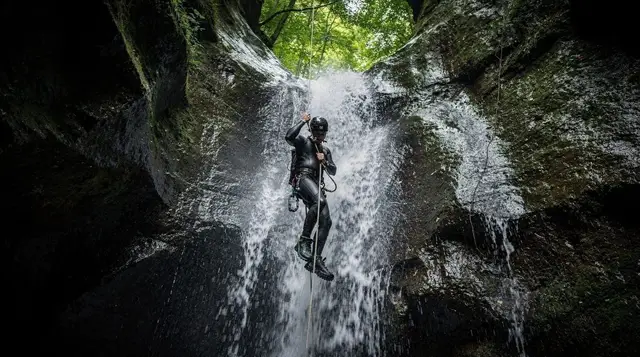
If cold glacier water and grade III rapids sound appealing but a raft feels tame, canyoning in the gorges above Lauterbrunnen and Grindelwald covers similar terrain on foot: abseiling down waterfalls, sliding through rock chutes, and jumping into plunge pools, all in the same glacier-fed water as the Lütschine. It is a different skill set from rafting — solo movement rather than a paddling crew — and generally a longer, more intense half-day. See canyoning in the Bernese Oberland for the full breakdown of routes and difficulty.
a combined rafting and adventure day trip that runs from Zurich bundles rafting with other activities for visitors who only have one day to spend in the region and want to sample more than one sport.
For visitors who want to be on the water without paddling at all, the region’s lakes are the calmer alternative: see swimming in Lake Thun and Lake Brienz and kayaking and SUP on Lake Brienz. Neither involves the guiding fees or scheduling of a commercial rafting trip, though neither delivers the same rush either.
Anyone building a fuller adrenaline itinerary around Interlaken’s other activities should also read paragliding in Interlaken, bungee and canyon swings, and via ferrata around Mürren and Gimmelwald, all of which are sold by the same handful of local operators and can sometimes be combined into a multi-day package at a small discount.
When it is not worth going
Rafting near Interlaken is not universally worth the money. Skip it, or downgrade to the Aare, if any of the following apply:
- You are travelling in April or the first half of May, when the Lütschine is often still too low or too cold, and trips get rescheduled or cancelled at short notice.
- The forecast shows a hot spell in the days just before your booking — a sudden glacier melt spike can either cancel the trip or push the grade up beyond what a first-timer will enjoy.
- You have back, neck, or shoulder problems: the jolt of hitting a standing wave on the Lütschine is real, and operators will ask about this before letting you on.
- You are visiting only for a day and have already committed that day to Jungfraujoch or another full-day mountain excursion — a rafting half-day does not compress well alongside a train day that starts before 8am.
- Your budget for adventure sports in the region is limited and you would rather spend it on paragliding, which many first-timers rate as the more memorable half-hour for a comparable price.
Check when mountain railways open and close and general best time to visit Interlaken guidance if you are trying to plan a trip around both rafting and the high-altitude excursions, since the two follow different seasonal logic — one is driven by snowmelt volume, the other by lift maintenance schedules.
Frequently asked questions about rafting near Interlaken
Is rafting the Lütschine safe for beginners?
Most Lütschine trips near Interlaken are graded III to III+, which is genuine white water, not a scenic float. Operators take first-timers, but you should be a confident swimmer, comfortable being briefly underwater, and honest about any back or neck problems before booking. Guides give a safety briefing and swim-testing on calm water before the rapids start.
What is the difference between rafting the Lütschine and the Aare?
The Lütschine is a short, steep, glacier-fed river with continuous rapids and cold, grey-green meltwater. The Aare, particularly the stretch used for rafting between Thun and Bern, is wider, warmer, and much gentler, with long calm sections between mild rapids. The Lütschine is the adrenaline trip; the Aare is closer to a scenic paddle.
When is the water level too low or too high for rafting?
The Lütschine depends on glacier and snowmelt, so early May can still be too low and a hot spell in July can bring it up fast and hard. Operators check gauge readings daily and cancel or reroute if the water is dangerously high, usually after heavy rain or a sudden warm spell on the glaciers. Late June to August is the most reliable window.
Do I need to bring my own wetsuit?
No. Every rafting operator around Interlaken supplies a wetsuit, splash jacket, helmet, and buoyancy aid as part of the price, because glacier meltwater on the Lütschine sits at around 8 to 12 degrees Celsius even in summer. Bring swimwear to go underneath, a towel, and dry clothes for afterwards.
How long does a rafting trip near Interlaken actually take?
Budget half a day, even though the time on the water itself is usually 1 to 1.5 hours for the Lütschine and up to 2.5 hours for a longer Aare trip. The rest goes on transfers, kitting up, the safety briefing, and getting changed afterwards, so a 9am pickup can easily mean you are back in Interlaken by early afternoon.
Can children go rafting on the Lütschine or the Aare?
Most operators set a minimum age of 14 to 16 for the Lütschine because of the grade III water and swim-testing requirement, and a minimum weight rather than age for some trips. The Aare is more forgiving and some family-oriented trips accept children from around 8, but always check the specific operator’s age and weight limits before booking, since they vary.
Is rafting worth it if I get travel sick or dislike cold water?
The Lütschine involves repeated, unavoidable splashes of very cold glacier water and short bursts of turbulence, which is unpleasant if you dislike cold water rather than find it exciting. The Aare is gentler and warmer and a fairer test if you are unsure; some operators also run float trips on the Aare with no white water at all.
Adventure & outdoor activities on GetYourGuide
Verified deep-linked GetYourGuide tours. Book through these links and we earn a small commission at no cost to you.
GetYourGuide does not provide a product photo for this activity — the image shows the meeting point, photographed by us.