Via ferrata from Mürren to Gimmelwald: route, grade and gear
What is the Mürren–Gimmelwald via ferrata and how hard is it?
It is a 2.2km protected climbing route bolted to the cliff below Mürren, ending with a Nepalese suspension bridge and a zip line into Gimmelwald. It mixes ladders, cable and rock steps rated up to K/D on the via ferrata scale, so a head for exposure matters more than climbing experience. Allow 2.5 to 4 hours, plus travel to the start and from the finish.
The cliff path between two car-free villages
Mürren sits on a shelf above the Lauterbrunnen valley, and Gimmelwald — technically its own hamlet, reached the same way, without a road in either case — sits a few hundred metres lower on the same shelf. Between them runs a via ferrata: a protected climbing route bolted into the limestone band that drops away from Mürren’s plateau, with the valley floor visible more or less continuously beneath your boots. It opened in the mid-2010s as a way to give the village a second adventure activity alongside the paragliding that already fills the sky here on clear afternoons.
This is not a wilderness route you stumble onto. It is bolted, cabled and signed end to end, rented gear is available a hundred metres from the start, and the whole thing is designed to be done in an afternoon by a fit adult with no climbing background. What it demands instead is a tolerance for hanging cable ladders over open air, because for most of its 2.2km the ground is a long way down and the protection is a steel cable, not a path.
What the route actually involves
The via ferrata runs in three loosely graded sections along the cliff face below the Mürren plateau. The early sections are the most straightforward — cabled traverses with foot ledges, a few short ladder pitches, enough exposure to establish whether you’re comfortable with the format before it gets harder. The middle section is where the grade steps up: steeper cable, a handful of overhanging moves where you’re relying on arm strength rather than footholds, and stretches where the valley floor is directly below rather than off to one side.
The finish is the part everyone has seen a photo of. A Nepalese-style suspension bridge sags and sways across a gap in the cliff, cabled but with slack enough that it moves underfoot with every step — unnerving the first time, manageable once you commit to a steady pace and stop looking for a way to hurry. From the far side, a zip line (locally, and on route signage, called a flying fox) carries you the last stretch down into Gimmelwald. There is no walking alternative past this point: once you’re through the last ladder section, the bridge and the zip line are how you finish the route.
Graded on the Hüsler via ferrata scale used across the Alps, the route sits around K/D — moderately difficult, not extreme, but with enough sustained exposure that it is a poor choice for a first outdoor adventure activity if heights genuinely unsettle you. It rewards steady technique — three points of contact, clip ahead before unclipping behind, don’t rush the ladder rungs — more than raw fitness, though a base level of upper-body strength makes the overhanging sections considerably less draining.
Route sections at a glance
| Section | Character | Relative difficulty |
|---|---|---|
| Start to first ladder bank | Cabled traverse, foot ledges, gentle exposure | Easier — good gauge of comfort level |
| Middle cliff band | Steeper cable, some overhanging moves | Moderate to hard — the crux of the route |
| Nepalese bridge | Swaying suspension bridge, cabled | Psychologically hardest, technically simple |
| Zip line to Gimmelwald | Seated zip line, staff-assisted | Easy — the reward at the end |
Total time on the cable, moving steadily with a short rest at each anchor point, runs 1.5 to 2.5 hours depending on group size and confidence. Add the walk from Mürren to the start, briefing time if you’re using rented gear for the first time, and the descent or cable car back from Gimmelwald, and a half day — 2.5 to 4 hours door to door — is the realistic budget.
Who should do it, and who should skip it
Adults with reasonable fitness, no vertigo, and a willingness to follow instructions on clipping technique manage this comfortably, guided or not. It works as a genuine first via ferrata: the bolting is generous, the exposure is real but not extreme by via ferrata standards elsewhere in Switzerland, and staff at the rental counters are used to talking nervous first-timers through the basics before they set off.
It is the wrong choice for young children — most local operators set a minimum age around 12, partly for arm strength on the overhanging sections and partly because the exposure genuinely needs to be managed by the participant, not carried by a guide. It is also the wrong choice for anyone with a serious fear of heights: the Harder Kulm viewpoint or a valley walk from Lauterbrunnen will show you the same scenery without the cable. And it should be skipped outright in wet weather — more on that below.
Gear: rent it, don’t bring it
Almost nobody arrives with their own via ferrata set. Mürren Sports and the Mürren Alpin Center, both in the village centre, rent the complete kit by the day: a climbing harness, a via ferrata lanyard with an energy-absorbing brake, and a helmet. Staff check boots and clothing before renting — approach shoes or sturdy trainers with grip are fine, sandals or worn-smooth soles are not, and they will say so.
Expect to pay in the region of CHF 25 to 35 for a full day’s gear rental, more if you book a guided half-day through the Alpin Center rather than going self-guided. A guide adds real value on a first attempt: someone who talks you through clipping sequence on solid ground before the first exposed section, sets the pace, and carries a first-aid kit, for roughly CHF 100 to 160 depending on group size. None of this needs booking weeks ahead in shoulder season, but a fine Saturday in July is a different matter — turning up the evening before to reserve gear and a guide slot avoids a wasted morning.
If you’re deciding between a fully independent day and a guided one, it’s worth comparing this against Mürren’s other headline adventure activity: a tandem paragliding flight off the Hohematte-adjacent launch sites requires zero gear of your own and zero technique, which is one reason it outsells the via ferrata for first-time visitors who just want the view without the cable work.
a combined Mürren hike and paragliding flight pairs a walk on the same plateau with a tandem flight over the valley, which is a reasonable way to see the terrain from the air first and decide afterwards whether the via ferrata’s exposure sounds appealing or excessive.
Season and when it closes
The via ferrata typically runs from late May to late October, in line with the operating season of most protected routes in the Jungfrau region — the exact opening date shifts a little each year with snow cover on the higher ledges. Within that window, the route closes for the day whenever the rock is wet: rain makes the footholds and rungs slick in a way that matters far more here than on an ordinary trail, and a forecast with thunderstorms anywhere nearby is an automatic no from the rental counters, since there is no fast way off an exposed cable section if lightning arrives.
Check conditions the same morning rather than assuming a booking a week out will hold — this is the same caution that applies to cable cars and mountain railways across the region, which close for wind or maintenance with little notice and ruin more days than any other single factor. If you have a flexible itinerary, treat the via ferrata as a fair-weather activity to slot in opportunistically rather than the fixed centrepiece of a single day, and read up on what to do in Interlaken when it rains as your fallback.
Midsummer mornings are the most reliable window: rock is dry from the previous day’s sun, afternoon thunderstorms common in July and August haven’t built yet, and the crowds attempting the route are thinner than on a warm Saturday afternoon. September carries good odds too, with cooler air but usually stable high pressure.
Getting to the start and back from the finish
The standard approach is Mürren itself, reached by cable car from Stechelberg via Gimmelwald, or by the Lauterbrunnen–Grütschalp funicular and then the panoramic train along the plateau. Both routes are covered under the region’s transport passes; see the Jungfrau and Berner Oberland pass guide if you’re stacking several mountain trips into one visit. From Mürren village, it’s a short walk to the via ferrata’s marked starting point below the plateau edge.
At the far end, Gimmelwald has its own cable car station connecting back up to Mürren in a few minutes, which is the quickest way to close the loop if you’ve left a car or belongings in the village. The alternative is to continue downhill on foot or by cable car to Stechelberg, from where postbuses run back towards Lauterbrunnen and on to Interlaken — a reasonable option if you’re heading straight back to base rather than staying another night up top.
Both Mürren and Gimmelwald are car-free villages, so if you’ve driven up the valley, the car stays at Stechelberg or Lauterbrunnen and the rest of the day runs on cable cars, trains and your own legs.
What it costs, all in
| Item | Approximate cost (CHF) |
|---|---|
| Via ferrata gear rental, full day | 25–35 |
| Guided half-day (gear included) | 100–160 per person |
| Stechelberg–Mürren cable car, return | 30–35 (less with a regional pass) |
| Gimmelwald–Mürren cable car, one way | 8–10 |
| Lunch or coffee in Mürren before/after | 20–30 |
A self-guided day for someone with prior via ferrata experience runs roughly CHF 60 to 80 once transport and gear are added up; a guided first attempt pushes that closer to CHF 150 to 200. Neither figure is cheap by the standards of a walking day in the Alps, but it’s in line with what protected climbing routes cost elsewhere in Switzerland, and considerably less than a helicopter flight or a full canyoning day in the same region.
Combining it with the rest of the day
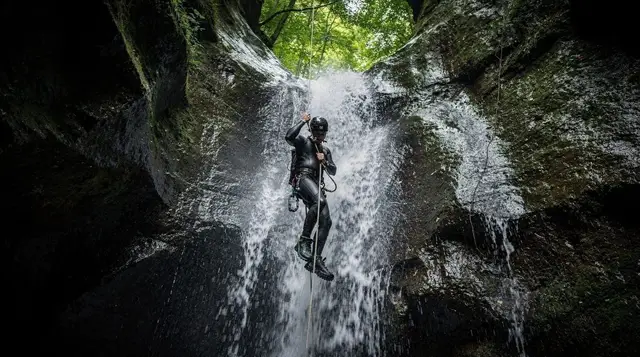
Because the route finishes in Gimmelwald with a fast cable car straight back to Mürren, it’s easy to treat the via ferrata as a morning activity and still have the afternoon free for the cable car up to the Schilthorn and its revolving restaurant, or for a gentler walk along the plateau. Anyone building a longer stay around Mürren and the valley below should also look at the via ferrata’s near neighbour on the adventure side of the ledger — canyoning trips run from bases lower in the valley and offer a genuinely different kind of exposure, in moving water rather than open air.
a full-day canyoning trip in the Bernese Oberland is the obvious pairing for anyone treating this as an adventure-sports week rather than a one-off — book the two on separate days, since both leave you legitimately tired.
For visitors who want the scenery of the Mürren plateau without the cable work, a guided version of the same terrain exists as a walking and sightseeing day.
a day tour taking in Grindelwald, Lauterbrunnen and Mürren covers the same villages by train and cable car, which is a sensible way to scout the area the day before attempting the via ferrata itself, or a fallback if the route is closed for weather on the day you’d planned.
Those arriving from further afield — Zurich in particular — sometimes prefer to build the whole day, transport included, around a single booking rather than assembling trains and cable cars themselves.
a private day trip to Mürren and the Schilthorn from Interlaken removes the transport planning if you’d rather spend the morning on the via ferrata and let someone else handle the logistics of getting up and back down the valley.
Common mistakes worth avoiding
The most frequent problem is booking a fixed slot — a guide, a group, a rental reservation — for a specific day too far in advance and then finding the route closed for rain or high wind, with no flexibility left in the itinerary to shift it. Building at least one spare day into a Bernese Oberland stay, as covered in the wider Interlaken itinerary planning, absorbs this far better than a tightly scheduled single-day visit.
The second is underestimating arm strength requirements on the overhanging middle section — this is not a route where a determined walker with no upper-body fitness sails through purely on nerve. A short warm-up via ferrata or even a few days of general hiking beforehand, such as the walks covered in the best day hikes from Interlaken guide, makes a genuine difference to how the middle section feels.
The third is treating the Nepalese bridge and zip line as optional extras to bail out of if nerves get the better of you at the last minute — they are not; there is no separate walking path down from that point, and turning back means reversing the hardest section of cable you’ve just climbed. Anyone seriously unsure about the bridge should say so at the rental counter before setting out, not partway along the route.
Adventure & outdoor activities on GetYourGuide
Verified deep-linked GetYourGuide tours. Book through these links and we earn a small commission at no cost to you.
GetYourGuide does not provide a product photo for this activity — the image shows the meeting point, photographed by us.