Zurich in one day from Interlaken
Is Zurich worth a day trip from Interlaken?
Only if the mountains are closed to you that day. The train is roughly 2 hours 5 minutes each way from Interlaken Ost, so a return trip eats over 4 hours on rails before you have seen anything. Zurich is a fine city day out, but it competes with the Jungfraujoch and Schilthorn for your limited days, and it loses that competition on a clear day.
Why Zurich, and why only sometimes
Zurich is a two-hour train ride from Interlaken in the wrong direction from the mountains you came for. That is the honest starting point for this guide. A day trip to Switzerland’s largest city means roughly 4 hours 10 minutes on rails for a round trip, out of a day that has perhaps 10 usable hours. What is left is enough for a solid but not exhaustive look at the old town, the lake shore and the Bahnhofstrasse — not enough for museums in depth, not enough for the outlying districts, and nowhere near enough to call it a proper visit to the city.
That trade-off makes sense on exactly one kind of day: a day when the mountain excursions you actually planned for are closed, fogged in, or not worth the money because you will see nothing but grey from the top. Cable cars and mountain railways in the Jungfrau region close for scheduled revision in spring and autumn, and even outside those windows, wind and low cloud shut them down or make the summit views pointless.
If you have already checked the webcams and the forecast and today is not a Jungfraujoch or Schilthorn day, Zurich is a reasonable way to spend a wasted mountain slot. If it is a clear day, spend it in the Zurich region’s own back yard instead — this trip should not compete with a good day at altitude.
Getting there: the train from Interlaken
Trains from Interlaken Ost to Zürich Hauptbahnhof (Zurich HB) take about 2 hours 5 minutes, typically with one change, most often at Bern or Spiez. Departures run roughly hourly through the day, with extra services at commuter peak times. Swiss trains do not require seat reservations on domestic routes, so any valid ticket or pass gets you on board — walk to the platform, find a seat in your class, and go.
A standard second-class one-way fare from Interlaken to Zurich runs somewhere in the CHF 65-75 range at full price, so a same-day return without a pass can reach CHF 130-150 per person. That is steep for a day out, and it is the main reason this trip is worth reserving for days when the alternative is sitting in a hotel room watching rain hit the window.
If you already hold a Swiss Travel Pass, the journey is included at no extra cost. A Half Fare Card cuts the fare in half, and a Saver Day Pass bought in advance for a specific train can bring the round trip down to well under CHF 100 if you book early enough — prices rise as the train fills, so a spontaneous rainy-morning decision will cost more than a pass bought the night before.
Confirm you are boarding at Interlaken Ost, not Interlaken West — Zurich-bound trains depart from Ost, and mixing up the two stations on the Bodeli is a reliable way to miss a connection on a day when you have already lost the morning to weather.
| Item | Approx. cost (CHF) | Notes |
|---|---|---|
| Return train, full fare, 2nd class | 130-150 | No reservation needed |
| Return train, Half Fare Card | 65-75 | Card itself costs extra if bought just for this |
| Return train, Swiss Travel Pass | 0 (included) | Best value if you already hold one |
| Fraumünster Chagall windows entry | 5-6 | Cash or card at the church |
| Lake Zurich short boat trip | 8-10 | Zürichsee-Schifffahrtsgesellschaft |
| Lunch in the old town | 25-35 | Sit-down restaurant, one course plus drink |
Arriving at Zürich HB and getting your bearings
Zürich Hauptbahnhof drops you in the middle of the city, at the head of the Bahnhofstrasse. The station itself is worth thirty seconds of attention for the Niki de Saint Phalle guardian angel sculpture hanging over the main hall, but do not linger — with two hours of travel already spent, the clock is against you.
Lockers are available at the station if you are carrying luggage rather than a day bag; do not try to drag a suitcase around the old town’s cobbled lanes. If you are connecting from further afield rather than starting in Interlaken, this same station is also the hub referenced in the guide to reaching Interlaken from Zurich Airport — the airport sits on a direct rail line 10 minutes north of here.
Bahnhofstrasse: look, do not necessarily buy
Walking south from the station, the Bahnhofstrasse runs for about 1.4 km down to the lake, lined with flagship stores, jewellers, and the discreet private banks Zurich is known for. It is regularly ranked among the most expensive retail streets in the world, and it looks it — glass frontages, no visible price tags in some windows, and a general absence of the tourist tat you find on Interlaken’s Höheweg.
Twenty minutes covers the street end to end at a normal walking pace. Unless you are actually shopping, this is a corridor to pass through rather than a destination, but it is a useful spine for orientation: it runs roughly parallel to the old town on one side and the lake at the far end, so you will likely cross it more than once during the day.
The old town: Niederdorf and the Chagall windows
Cross the Limmat river from the Bahnhofstrasse side and you reach the Niederdorf, the tangle of narrow lanes on the river’s right bank that makes up Zurich’s medieval old town. It is dense with small restaurants, bars and independent shops, and it rewards wandering without a fixed plan more than any checklist of sights — pick a lane, follow it, double back when it dead-ends at the river.
On the left bank, the Fraumünster church holds the reason most visitors come to this part of the city: five stained-glass windows designed by Marc Chagall and installed in 1970, plus a rose window by Giacometti. Entry costs a small fee (around CHF 5-6), photography is generally not permitted inside, and the windows themselves are the whole visit — this is a fifteen-minute stop, not an hour. The Grossmünster, Zurich’s twin-towered landmark church, sits a short walk away on the opposite bank and is free to enter, with a climb up one tower for a view over the rooftops if you have the time and the legs after a day already spent on trains.
a guided walk through the old town, from its Roman-fort origins to the banking district it is now is a reasonable way to cover the Niederdorf and the churches with context rather than guessing at plaques, if you would rather not self-navigate on a day already built around trains and timetables.
The lake
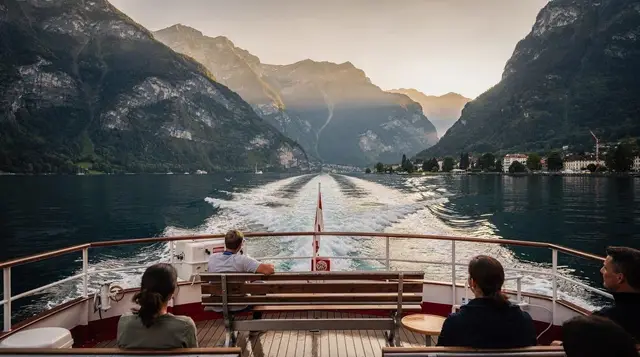
Lake Zurich opens up at the southern end of the Bahnhofstrasse, and the promenade along both shores is where the day trip earns its keep if the weather has actually improved by afternoon. A short lake cruise with Zürichsee-Schifffahrtsgesellschaft runs about an hour for CHF 8-10 and gives you the skyline from the water, including the Grossmünster and Fraumünster towers side by side.
If you would rather move under your own power, a bike tour with a local guide covers more ground along the river and lakeshore than walking allows, useful if your window of good weather in Zurich is narrower than your remaining time there. For a shorter, low-cost option, a self-guided walk taking in the cable car and a panoramic view over the lake fits into a gap of an hour or two without committing the whole afternoon.
A realistic timed itinerary
This assumes a 7am-ish departure from Interlaken and a last sensible train back in the 8-9pm range.
| Time | Activity |
|---|---|
| 07:00-09:10 | Train, Interlaken Ost to Zürich HB |
| 09:10-09:30 | Walk the Bahnhofstrasse toward the lake |
| 09:30-10:30 | Niederdorf old town, wander without a fixed route |
| 10:30-11:00 | Fraumünster, Chagall windows |
| 11:00-11:30 | Grossmünster, free entry, optional tower climb |
| 11:30-12:30 | Lunch in the old town |
| 12:30-13:30 | Lake promenade or short boat trip |
| 13:30-16:00 | Free block: Bahnhofstrasse shopping, a museum, or a longer lake walk |
| 16:00-17:00 | Return to Zürich HB, buy anything from the station shops |
| 17:00-19:10 | Train back to Interlaken Ost |
That leaves a genuinely open afternoon block of roughly two and a half hours, which is not enough for one of Zurich’s major museums at a proper pace but is enough for a second lake walk, a coffee stop in Niederdorf, or backtracking to any street you rushed past in the morning.
Why this only makes sense as a bad-weather day
Compare the arithmetic against a mountain day. A trip up to the Jungfraujoch or the Schilthorn from Interlaken involves less total travel time than Zurich and delivers a landscape you cannot get anywhere else in the region — glaciers, a 360-degree Alpine panorama, a revolving restaurant. Zurich, by contrast, is a well-run, pleasant Swiss city that resembles other well-run, pleasant Swiss cities you may see later in a trip, at Lucerne or Bern, both of which are closer to Interlaken and cost less in both time and money.
If the forecast shows a clear morning at altitude, do not burn it on a train to Zurich. Save this itinerary for the day the webcams show cloud sitting on the Eiger, or for a stretch of the trip when the mountain railways are closed for scheduled maintenance and there is genuinely nothing to lose by heading downhill and north instead. On those days, a city with functioning museums, covered arcades and indoor dining is exactly what you want, and Zurich does that better than sitting out the rain in Interlaken itself, useful as the rainy-day guide to Interlaken is for shorter gaps.
Alternatives worth weighing first
Zurich is not the only bad-weather escape valve from Interlaken, and it is not always the best one. Bern, the Swiss capital, is under an hour away by train and has a walkable, UNESCO-listed old town that fits comfortably into half a day, leaving room for the Zentrum Paul Klee or another museum without the four-hour round-trip tax Zurich charges. Lucerne is closer still in travel time via the scenic Brünig line and pairs a walkable old town with the lake and Mount Pilatus as a backup plan if the weather clears mid-afternoon.
If it is specifically a full urban day out you are after, and Zurich’s museums are the draw, Basel’s art museums are a similar distance away and arguably deliver more per hour spent, given Basel’s unusually strong concentration of galleries. The Rhine Falls near Schaffhausen can also be tacked onto a Zurich-direction trip as a shorter, single-sight outing if a full city day feels like too much travel for one bad-weather day.
None of this rules Zurich out. It rules out treating it as a default. Check how many days you actually have in Interlaken and what a realistic daily budget looks like before committing a full day and CHF 100-plus in train fares to a city that, however pleasant, is not what most people book this region for. Once you have ruled out a mountain day and a shorter option like Bern, Zurich earns its place as the fallback with the most to see for the travel time it costs — book the outbound train, keep half an eye on tomorrow’s forecast, and treat the whole day as recovered time rather than the trip’s highlight.
For a broader look at how a Zurich day sits alongside other options, the day trips from Interlaken hub rounds up the full set, and the things-to-do day-trips category lists them by type if you are still deciding between a city, a lake or a mountain for tomorrow.
If you do want a private, more flexible take on the region beyond the standard rail day, a private tour pairing Zurich with a Limmat riverside walk out toward Baden extends the day past the old town for travellers based in or passing through Zurich itself rather than day-tripping from Interlaken.
Lake cruises & boat tours on GetYourGuide
Verified deep-linked GetYourGuide tours. Book through these links and we earn a small commission at no cost to you.
GetYourGuide does not provide a product photo for this activity — the image shows the meeting point, photographed by us.