Mount Titlis: the Rotair, the ice cave and the Cliff Walk
Is Mount Titlis worth the day trip from Interlaken?
Yes, but budget a full day and a proper travel connection: Titlis sits above Engelberg, reached from Interlaken via Lucerne, not directly through the Jungfrau valleys. The Rotair revolving cable car, the Cliff Walk suspension bridge and the glacier ice cave are genuinely distinctive, though the summit gets crowded with tour groups from mid-morning.
Mount Titlis is not part of the Jungfrau region, and it is not reached the way you’d reach Grindelwald or Lauterbrunnen. The summit, at 3,238m, rises above Engelberg in the canton of Obwalden, on the other side of the Bernese Alps from Interlaken.
What draws people there anyway is a short list of genuinely distinctive things: the Rotair, the world’s first revolving cable car; the Titlis Cliff Walk, Europe’s highest suspension bridge; an ice cave carved into the glacier; and a patch of maintained snow at the top where visitors can take photos, sledge or try skiing in the middle of summer. It works well as a long day trip from Interlaken if you’re also passing through Lucerne, less well if you’re trying to squeeze it in alongside a Jungfraujoch day.
Getting from Interlaken to Mount Titlis
There is no direct line. From Interlaken Ost, the standard route runs via Lucerne on the Brünig line, which takes around one hour fifty minutes on its own — the same connection covered in our Lucerne day trip guide and on the panoramic Luzern-Interlaken Express. From Lucerne, a separate Zentralbahn train continues to Engelberg, adding around 45 minutes. Add the cable car ascent from Engelberg and you’re looking at roughly three hours of travel each way, door to summit. That makes Titlis a full-day undertaking, not a half-day add-on.
Because of that travel time, most visitors either commit to Titlis as the day’s single destination or book it as part of an organised excursion that bundles the trains and cable cars into one ticket. The day tour from Lucerne combining Engelberg, Titlis and the Brunni side valley removes the connection-planning, which matters if you’re only in the area for a few days and don’t want to lose one working out train times.
If you’re holding a Swiss Travel Pass, the trains to Engelberg are covered, though the Titlis cable cars themselves are not — you’ll still pay the mountain ticket on top. Worth checking when mountain railways open and close before you travel, since Titlis, like most Swiss cable car systems, closes for scheduled revision in spring and again in autumn, and the Cliff Walk in particular closes in strong wind regardless of season.
The Rotair: the world’s first revolving cable car
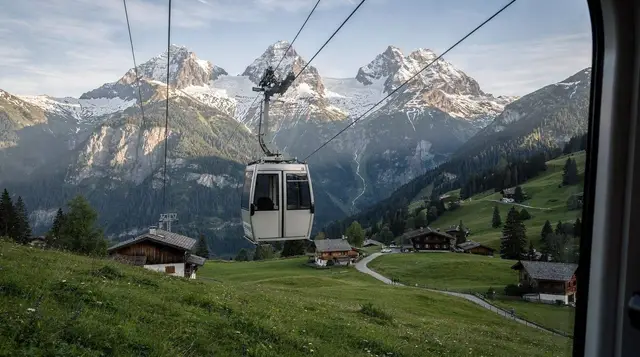
The final stage of the ascent, from the mid-station at Stand to the Titlis summit, is where the Rotair cabin operates. Opened in 1992, it was the first cable car in the world built with a rotating cabin floor: during the roughly five-minute ride, the floor turns a full 360 degrees, so every passenger faces the glacier, the surrounding cliffs and the Engelberg valley in turn without needing to move or jostle for the window side. It’s a genuine piece of engineering rather than a gimmick bolted on for tourists, and it’s still the only cable car of its kind on this scale in Switzerland.
The ride climbs over broken glacier ice and crevasses, and on a clear day gives views stretching toward the Bernese Alps in one direction and the central Swiss lakes in the other. On a cloudy day, expect white-out — Titlis sits high enough that low cloud is common even when Engelberg and Lucerne are clear, so check the live webcam before you leave rather than relying on the forecast for the valley floor.
The Titlis Cliff Walk
The Cliff Walk is a 100-metre-long suspension bridge, one metre wide, strung across a ridge at 3,041m near the summit station. It opened in 2012 and is marketed as Europe’s highest suspended bridge — a fair claim, since it beats most of the Alpine competition on altitude if not on length. The bridge sways in wind, which is the point rather than a flaw, and it closes outright above a certain wind speed for safety, which happens often enough in an exposed location like this that you shouldn’t assume it’ll be open on the day you visit.
Crossing takes a couple of minutes if you don’t stop; most people do stop, for photos over the glacier crevasses below, which is exactly what creates the bottleneck at busy times. There’s no separate ticket for the Cliff Walk — it’s included with the ascent — so the only real planning decision is timing your visit to avoid a queue on a metre-wide bridge with people trying to take photos in both directions at once.
The glacier ice cave
Below the summit station, a tunnel roughly 150m long has been cut into the Titlis glacier itself, lit from within so you can see the compressed blue-white ice up close. It sits at a constant temperature a couple of degrees below freezing regardless of the season outside, which means every visitor needs a layer warmer than what got them comfortably around Lucerne that morning. Like the Cliff Walk, it’s included in the summit ticket, and the walk-through takes about ten minutes unless you’re queuing behind a tour group, which at midday you usually will be.
It’s worth treating the ice cave as what it is: a man-made tunnel through natural glacier ice, interesting for the geology and the novelty rather than a wilderness experience. If you want a starker sense of an actual glacier’s scale, the day trip to the Aletsch glacier or Gornergrat and the Matterhorn Glacier Paradise both give more of that, at the cost of considerably more travel time from Interlaken.
Snow in August, and what’s actually there
Titlis markets itself heavily on the idea of snow in summer, and there is a maintained patch near the top station kept going through the warmer months for photos, sledging runs and beginner ski lessons — the first-time ski experience at the summit snow park runs on exactly this area. It’s real snow, not artificial, but it’s a managed feature rather than an untouched glacier field: groomed, roped off in places, and shared with a lot of other visitors doing the same thing you are.
Being honest about it: in a hot, dry summer the snow zone has visibly shrunk by late August, and some years it gets patchy or slushy enough that the operator scales back what’s on offer. If snow photos in summer clothing are the specific reason you’re making the trip, it’s worth checking the current conditions on the operator’s site the morning of your visit rather than assuming the postcard version will be waiting. The glacier itself, like most in the Alps, has been retreating for decades, and Titlis is not an exception.
Prices, tickets and what’s included
| Ticket | Adult (CHF) | Notes |
|---|---|---|
| Engelberg to Titlis, return | ~96 | Half Fare Card and Swiss Travel Pass holders get a reduction, not a free ride |
| Children (6–15) | ~48 | Under 6 generally free with a paying adult |
| Ice cave | Included | No separate charge |
| Cliff Walk | Included | No separate charge; closes in high wind |
| Snow park equipment hire | Extra | Sledges and ski gear rented separately at the top |
Prices move year to year, so treat these as a working budget rather than a quote. What matters more than the exact franc amount is that Titlis is not a cheap half-day out once you add the Lucerne–Engelberg trains on top of the cable car: for a couple, the round trip from Interlaken including trains and lift tickets comfortably clears CHF 250–300 for the day. If that feels steep against a shorter trip, Harder Kulm or Niederhorn give a mountain view for a fraction of the cost and travel time, without the ice cave or the bridge.
Beating the queues
Titlis is a fixture on coach tours out of Lucerne, and the summit station, the Cliff Walk and the ice cave all bottleneck the same way between roughly 10.30am and 2pm, once the first wave of day-trip buses has arrived. The fix is simple and reliable: take the first or second cable car up from Engelberg in the morning. You’ll have the Cliff Walk close to empty, get through the ice cave without queuing behind a tour group, and be back down before the crowds peak — leaving the rest of the day free, or giving you the option to add a short walk around Trübsee, the lake at the base station, before heading back to Lucerne.
Weekday visits outside Swiss and Central European school holidays are consistently quieter than weekends. If you can only go on a weekend, the early-departure rule matters even more.
What to wear and altitude notes
Engelberg sits around 1,000m; the summit is over 3,200m, so the temperature drop is real even in summer — often 15–20°C colder at the top than at the valley station. A proper jacket is non-negotiable for the ice cave and the Cliff Walk regardless of the season, and sunglasses matter more than people expect: reflected glare off snow and ice at altitude is stronger than the ambient temperature suggests. See altitude, weather and what to pack for the fuller version of this advice, which applies just as much on Titlis as it does on the Jungfraujoch or Schilthorn.
Most visitors don’t spend more than an hour or two at the summit itself, which limits any altitude effects, but if you’re sensitive to elevation changes, moving at an ordinary pace between the Rotair, the Cliff Walk and the ice cave rather than rushing between all three is the sensible approach.
Titlis compared with other Swiss summits
| Altitude | Access from Interlaken | Standout feature | |
|---|---|---|---|
| Mount Titlis | 3,238m | ~3 hrs via Lucerne and Engelberg | Rotair, Cliff Walk, ice cave |
| Jungfraujoch | 3,454m | Direct from Interlaken Ost | Highest railway station in Europe |
| Schilthorn | 2,970m | Via Lauterbrunnen or Stechelberg | Revolving restaurant, 360° panorama |
| Mount Pilatus | 2,132m | Via Lucerne | Steepest cogwheel railway in the world |
| Mount Rigi | 1,798m | Via Lucerne | Gentler, less crowded, lake views |
If Titlis and Pilatus are both under consideration for the same Lucerne day, they’re roughly comparable in cost and travel time but very different in character — Titlis for the glacier features, Pilatus for the railway itself and the lake steamer approach. Either works better paired with a full Lucerne day trip than bolted onto a the Jungfrau Region itinerary, since the travel logistics don’t really overlap. For a broader view of how Titlis fits against the excursions closer to Interlaken, our roundup of the best mountain excursions from Interlaken covers where it sits in the pecking order.
Travellers building a longer stay sometimes fold Engelberg into a wider loop through central Switzerland — the day trip linking Zurich, Lucerne and Engelberg with the Titlis ascent is aimed at exactly that, useful if you’re coming from Zurich rather than Interlaken. For anyone extending the visit with more time in Obwalden itself, the guided mountain bike route through the Obwalden countryside and independent options like the self-guided Lucerne city and mountain pass both work as a second day rather than trying to cram everything into the same afternoon as Titlis.
If you’d rather build the whole trip around the Jungfrau side of the Bernese Oberland instead, our three-day Jungfrau region highlights itinerary sticks to destinations directly reachable from Interlaken, and our full mountains and peaks category rounds up every summit trip covered on this site, Titlis included.
Mount Titlis: frequently asked questions
Can I visit Mount Titlis from Interlaken in one day?
Yes. Leave Interlaken Ost early, change in Lucerne for Engelberg, and count on roughly three hours of travel each way including the cable cars. A first departure before 8am gives you the whole day at altitude and back to Interlaken by early evening.
Is there really snow on Titlis in August?
There is a maintained snow area near the top station used for photos, sledging and beginner ski lessons, kept going through summer. It has shrunk in recent hot summers, and by late August it can be smaller and slushier than photos suggest, so treat it as a novelty rather than a proper snowfield.
How much does the Titlis cable car cost?
The return trip from Engelberg to the summit costs around CHF 96 for an adult without a discount card, with reductions for Half Fare Card holders and children. The ice cave and the Cliff Walk are included in that ticket; there is no separate charge to enter either.
What is the Rotair?
The Rotair is the cable car cabin on the final stage from Stand to the Titlis summit. The cabin floor rotates a full 360 degrees during the roughly five-minute ride, so every passenger gets a turn facing the glacier, the cliffs and the Engelberg valley without moving.
How do I avoid the crowds on Titlis?
Take the first or second cable car of the day from Engelberg, on a weekday outside school holidays if possible. Titlis is a fixture on coach tours from Lucerne, and the summit station and the Cliff Walk both bottleneck badly between about 10.30am and 2pm.
Does Titlis close in bad weather?
The Cliff Walk closes in high wind, and the whole system can suspend service in poor visibility or storms, plus scheduled maintenance closures in spring and autumn. Check the Titlis status page or ask at the Engelberg valley station before you commit to the trip.
Is Titlis better than the Jungfraujoch or Schilthorn?
They are different trips rather than better or worse. Titlis has the Cliff Walk, the ice cave and the Rotair but sits outside the Jungfrau region proper and needs a change in Lucerne from Interlaken; the Jungfraujoch is higher and more directly linked to Interlaken’s own rail network.
Mountain excursions on GetYourGuide
Verified deep-linked GetYourGuide tours. Book through these links and we earn a small commission at no cost to you.
GetYourGuide does not provide a product photo for this activity — the image shows the meeting point, photographed by us.