Solothurn doesn’t come up much in first-time Switzerland planning, and that’s the case for going: a baroque old town on the Aare, built almost entirely in one architectural style within one century, with a genuinely odd local obsession with the number eleven running through it. It sits in the canton of the same name, on the river between Bern and Biel/Bienne, and it’s a realistic add-on to a Bern day rather than a destination in its own right from Interlaken — the train ride alone takes a chunk out of the day.
If you’re still deciding how Solothurn fits into the wider trip, the day trips from Interlaken overview shows what else competes for the same day, and Bern is the natural base to pair it with. Travellers who like the idea of a quieter baroque town may also compare it with Lucerne and the Interlaken vs Lucerne guide.
Getting to Solothurn from Interlaken
There’s no direct train. The standard route is Interlaken Ost to Bern (about 52 minutes), then a change onto the Bern–Biel/Bienne line to Solothurn (roughly 30 minutes, half-hourly), with a connection time in Bern usually under 15 minutes. Door to door that’s around 1h40, sometimes 1h50 depending on the connection.
| Leg | Duration | Notes |
|---|---|---|
| Interlaken Ost to Bern | ~52 min | Direct, roughly every 30 min |
| Bern to Solothurn | ~30 min | Direct, half-hourly |
| Total, one way | ~1h30-1h50 | Depends on connection |
A Swiss Travel Pass covers the whole route; without one, a standard second-class return from Interlaken Ost is roughly CHF 70-80 per adult, cheaper with a Half Fare Card. If you’re doing this as a genuine day trip rather than an extension of a Bern stay, that’s over three hours of travel for a day that realistically gives you six or seven hours on the ground — worth knowing before you commit to it. Details on passes and how they stack are in the /guides/swiss-travel-pass-guide/ and the wider /guides/trains-buses-and-boats-around-interlaken/.
St Ursen Cathedral and the number that runs through Solothurn
The cathedral — Kathedrale St. Ursen — is the reason most people photograph Solothurn’s skyline. It was built between 1762 and 1773 to a design by the Ticino architect Gaetano Matteo Pisoni, in a restrained, almost severe late-baroque style with a pale sandstone facade and twin towers that are visible from most of the old town and from the river.
The staircase in front of it is the physical anchor of Solothurn’s best-known local story: the town’s supposed fixation with the number eleven. The claim, repeated by guides and on plaques around town, is that Solothurn has eleven churches and chapels, eleven towers, eleven fountains, eleven guilds from its old craft-guild system, eleven bells in the cathedral, an old town clock that historically struck only up to eleven, and a cathedral staircase built in flights that echo the number.
Not every individual claim survives close scrutiny — some of it is folklore dressed up as fact, and locals will happily admit that — but it’s a genuinely enjoyable frame for walking the old town, because it sends you looking for eleven-based details in doorways, fountains and facades you’d otherwise walk straight past.
Inside, the cathedral is plainer than its exterior suggests — white stucco, restrained gilding, a treasury (Domschatz) with liturgical silver you can see on a separate ticket. Climbing the tower, when it’s open, gets you a view over the old town’s roofline to the Jura foothills; check the current hours at the cathedral office rather than assuming it’s open, since access is seasonal and depends on staffing.
A guided walk is the easiest way to get the eleven-motif details explained properly rather than half-remembered from a leaflet:
a guided walking tour of Solothurn’s old town covers the cathedral, the fountains and the fortifications with someone who actually knows which of the eleven claims hold up.
Switzerland’s most consistently baroque old town
Solothurn’s claim to be Switzerland’s most baroque town is more defensible than the eleven business. Much of the centre was rebuilt after a fire in the 17th century and again through the 18th, in a fairly narrow window of time, which is why the old town reads as unusually coherent — there’s less of the medieval-into-Gothic-into-neoclassical patchwork you get in Bern or Lucerne.
Worth building a walk around:
- Jesuit Church (Jesuitenkirche), on the main street — a much richer interior than the cathedral, with an illusionistic painted ceiling (trompe l’oeil) that’s one of the best surviving examples of the style in Switzerland.
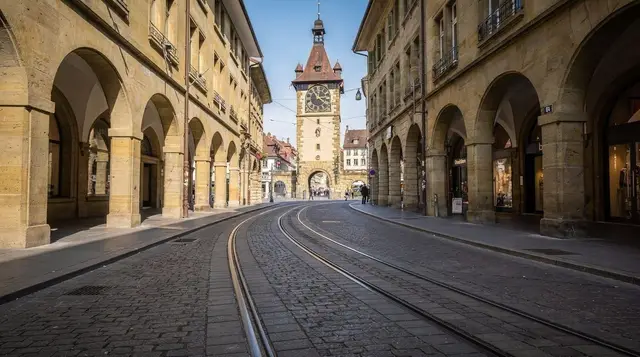
- Zeitglockenturm, the town’s clock tower, older than Bern’s and with its own astronomical clock face.
- The old fortifications — Baseltor and Bieltor gates, and sections of the town wall and bastions along the river, a reminder that Solothurn was a genuine fortress town for centuries.
- Altes Zeughaus (Old Arsenal), now a museum holding one of Europe’s larger collections of historic arms and armour — several floors of it, more than the building’s plain exterior suggests.
- Kunstmuseum Solothurn, a small but well-regarded fine art museum with a Madonna by Hans Holbein the Younger among its holdings.
- Ritterquartier, the old ambassadors’ quarter near the cathedral, where France’s envoys to the Swiss Confederacy were historically housed — a legacy of Solothurn’s old role as a diplomatic seat.
None of this takes long to walk between — the old town is compact enough to cover on foot in an afternoon, with cafes on the main squares for breaks. For a shorter, more flexible option than a fixed-route guided walk:
a private city tour of Solothurn, 60 or 90 minutes lets you weight the time towards whichever of the museums or churches interests you most.
The Aare cruise from Biel/Bienne
The Aare threads along the edge of the old town, and one of the more relaxed ways to see Solothurn is to arrive or leave by boat rather than train, on the seasonal Bielersee Schifffahrtsgesellschaft (BSG) service between Biel/Bienne and Solothurn. The crossing runs roughly April to October and takes about 1h35 one way, passing reed beds and a small nature reserve (the Vogelinsel, “bird island”) before the river opens out towards the town.
It’s not a fast way to travel — you’d get between the two towns by train in under 30 minutes — but it’s a pleasant one, and it works well as a one-way leg: take the train out to Solothurn, spend the day in the old town, then cruise back to Biel/Bienne for the return connection to Bern and Interlaken. Check the current-year timetable before planning around it, since sailings depend on water levels and are trimmed at the edges of the season.
Weissenstein and its funicular
Above Solothurn to the north rises the Weissenstein, a Jura ridge at around 1,300 metres reached by a rack funicular from the suburb of Oberdorf. On a clear day the panorama is the real draw — an uninterrupted line of the Bernese, Valais and even some Mont Blanc-area peaks along one horizon, with the Mittelland and the town laid out below on the other side. It’s a genuinely different view of the Alps from what you get standing among them at Jungfraujoch or Schilthorn: distant, layered, and — because you’re looking north to south across the whole range — unusually legible.
Two honest notes before you build a day around it. First, getting there involves a bus or short train from central Solothurn out to Oberdorf before the funicular, adding time on both ends — factor in 30-40 minutes each way beyond the funicular ride itself. Second, the Weissenstein funicular has a history of extended closures for renovation and maintenance, on top of the usual spring and autumn service breaks that affect most Swiss mountain railways. Check current operating dates directly before you plan around it; turning up to a closed funicular after the Solothurn detour is the kind of day that sours an otherwise good trip.
There’s a hotel and restaurant at the top, and marked hiking trails along the ridge if you want to turn the visit into a proper walk rather than a there-and-back.
Food, and a natural add-on
Solothurn’s kitchens lean into the same regional dairy and charcuterie tradition as the rest of the Bern hinterland — rösti, sausages, and the onion tart (Zwiebelkuchen) that shows up on menus around the old town, especially in autumn. It’s not a destination for a big food itinerary the way Gruyères or the Emmental heartland is, but it sits close enough to both that a Solothurn day pairs naturally with a stop at a working dairy on the way back through Bern territory:
an entry ticket to the Emmentaler Schaukäserei cheese dairy works well as a detour if you’re travelling by car or willing to build in an extra connection, and covers the cheese-making process the region is actually known for. More on that pairing in /guides/cheese-dairies-of-the-bernese-oberland/.
Making the day work in practice
A few habits make a long train day easier. Read the Bernese Oberland railways explained guide if the connections at Bern feel unfamiliar, and keep the luggage and lockers notes in mind if you’re carrying a bag between stations. Weather matters too: on a grey day the old town, the Jesuit Church and the museums still work, and the Interlaken in bad weather guide lists other indoor options for the days around it.
Solothurn also pairs well with other places on the Bern side of the trip. Fribourg, Biel/Bienne and Aarau and Olten are neighbouring towns worth a look if you’re building a longer loop, and the Zentrum Paul Klee and Bern museums guide suits anyone who wants more art after the Kunstmuseum. For a fuller plan that includes day trips, the Interlaken with day trips, 7 days itinerary shows where a Solothurn day could sit.
Is Solothurn the right day trip, or is something else?
Solothurn is a genuinely good day out, but it’s not mountain scenery, and if the trip is only worth it to you as an Alps day, this isn’t that. It suits people who’ve already done a Bern day, or who want a lower-key, less crowded old town than Lucerne’s — Lucerne pulls far more day-trip traffic and it shows on the Chapel Bridge and the lakefront in summer. If what you actually want on a “spare” day is another big mountain rather than a baroque town, the more direct option from the Interlaken side is a full Bernese Oberland day:
a small-group day trip to Mount Schilthorn and Mürren, departing from Bern covers the cable car up to Piz Gloria and the revolving restaurant, and is a reasonable way to combine a Bern-area stay with the mountains rather than the Jura.
For comparing the realistic time cost of Solothurn against other Bern-adjacent options, see /guides/day-trips-from-interlaken/ and /guides/bern-day-trip-from-interlaken/; for the wider question of how many days to give the region overall, /guides/how-many-days-in-interlaken/ and /guides/interlaken-travel-costs/ cover the budgeting side, with /guides/interlaken-on-a-budget/ if you’re trying to keep costs down across a longer trip. General traps to avoid on days like this — mistimed connections, closed lifts, overpriced set menus near the main square — are collected in /guides/tourist-traps-and-overpriced-things/ and /guides/best-mountain-excursions-from-interlaken/ if Weissenstein has you thinking about the bigger peaks instead.
If you’d rather stay closer to base, Bern’s own old town and Thun’s castle are shorter trips from Interlaken and don’t require the extra Solothurn leg — see /destinations/bern/, /guides/bern-old-town-walking-guide/, /destinations/thun/ and /guides/thun-old-town-and-castle-guide/. The Emmental valley, which sits between Bern and Lucerne, is the other natural pairing if cheese and countryside interest you more than architecture — /destinations/emmental/.
Practical information
| Item | Detail |
|---|---|
| St Ursen Cathedral | Free entry; tower and treasury access seasonal, check locally |
| Altes Zeughaus (Arsenal Museum) | Entry around CHF 8-10; closed Mondays in low season |
| Weissenstein funicular | Return fare roughly CHF 20-24 when operating; confirm current status before travelling |
| Biel/Bienne–Solothurn boat | Seasonal, April to October, roughly CHF 30-35 one way |
| Old town | Free to walk; most museums closed Mondays |
Frequently asked questions about visiting Solothurn from Interlaken
How do I get from Interlaken to Solothurn?
By train via Bern: Interlaken Ost to Bern (about 52 minutes), then a connecting train to Solothurn (about 30 minutes). Total journey time is roughly 1h30 to 1h50 depending on the connection, with services running about every 30 minutes on both legs.
Is Solothurn worth visiting as its own day trip from Interlaken?
It works better as an extension of a Bern day than as a standalone trip from Interlaken, since the travel alone takes over three hours round trip. If you’re already spending a day in Bern, the extra 30 minutes each way to Solothurn is easy to justify for the old town and cathedral.
What is the “eleven” legend about Solothurn?
Local tradition holds that the number eleven recurs throughout the town — in its churches, towers, fountains, guilds and the cathedral’s staircase. Some of the specific claims are more folklore than verified fact, but it’s a well-known and enjoyable frame for exploring the old town’s details.
Is the Weissenstein funicular always running?
No. It has a history of extended closures for renovation, on top of the routine spring and autumn maintenance breaks common to Swiss mountain railways. Confirm current operating status before building a day around it.
Can I combine Solothurn with the Aare boat cruise?
Yes. The seasonal BSG boat between Biel/Bienne and Solothurn runs roughly April to October and takes about 1h35 one way. A common pattern is to take the train out to Solothurn and the boat back to Biel/Bienne, or vice versa.
How does Solothurn compare to Lucerne as a baroque old town?
Solothurn is smaller, quieter and architecturally more uniform, since much of it was rebuilt within a fairly narrow window in the 17th and 18th centuries. Lucerne is larger, busier with day-trip tourism, and mixes several architectural periods, most famously around the medieval Chapel Bridge.
Do I need a full day for Solothurn, or is half a day enough?
Half a day covers the old town and cathedral comfortably. A full day is needed if you also want to add the Weissenstein funicular, one of the museums in depth, or the boat cruise to or from Biel/Bienne.