A city split down the middle by language
Biel/Bienne is Switzerland’s largest officially bilingual city: German on one side of most sentences, French on the other, and around 55,000 people who move between the two without much ceremony. It sits at the northern tip of Lake Biel (Bielersee/Lac de Bienne), where the canton of Bern meets the language border that runs through much of the country. Street names, restaurant menus and train announcements alternate between Biel and Bienne, and locals genuinely write the double name rather than picking a side.
The city built its modern identity on watches. Omega has its headquarters and a production site here, and Swatch Group’s presence runs deep enough that the watchmaking trade shapes the skyline: functional 20th-century industrial buildings sit a few streets from a well-preserved medieval old town, with an unusually large concentration of Art Nouveau and Art Deco houses from the boom years of the early 1900s in between. It is not a conventionally pretty Swiss town in the way Thun or Bern are, but it rewards people who like the specific combination of industrial history, design and water.
For anyone based in the Jungfrau region, Biel/Bienne is a long day out rather than a quick add-on. It works best paired with Bern on the same rail ticket, or treated as a deliberate one-subject day for watch fans and Rousseau readers.
Getting there from Interlaken
There is no direct train. From Interlaken Ost, trains run to Bern in about 52 minutes; from Bern, a further regional or InterCity service to Biel/Bienne takes 25-30 minutes, with a short connection window at Bern’s main station. Total journey time is typically 1h20 to 1h35 each way, so budget close to three hours of travel for the round trip alone.
A Swiss Travel Pass or Half Fare Card covers this route like any other SBB/CFF journey; there is no dedicated regional pass for Biel/Bienne itself, unlike the Berner Oberland Pass that covers travel closer to Interlaken. If you are combining the trip with Bern’s old town, buy a single ticket routed through both rather than two separate return fares.
Driving is possible (about 1 hour 10 via the A6/A1 motorways) but the old town and lakefront are best explored on foot, and parking near the centre is limited and metered like most Swiss city cores.
a guided day trip from Bern that combines Biel’s old town with an Omega Museum visit removes the logistics of timing the train connection and the museum slot on the same day, which is the main friction point of a DIY visit.
The old town: fountains, a bear pit look-alike and Art Nouveau streets
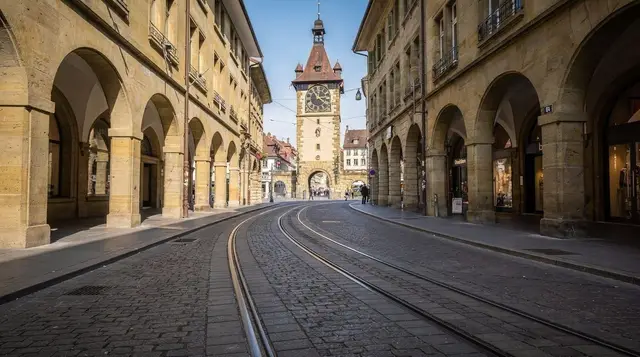
Biel/Bienne’s Altstadt/Vieille Ville centres on the Ring, a small triangular square that has served as the market and civic heart of the city since the Middle Ages. Red sandstone fountains from the 16th century stand at several corners, similar in style to Bern’s but far less visited. The Gothic Stadtkirche/Église du Bourg, with its restored 15th-century tower, anchors one side of the old town; step inside and the Reformation-era whitewashed interior is a plainer counterpart to Bern’s Münster.
What sets Biel/Bienne apart from other Bernese Oberland towns is the belt of Art Nouveau and Art Deco buildings just outside the medieval core, built during the watchmaking industry’s early-20th-century expansion. The Rue Centrale/Zentralstrasse and the streets around the Palais des Congrès carry decorative facades, wrought-iron balconies and stained glass that are unusual for a working industrial city rather than a resort town. It is worth twenty minutes of aimless walking rather than a fixed route.
a 60-minute walking tour with a local guide is a reasonable way to get oriented quickly if your day budget for Biel is tight, since the old town’s layout is compact but the context (which buildings are watch-industry money, which are older civic buildings) is not obvious without someone explaining it.
The Omega Museum
The Omega Museum sits on Biel’s Freundstrasse, close to the company’s production site, and covers the brand’s history from 19th-century pocket watches through the Moonwatch worn on the lunar surface in 1969 to current chronometer movements. Entry is free, which is unusual for a manufacturer museum of this quality, but space is limited and groups can fill it, so booking a visit slot ahead is worth doing in July and August.
The exhibits lean technical: movement mechanisms under magnification, historical advertising, and a section on the brand’s long relationship with sports timing and space missions. It suits people with a genuine interest in horology or design history more than a general sightseeing stop; if watches are not your subject, twenty minutes will cover it comfortably, whereas an enthusiast can spend well over an hour.
Biel/Bienne is also home to Swatch Group’s striking modern headquarters (the “Swatch Omega Campus”, visible but not generally open to casual visitors), a reminder that the watch industry here is a live employer, not just a heritage story.
Taubenloch Gorges
A short bus or tram ride from the centre (or about a 30-40 minute walk) brings you to the Taubenloch Gorges (Taubenlochschlucht/Gorges du Taubenloch), where the Schüss/Suze river has cut a narrow limestone gorge through the hills north of the city. A wooden walkway, built into the rock face over more than a century, follows the water past waterfalls and pools for around 3 kilometres one way.
The gorge is genuinely striking and far less crowded than comparable sites in the Jungfrau region, but it is seasonal: the walkway typically closes from November to March or April because of ice and rockfall risk, and can close temporarily after heavy rain at other times of year too. There is a small entrance fee. If you are visiting outside the core May-to-September window, check the current status before making the trip out, since there is little else to do at the gorge entrance if it is shut.
Lake Biel and St Peter’s Island
Lake Biel (Bielersee/Lac de Bienne) is smaller and less developed for tourism than Lake Thun, with vineyard-covered south shores around Twann and Ligerz producing some of the better-regarded white wines in the canton. Passenger boats run from Biel’s harbour along the lake between roughly April and October, similar in style to the paddle-steamer network on Lake Thun and Lake Brienz but on a smaller scale and with fewer daily departures.
The lake’s best-known destination is St Peter’s Island (St. Petersinsel/Île Saint-Pierre), technically a peninsula connected to the shore near Erlach by a narrow isthmus that floods in high water. Jean-Jacques Rousseau spent six weeks here in the autumn of 1765, having fled persecution after the publication of Emile, and later wrote about the stay in his Reveries of a Solitary Walker as the happiest period of his life. The building he stayed in, a former Cluniac priory, is now a restaurant and small guesthouse, and a modest exhibit inside marks the connection.
Boats from Biel to the island take around 50 minutes; alternatively, walking or cycling the isthmus from Erlach takes roughly 30-40 minutes each way when water levels allow it. There are no cars on the island itself, and the paths around its edge make for an easy, flat 45-minute circuit.
Comparing the two access routes to Biel/Bienne
| Route | Time from Interlaken | Notes |
|---|---|---|
| Train via Bern | 1h20-1h35 | Best combined with a Bern stop on the same ticket |
| Driving via A6/A1 | About 1h10 | Parking near the old town is limited and metered |
| Guided day tour from Bern | Full day | Bundles transport, Omega Museum slot and old town walk |
What a day in Biel/Bienne actually costs
A no-frills day (train fare, museum entries, a simple lunch) runs roughly CHF 60-90 per person beyond your Interlaken accommodation, since the Omega Museum itself is free and the Taubenloch Gorges entrance fee is modest. Add a guided walking tour or the Bern-Biel combined tour and a proper restaurant lunch, and CHF 150-190 is more realistic. A lake boat return fare to St Peter’s Island adds roughly CHF 30-40 depending on the season and departure point.
This is not a cheap add-on to a the Jungfrau Region itinerary once travel time and a full day’s meals are counted, which is why it suits travellers with a specific reason to go (watches, Rousseau, Art Nouveau architecture) rather than being a default day trip the way Bern or Lucerne often are.
Nearby options if you extend the trip
Biel/Bienne sits close enough to a handful of other towns that a Bernese lowlands day can be stretched further. Solothurn, one of Switzerland’s best-preserved baroque towns, is about 20 minutes further by train and pairs naturally with a Biel morning.
a guided walk through Solothurn’s baroque old town covers the cathedral and the town’s obsession with the number eleven (eleven churches, eleven fountains, eleven museums, by local tradition) in a compact couple of hours, and a private 60- or 90-minute city tour of Solothurn works well for a smaller group wanting more flexibility on timing.
Neuchatel, on the far side of the lake system, and Zurich are both reachable in under an hour from Biel/Bienne by rail, though either turns this into a two-destination day rather than a relaxed one.
Where Biel/Bienne fits in a wider trip
Because of the travel time involved, Biel/Bienne works better as part of a longer Swiss circuit than as a standalone Interlaken day trip. It sits naturally on the grand tour of Switzerland from Interlaken over seven days, and pairs well conceptually with other planned outings covered in day trips from Interlaken.
If your available time from Interlaken is limited to a single day, weigh Biel/Bienne against a day trip to Bern or Thun’s old town and castle, both of which sit closer and cost less travel time. Biel earns its place when the Omega Museum, the Taubenloch Gorges or Rousseau’s island are specifically what you are after, not as a generic “pretty Swiss town” stop.
For planning the wider transport picture, see the Swiss Travel Pass guide and getting to Interlaken from Zurich Airport if you are routing a longer trip through the Bernese lowlands. General day-trip budgeting is covered in Interlaken travel costs, and for city-focused sightseeing more broadly, see city sightseeing and the full destinations list.
Biel/Bienne travel FAQ
Is Biel/Bienne worth a day trip from Interlaken?
Yes if you care about watches, Art Nouveau architecture or Rousseau’s writing, but it is a long day: roughly 1h20-1h35 each way with a change in Bern. Combining Biel with Bern on the same rail ticket, rather than a standalone round trip, makes better use of the travel time.
Why does the city have two names?
Biel is the German name and Bienne the French one. The city sits almost exactly on the language border, is officially bilingual, and street signs, menus and announcements switch between the two without much pattern. Locals write it as Biel/Bienne.
Is the Omega Museum free?
Yes, entry to the Omega Museum in Biel is free, though you should book a slot in advance in high season because group visits can fill the small galleries.
Do you need a car to reach St Peter’s Island?
No. Boats run from Biel and from Neuchatel to St Peter’s Island between roughly April and October. Outside boat season, or if you prefer, you can walk or cycle the isthmus from Erlach, though it floods in high water and closes without warning.
Are the Taubenloch Gorges open all year?
No. The wooden walkway through the Taubenloch Gorges closes over winter, typically from November to March or April, because of ice and rockfall risk. Check the current dates before planning a visit outside summer.
Can Biel/Bienne be combined with Bern in one day from Interlaken?
Yes, and it is the more efficient option. Trains from Interlaken Ost to Bern take about 52 minutes, and Bern to Biel/Bienne is a further 25-30 minutes, so a Bern-plus-Biel day works on a single outbound and return journey rather than two separate round trips.