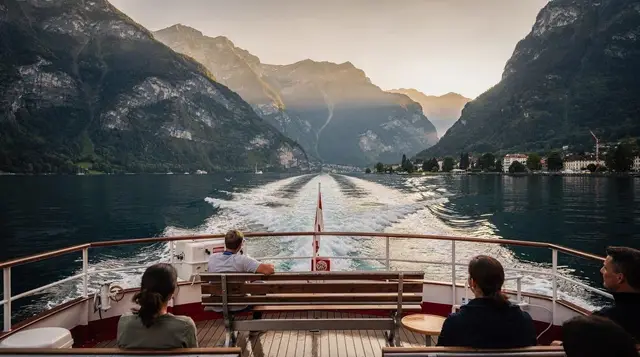
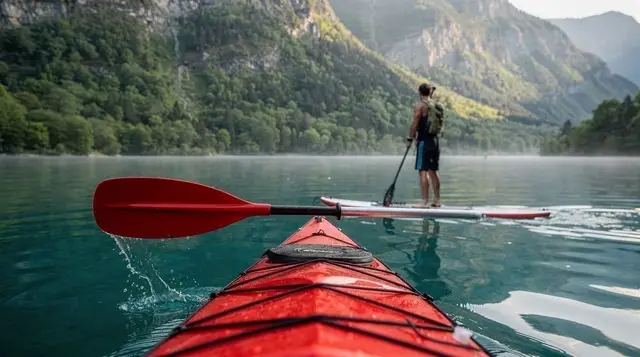
Why Neuchâtel is different from the rest of the Lake Geneva region
Most of the destinations grouped under Lake Geneva and Gruyères sit on or near Lac Léman. Neuchâtel doesn’t. It sits on Lake Neuchâtel, the largest lake entirely within Switzerland (Geneva’s lake is shared with France), about an hour further north. That geography is the first thing to get right: this is not a stop you tack onto a Montreux or Lausanne day, it’s a separate trip with its own train connection from Interlaken.
What you get for the extra distance is a town built almost entirely from the same pale yellow sandstone, quarried locally and used for everything from the château to ordinary shopfronts. Alexandre Dumas is credited with calling it a town that looks carved out of a single block of butter, and on a sunny afternoon the description holds up better than most quotes attached to famous writers who probably never said them. The old town, the collegiate church and the castle sit on a low hill above the lake, and the whole historic centre is small enough to see on foot without a plan.
Neuchâtel is also the historic centre of Swiss watchmaking and precision mechanics, which is why it’s home to one of the odder museum experiences in the country: three 18th-century automatons that still work, wound up and demonstrated on the first Sunday of most months.
Getting there from Interlaken
There’s no direct train. The standard route runs Interlaken Ost to Bern, then Bern to Neuchâtel, with a change of platform in Bern that’s usually well under 15 minutes. Total journey time is around 2 hours 15 minutes, and trains run roughly hourly through the day on the regular SBB timetable.
| Leg | Duration | Notes |
|---|---|---|
| Interlaken Ost to Bern | ~52 min | Direct InterRegio |
| Bern to Neuchâtel | ~35-40 min | Direct IC or IR |
| Total, one way | ~2h10-2h20 | Including the change in Bern |
A Swiss Travel Pass covers the whole route, as it does most of what’s described in this guide. If you’re paying per journey, a Half Fare Card cuts the fare roughly in half and pays for itself on a trip this long. Check Swiss Travel Pass guide before buying anything for a single day trip, since a pass rarely earns its price on one outing alone; it makes more sense if Neuchâtel is one leg of a longer loop that also takes in Bern or Lausanne.
Given the distance, this is a trip to plan as a deliberate day out rather than a spontaneous half-day, and it competes directly with closer options. If your priority is maximising sights per hour of travel, day trips from Interlaken covers the shorter alternatives; Neuchâtel earns its place mainly for people who specifically want the old town, the automatons or the Creux du Van, not as a generic “nice Swiss town” add-on.
The old town: what to actually walk
Neuchâtel’s centre is compact enough that a slow circuit takes 90 minutes to two hours, longer if you stop for coffee or duck into shops. The core streets worth walking are Rue du Château, Rue du Seyon and the arcaded Rue de l’Hôpital, all lined with that same yellow-grey sandstone and 18th-century facades. Unlike some restored old towns in Switzerland, this one is a genuine working centre with shops, offices and apartments rather than a museum piece, which means some streets look a little worn at street level between the postcard buildings.
A guided 60-minute walk with a local is a reasonable way to get oriented quickly if you’re short on time, since it covers the château hill, the market square and the lakefront in a single loop with someone who can point out details you’d otherwise miss, like the mechanical clock on the Collégiale or the carved doorways on Rue du Château.
The Place des Halles, the old covered market square, hosts a produce and flower market on Tuesday and Saturday mornings, worth timing your visit around if markets interest you. The lakefront promenade below the old town, the Jardin Anglais, is where locals actually spend their lunch breaks, with lake and Alps views on a clear day, and it’s a reasonable free alternative if the museums and château feel like enough indoor time already.
The château and the Collégiale
The Château de Neuchâtel sits on the hill above the old town and has been the seat of local government since the 12th century, which means most of it is used as administrative offices and is not open to casual visitors except on guided tours, usually run on weekend afternoons in season. Check the current schedule locally rather than assuming a walk-up visit is possible; this trips up a fair number of visitors who arrive expecting a museum-style castle.
Next to it, the Collégiale de Neuchâtel is a Romanesque and Gothic church, free to enter, and worth the few minutes it takes to see the Cenotaph, a 15th-century sculpted monument showing 15 painted figures including the counts of Neuchâtel, considered one of the more significant pieces of medieval sculpture in Switzerland. The terrace outside the church gives one of the better free viewpoints over the old town roofs and the lake.
The Jaquet-Droz automatons: the odd, genuine highlight
The three automatons made by Pierre Jaquet-Droz and his collaborators between 1768 and 1774, “The Writer,” “The Draughtsman” and “The Musician,” are held at the Musée d’Art et d’Histoire (MAHN) on the lakefront. Each one is a genuine 18th-century mechanical marvel: The Writer can be programmed to write any text up to 40 characters using a set of interchangeable cams, The Draughtsman produces four different drawings, and The Musician plays an organ while visibly breathing and following the music with her eyes.
They’re demonstrated live, wound up by hand, on the first Sunday of the month at set times (typically early afternoon), and the demonstration draws a genuine queue in high season, so arrive before the scheduled time if you want a clear view. Outside of the first Sunday, the automatons are on static display and still worth seeing, but the moving demonstration is the reason people specifically plan a visit around this museum. If your day trip doesn’t land on a first Sunday, factor that into whether the museum stop is a priority or a nice-to-have.
The Laténium, the archaeology museum a short bus or bike ride outside the centre on the lakeshore, is the other museum worth knowing about if you have a second day; it covers Neolithic lake-dwelling sites found in the region and is one of the larger archaeology museums in Switzerland, but it’s genuinely a separate outing rather than something to combine with the old town on a tight schedule.
What a day in Neuchâtel costs
| Item | Typical cost (CHF) |
|---|---|
| Return train, Interlaken-Neuchâtel (full fare, 2nd class) | 90-110 |
| Return train with Half Fare Card | 45-55 |
| MAHN entry (automatons) | 15 (free on the first Sunday of the month) |
| Château guided tour | Usually free, donation-based |
| Lunch, mid-range restaurant | 25-35 |
| Coffee and pastry | 8-12 |
A full day, including a sit-down lunch and the museum, runs roughly CHF 80-140 per person depending on how you handle the train fare and whether you eat cheaply or properly. That’s before any of the boat trips or wine tastings the wider Lake Neuchâtel region also offers, which aren’t necessary for a first visit but push the budget up if you add them.
Creux du Van: the reason to stay longer
About an hour’s drive or a combination of train and postbus from Neuchâtel, the Creux du Van is a natural rock amphitheatre roughly 1.4 km wide with cliffs up to 160 m high, carved by glacial and erosive action rather than a meteor impact, despite how it looks from photographs. It’s one of the more striking natural formations in the Jura mountains and genuinely comparable, in visual drama if not in scale, to viewpoints much further afield.
Getting there from Neuchâtel by public transport takes roughly 1 to 1.5 hours each way, via train to Noiraigue or Travers and then a postbus or a marked walking trail up to the rim. The standard approach from the village of Noiraigue is a signed hike of around 1.5-2 hours up to the viewpoint, meaning “an hour’s walk” is optimistic for most visitors starting from the valley floor rather than from a closer trailhead reached by car or postbus in summer.
Given the combined travel time from Interlaken (over 2 hours) plus the onward trip to the Creux du Van and back (another 2-3 hours round trip with the hike), this is not realistic as a same-day add-on to the old town. Treat it as the reason for a second day, an overnight stay in Neuchâtel, or a dedicated trip in its own right if the Creux du Van is genuinely your priority. Trying to squeeze both the old town and the Creux du Van into one day from Interlaken means a very early start and a late return, and most visitors end up shortchanging one or the other.
The best months for the hike are May through October; snow and ice on the exposed rim trail make it a poor idea, or at least a different, more technical proposition, in winter. Sturdy footwear is worth the effort even in summer, since the trail surface is uneven limestone and can be slick after rain.
Practical notes
Neuchâtel’s train station sits above the old town; it’s a 10-15 minute walk downhill to the lakefront, or a short bus ride if you’d rather save the climb for later. Left-luggage lockers are available at the station if you’re combining Neuchâtel with onward travel the same day, which matters given how long the return journey to Interlaken already runs.
The town is bilingual in spirit even though French is the dominant language locally, unlike Interlaken’s German-speaking Bernese Oberland; menus and signage lean French, and English is common in tourist-facing businesses but less universal than in the more heavily touristed parts of the Jungfrau region.
If you’re building a longer western Switzerland loop rather than a single day trip, Neuchâtel pairs reasonably with Fribourg or Gruyères using the same regional rail network, and the Gruyères and Broc day trip guide covers a similar cheese-and-chocolate combination in the Fribourg region if the automatons and clockwork theme appeals but you’d rather not commit to the Neuchâtel journey specifically.
For a shorter regional taste of Alpine cable-car scenery on the same rail lines, a day trip to Glacier 3000 from Montreux or a guided visit to Gruyère village covers ground closer to Lake Geneva itself.
Anyone treating this as one stop within a bigger circuit of the region, rather than a dedicated Neuchâtel day, should also check how many days in Interlaken makes sense overall, since a Neuchâtel add-on effectively costs a full day out of a Jungfrau-focused itinerary.
Frequently asked questions about visiting Neuchâtel from Interlaken
How long does it take to get from Interlaken to Neuchâtel?
Around 2 hours 15 minutes by train, changing in Bern. There’s no direct service, but connections are typically well-timed and run roughly hourly.
Is Neuchâtel worth the trip from Interlaken?
For an old-town and museum day it’s a solid but not essential option, since Bern and Thun offer similar architecture much closer to Interlaken. Neuchâtel’s specific draws, the working automatons and the Creux du Van, are worth the extra distance mainly if those two things interest you specifically.
Can you see the Jaquet-Droz automatons any day of the year?
They’re on static display year-round at the Musée d’Art et d’Histoire, but the live wind-up demonstration only happens on the first Sunday of most months at scheduled times. Check the museum’s calendar before planning around it.
Is the Creux du Van doable as part of a one-day trip from Interlaken?
Not comfortably. The Interlaken-Neuchâtel train alone takes over two hours each way, and the Creux du Van adds another 3-4 hours round trip including the hike from Noiraigue. Combining both in a single day from Interlaken means a very early departure and a late return.
Do you need a car to visit the Creux du Van?
No, but public transport requires a train to Noiraigue or Travers followed by a postbus or a signed walking trail, and the whole outing takes longer without a car than the “one hour’s walk” shorthand suggests.
Is the Château de Neuchâtel open to visitors?
Only via guided tours, typically on weekend afternoons in season, since most of the building is used for cantonal government offices. It’s not a walk-up museum visit.
What language is spoken in Neuchâtel?
French. It’s a noticeable shift from Interlaken and the German-speaking Bernese Oberland, though English is widely understood in restaurants and museums.
Does a Swiss Travel Pass make sense just for this trip?
Rarely for a single day. The pass earns its cost better if Neuchâtel is one stop on a longer multi-day loop through western Switzerland rather than a standalone return trip from Interlaken.