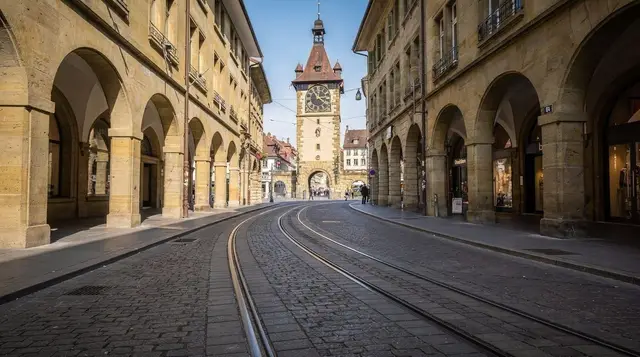
Swiss punctuality is not a myth
The first time a Swiss conductor told me my connection had exactly three minutes, I assumed it was a typo. I was standing on the platform at Spiez, watching a train from Bern pull in at one minute past the hour, and the departure board said my train to Interlaken left at four minutes past, from the platform opposite. Three minutes to get off, cross the platform, and get on. I have since taken that same change a dozen times and it has never once failed me. That is the part visitors don’t quite believe until they’ve done it themselves.
What the numbers actually say
The oft-repeated line about Swiss trains is that they run “on time,” but the real figure is more specific than that. SBB’s own annual reporting puts punctuality at around 90 to 93 percent of trains arriving within three minutes of the timetable, network-wide, including regional and mountain lines, not just the flagship intercity services between Zurich and Geneva. That three-minute margin is not an accident. It is baked into how the whole timetable is designed, and it is worth understanding if you’re building your own days out from Interlaken.
The Taktfahrplan, in plain terms
Switzerland has run on a cadenced timetable, the Taktfahrplan, since 1982. Instead of trains departing at scattered times decided route by route, each line runs at a fixed interval, usually every 30 or 60 minutes, at the same minute past the hour, all day. A train leaving Interlaken Ost for Lucerne might leave at 25 and 55 past every hour, every day, for the whole timetable year. Once you know that, you stop checking a specific departure and start thinking in terms of the pattern instead.
The reason this matters for connections is that the whole system is engineered around hub stations where several lines cross at the same few minutes each hour. Spiez is one of these hubs for anyone heading toward Lake Thun or on to Bern; Zweisimmen is another on the way to Gstaad and the GoldenPass line.
The timetable planners build in just enough time for a fit adult to cross a platform, no more, because giving everyone ten spare minutes at every junction would make the entire network far slower. You can read more about how the pieces fit together in our guide to trains, buses and boats around Interlaken.
A day where the minutes actually mattered
I want to walk through an ordinary day rather than a showcase one, because that is where the system proves itself. I left Interlaken Ost at 7:35 for the Jungfraujoch, changing at Lauterbrunnen and again at Kleine Scheidegg, both changes scheduled at around eight minutes, comfortable rather than tight. That itinerary is common enough that our Jungfrau railway guide and the broader piece on the Bernese Oberland railways both walk through it station by station.
The tight connection came later, on the way back. I’d decided on impulse to detour to Grindelwald rather than heading straight down, which meant catching the Wengernalp railway down to Grindelwald and then the newer Eiger Express cable car, which meant a genuinely tight four-minute window at Grindelwald Terminal between the cog train arriving and the gondola doors closing. I made it, mostly because Swiss stations are designed so the connecting platform or terminal is never more than a short, obvious walk away, with signage that tells you exactly which way to go the moment you step off.
If you’d rather someone else own that timing pressure for a day, a guided option removes the guesswork: the Interlaken Swiss Alps guided walking tour with cable car handles the connections for you while you focus on the view, and a hiking guide who also knows the timetable is worth the fee on a day when the margins are genuinely narrow.
Connections worth knowing, and how tight they run
| Connection | Typical change time | Hub station |
|---|---|---|
| Bern to Interlaken via Spiez | 4 to 7 minutes | Spiez |
| Zurich HB to Interlaken via Bern | 8 minutes | Bern |
| Lauterbrunnen to Kleine Scheidegg | 6 to 10 minutes | Lauterbrunnen |
| Grindelwald Terminal (train to Eiger Express) | 4 to 6 minutes | Grindelwald Terminal |
| Interlaken to Zweisimmen for the GoldenPass | 10 minutes | Zweisimmen |
| Interlaken to Lucerne via Brünig (Luzern-Interlaken Express) | direct, no change | — |
None of these look alarming written down, but the first time you’re the one sprinting across a Swiss platform with a rucksack, three minutes feels shorter than it sounds. It works because the platforms are close, the announcements are precise down to the minute, and staff expect you to be doing exactly this. For a same-ticket, no-fuss version of a cross-country transfer, the Luzern-Interlaken Express runs direct and removes the question entirely.
What actually goes wrong
Punctuality is not absolute. Heavy snowfall on the Kleine Scheidegg line, a rockfall notice on the Grindelwald side of the valley, or planned engineering work in the autumn maintenance window can all push a train back by ten or fifteen minutes, which is enough to break a three-minute connection.
When that happens, staff at the next station rebook you automatically, whether you’re on a point ticket or a Swiss Travel Pass, and the delay does not usually cost you anything beyond the wait. I’ve had it happen exactly once, on a January day when a signal fault near Bern added twelve minutes to an approach into Spiez, and the fix was simply boarding the next Interlaken service twenty minutes later, no new ticket required.
The lesson I took from that is not to distrust the timetable, but to leave one buffer connection somewhere in a demanding day rather than none. If every single change in your plan needs to work perfectly, build the day around Interlaken itself rather than a multi-valley loop, and treat detours like Bern or the Brünig route toward Lucerne as separate, lower-pressure days.
It also means checking the current timetable rather than an old screenshot, since cable cars and funiculars especially can shift schedules for wind or seasonal maintenance, a point covered in our wider list of day trips from Interlaken.
If a day of tight train connections sounds like more stress than scenery, an e-bike sidesteps the timetable altogether: the Discover Interlaken lakes, ruins and views e-bike tour covers ground at your own pace along the Bödeli, and a Harder Kulm hike booked as a guided hike to Harder Kulm with a Swiss triathlete starts right from town, no connection to make at all. Arriving from Zurich Airport, the timing questions start even earlier, which our guide to getting to Interlaken from Zurich Airport covers step by step.
The takeaway
Swiss punctuality is not a myth, but it is also not magic. It is a deliberately engineered system where every minute of a connection is a design decision, not a courtesy, and it rewards you for understanding that rather than fighting it. Once you stop treating a three-minute change as reckless and start treating it as normal, Switzerland’s trains stop being a source of anxiety and start being the most efficient part of the trip.
tours.Culture
Verified deep-linked GetYourGuide tours. Book through these links and we earn a small commission at no cost to you.
GetYourGuide does not provide a product photo for this activity — the image shows the meeting point, photographed by us.