Brienzer Rothorn: the steam train, the summit, and the walk down
Is the Brienzer Rothorn steam train worth the extra cost?
The steam supplement adds roughly CHF 20 to CHF 30 on top of the standard fare and only applies to specific rostered departures, usually late morning. The view from 2,350 m over Lake Brienz, Lake Thun and Lake Lucerne is the same whichever locomotive pulls the train, so the supplement buys nostalgia and noise, not scenery.
Switzerland’s last steam rack railway, in plain terms
The Brienzer Rothorn Bahn is the last rack railway in Switzerland that still runs steam locomotives on its regular timetable, not as a museum piece rolled out for photographs but as working machines that share the same track as ordinary diesel trains. It climbs from the lakeside town of Brienz to a 2,350 m summit above the Bernese Oberland, and it does it slowly enough, and loudly enough, that the ride is as much the point as the view. It is also one of the least crowded of the big Interlaken-area summits, mostly because getting there takes a deliberate detour rather than a single cable car from the town centre.
This guide covers what the steam supplement actually buys you, how the timetable and the weather interact, what the summit delivers over three lakes, and why the walk down through Planalp is worth doing at least once even if you rode the train up.
Getting to Brienz and the railway station
Start at Interlaken Ost, the eastern of the town’s two stations, and take a regional train or the Luzern-Interlaken Express toward Lucerne. Brienz is about 20 minutes away, and the line hugs the northern shore of Lake Brienz the whole way, so sit on the right-hand side going east for water views. From Brienz’s main station it is a five-minute walk along the lakefront to the separate Brienz Rothorn Bahn terminus; the two stations are not connected, so allow a buffer if you are catching a specific departure.
An alternative is the boat: Lake Brienz passenger boats call at Brienz on their way from Interlaken, and combining the cruise with the train is a pleasant way to arrive without doubling back on rails you have already used. Anyone doing this as a single outing rather than piecing it together themselves can book it as a package: a combined lake cruise and Rothorn steam train excursion covers the boat one way and the mountain railway the other, which avoids retracing the same route twice.
Steam or diesel, and what the supplement costs
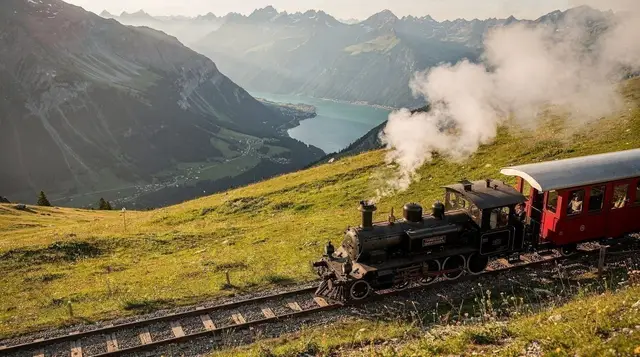
This is the detail most visitors get wrong before they arrive: not every departure on the Brienzer Rothorn Bahn is steam-hauled. The railway runs a mixed fleet. Most trains, including the first and last of the day, use HGe diesel locomotives built in the 1990s to resemble the historic engines, and they climb the mountain just as effectively and considerably more cheaply to operate. Genuine steam locomotives, several of them originally built between 1892 and 1936, are rostered onto specific mid-morning departures, typically only from around June to October, and only in reasonable weather.
The steam supplement runs roughly CHF 20 to CHF 30 per adult on top of the standard fare, paid separately at the ticket counter in Brienz, and it is not something the Swiss Travel Pass, Half Fare Card, or regional passes discount — those cover the base fare only. If you specifically want the steam experience, check the timetable board or the operator’s website the same morning, because the steam roster can be adjusted for maintenance or crew availability, and a diesel substitution is not always announced far in advance.
Whether it is worth paying is a matter of taste rather than scenery: the summit view is identical, the journey time is the same, and the rack-and-pinion mechanism does the actual climbing regardless of what is burning in the firebox. What steam buys is the smell of coal smoke, a slower and more deliberate rhythm on the steepest sections, and the sight of the locomotive’s boiler tilted forward to stay level on gradients that reach 25 percent. If that appeals, it is worth the money. If you mainly want to reach the top and back for a fixed budget, the diesel service does the same job for less.
The hour up the mountain
The full run from Brienz to Rothorn Kulm covers about 7.6 km and 1,678 m of ascent in a little over an hour, entirely on rack track, at a pace slow enough to watch the terrain change from lakeside meadow to spruce forest to open alpine pasture and finally bare rock. There are no tunnels of note, so the views build gradually rather than arriving all at once through a portal, which is part of why this ride feels different from the Jungfrau line’s underground final stretch.
Around the halfway point the train passes Planalp, a scattering of farm buildings and a mountain restaurant that will matter again later if you plan to walk down. Above Planalp the tree line falls away and the last kilometres run across open ground with Lake Brienz dropping steadily below on the left. The terminus, Rothorn Kulm, sits at 2,244 m; the actual summit and its viewpoint are a further ten-minute walk uphill on a good path, with a hotel and restaurant at the top for anyone who wants to linger over lunch rather than turn straight around.
What you actually see from the top
The Brienzer Rothorn’s summit is often sold on the promise of three lakes, and on a clear day it delivers: Lake Brienz directly below to the north, Lake Thun visible to the west past the Bodeli where Interlaken sits between the two, and Lake Lucerne appearing to the east beyond the Brünig pass on the clearest days. To the south the skyline is dominated by the familiar Bernese trio of the Eiger, Mönch and Jungfrau, seen here from an angle that most visitors, who view them from Interlaken or Grindelwald, never get.
The caveat is the same one that applies to every summit in this region: cloud sits on the Rothorn often enough that a clear-day view cannot be booked in advance. Because this is one of the cheaper and less crowded high points near Interlaken, it is a reasonable one to gamble on with a same-morning weather check rather than committing to it days ahead, unlike the Jungfraujoch, where the ticket price makes a wasted trip sting more.
For a fuller comparison of which summit rewards which kind of day, see the general rundown of mountain excursions from Interlaken, and the direct comparison of the Harder Kulm and Schynige Platte viewpoints, both of which are closer to town but lower and busier.
Walking down via Planalp
Riding the train both ways is the default, but walking down is the better use of a clear day. The path from the summit to Planalp drops about 700 m over roughly 6 km, well marked with the yellow diamond signs used across the Swiss hiking network, and it takes most walkers two and a half to three hours at a steady pace. The upper section is rocky and exposed, with switchbacks that benefit from trekking poles, before the trail eases into pasture and forest lower down.
Planalp itself is worth a stop rather than a pass-through: it has a working farm, a mountain restaurant serving simple food, and views back up to the peak you have just descended from. From there you can either continue walking down to Brienz on a lower, gentler stretch, adding another hour and a half, or catch the train for the final descent, which is the more common choice given that most of the dramatic scenery is already behind you by Planalp.
This is one of the better half-day hikes in the area precisely because the train does the hard climbing and you only have to manage the descent, a pattern covered more broadly in the guide to day hikes from Interlaken. Anyone building a longer outdoors itinerary around Brienz might also look at hiking to the wildlife park above Hofstetten as a lower-effort alternative on the same side of the valley, bookable as a guided hike from Hofstetten to the wildlife park if a marked trail alone feels insufficient.
Fares and journey times at a glance
| Leg | Duration | Approx. fare (adult return) |
|---|---|---|
| Interlaken Ost to Brienz (train) | ~20 min | CHF 9.40 (half fare CHF 4.70) |
| Brienz to Rothorn Kulm (rack railway) | ~1 h | approx. CHF 80–86 return, half fare discount applies |
| Steam locomotive supplement | — | approx. CHF 20–30 per person, no pass discount |
| Rothorn Kulm to Planalp (on foot) | 2.5–3 h | free |
| Planalp to Brienz (train, if not walking) | ~25 min | included on a Rothorn Bahn return ticket |
Fares change year to year and by season; treat the table as a planning guide and confirm current prices at the Brienz ticket counter or the operator’s own site before travelling.
Combining the Rothorn with the rest of Lake Brienz
Because Brienz sits at the base of the railway, it is easy to fold the mountain into a wider day on the lake rather than treating it as an isolated trip. A guided version that handles both halves in one booking is a guided ascent of the Brienzer Rothorn led by a Swiss triathlete, aimed at visitors who want route knowledge and pacing advice on the descent rather than navigating the Planalp path alone.
For a shorter, lower-commitment version of the same mountain, the aerial tram option covered by a return aerial tram trip to the Rothorn reaches similar terrain without the full rack-railway timetable, useful on a day when train departures do not line up with your schedule. And for visitors treating Brienz as one stop among several rather than the main event, a Bernese Oberland day trip by cable car covering several highlights packages the Rothorn alongside other viewpoints for a single day out.
Lake Brienz itself rewards a slower look beyond the train window. The boat trips guide covers the paddle steamer schedule and stops at Iseltwald and Giessbach, while the region’s distinctive turquoise water is explained in the Lake Brienz colour guide and the broader question of Lake Thun versus Lake Brienz for swimming and scenery.
Anyone wanting to get onto the water rather than just look at it should check kayaking and stand-up paddleboarding on Lake Brienz, or the calmer option of swimming in Lake Thun and Lake Brienz at one of the public lidos.
When to go, and when to skip it
The railway typically operates from late May or early June through to late October, closing outside that window for winter and undergoing scheduled maintenance in spring, the same pattern that affects most Bernese Oberland summit railways; see the general explainer on when mountain railways open and close if you are trying to plan a trip outside high summer. Within the operating season, the line does not run in high wind, heavy snowfall, or when lightning risk is forecast near the exposed summit track, and delays or cancellations are announced on the day rather than in advance.
Late June to September gives the best odds of clear views and ice-free paths for the Planalp descent. Shoulder-season visits in late May or October can be rewarding for smaller crowds but carry a higher chance of a train that only reaches a lower intermediate station if snow has closed the final stretch, so check the live status before committing a full day to the trip. If the forecast for the day looks doubtful, the lower and cheaper Harder Kulm, reachable straight from Interlaken Ost, is a safer bet, and the general guide to what to do in Interlaken when it rains covers other fallback options.
Common questions about the Brienzer Rothorn
Does every train up the Brienzer Rothorn run on steam?
No. Most departures use modern diesel locomotives built to look similar to the historic engines. Only a handful of trains per day, typically mid-morning in high season, run behind one of the original steam locomotives from 1892 to 1936, and only from roughly June to October.
How much is the steam supplement?
Budget an extra CHF 20 to CHF 30 per adult on top of the standard return fare, payable at the Brienz station ticket counter. It is not covered by the Swiss Travel Pass or Half Fare Card, which only discount the base fare.
How long does the journey to the summit take?
About an hour each way on the rack railway, covering roughly 7.6 km and climbing from 566 m in Brienz to 2,244 m at Rothorn Kulm station, from where it is a further ten-minute walk up to the 2,350 m summit viewpoint.
Can you see three lakes from the top?
Yes, on a clear day. Lake Brienz sits directly below, Lake Thun is visible to the west beyond the Bodeli, and Lake Lucerne appears to the east across the Brünig pass, with the Bernese Alps including the Eiger, Mönch and Jungfrau along the southern skyline.
Is the walk down to Planalp difficult?
It is a steady, well-marked descent of about 700 m in altitude over roughly 6 km, taking two and a half to three hours to Planalp, where you can catch the train the rest of the way down. Good boots and trekking poles help on the steeper switchbacks below the summit.
Does the railway close for weather or maintenance?
Yes. It typically operates from late May or early June to late October, with the schedule paused for spring revision, and the line does not run in strong wind, heavy snow or lightning risk near the summit. Check the official Brienz Rothorn Bahn site the morning of your visit rather than assuming a fixed timetable.
Are dogs allowed on the train?
Yes, dogs travel on a lead for a reduced fare, and the summit paths and the descent to Planalp are dog-friendly, though there is no shade at the top and rock can be hot in midsummer.
Is Brienz station the same as Interlaken Ost?
No. You take a regular train from Interlaken Ost to Brienz, around 20 minutes on the Luzern-Interlaken Express or the Brünig line, then walk about five minutes from Brienz mainline station to the separate Brienz Rothorn Bahn terminus by the lake.
Mountain excursions on GetYourGuide
Verified deep-linked GetYourGuide tours. Book through these links and we earn a small commission at no cost to you.
GetYourGuide does not provide a product photo for this activity — the image shows the meeting point, photographed by us.