Spa hotels in the Jungfrau region open to non-residents
Can non-guests use spa hotels in the Jungfrau region?
Yes. Several hotels in Interlaken, Grindelwald and Wengen sell day spa passes to non-residents, usually for CHF 35 to 90 for pool and sauna access, with treatments booked separately. Advance booking is strongly recommended, since capacity is limited and hotel guests get priority.
Day spa access: the basic rules
Nobody in the Jungfrau region advertises hotel spas to outsiders very loudly, but most of the larger properties in Interlaken, Grindelwald and Wengen do sell day passes. The catch is that none of them run this as a walk-up business. Spas are sized for hotel occupancy, not for a queue of day trippers off the 10:14 train, so capacity for non-residents is limited and bookable slots get released on a day-by-day basis around whatever the hotel’s own guests haven’t claimed.
The practical rules are fairly consistent across the region. Expect a minimum age of 14 to 16 for spa areas (this is strict, not a suggestion — staff will turn away younger children even if a parent is present). Swimwear is required in pools; saunas frequently follow the mixed-gender, textile-free convention standard in German-speaking Switzerland, with a separate towel-wrap etiquette rather than swimsuits inside the cabin. If that’s not something you’re comfortable with, ask at reception whether single-sex sessions or a swimsuit-permitted sauna exist — some hotels offer both. Bring your own flip-flops; rental towels and robes are usually included in the day-pass price but check when booking.
Booking ahead by phone or email, ideally a day or two out, is the single most useful piece of advice here. Weekends, the Christmas and New Year period, and peak ski weeks in January and February are the times day passes disappear first, because hotel occupancy is highest exactly when the pool looks most appealing from the outside.
The hotels that actually sell day passes
| Hotel | Location | Day pass (CHF, indicative) | What’s included |
|---|---|---|---|
| Victoria-Jungfrau Grand Hotel & Spa | Interlaken | 90–130 | Indoor-outdoor pool, sauna, steam room, fitness studio; treatments extra |
| Lindner Grand Hotel Beau Rivage | Interlaken | 60–90 | Indoor pool with Lake Thun-facing terrace, sauna, steam bath |
| Grandhotel Giessbach | Lake Brienz shore | 40–60 | Smaller indoor pool, sauna; strongest on setting rather than facilities |
| Belvedere Swiss Quality Hotel | Grindelwald | 45–70 | Rooftop pool facing the Eiger and Wetterhorn, sauna, steam room |
| Hotel Schweizerhof Grindelwald | Grindelwald | 35–55 | Indoor pool, Finnish sauna, panorama relaxation room |
| Sunstar Hotel Grindelwald | Grindelwald | 30–45 | Indoor pool and sauna, less view-driven, generally the best value in the village |
| Beausite Park Hotel | Wengen | 40–60 | Indoor pool, sauna, valley views; car-free village adds a bit of hassle for a day-only visit |
Prices move with season and demand and hotels revise them without much notice, so treat this table as a starting point for a phone call rather than a quote. A few properties bundle a light lunch or a drink voucher into a half-day package; ask, since it isn’t always advertised on the hotel website.
Grindelwald: the region’s best hotel-spa view
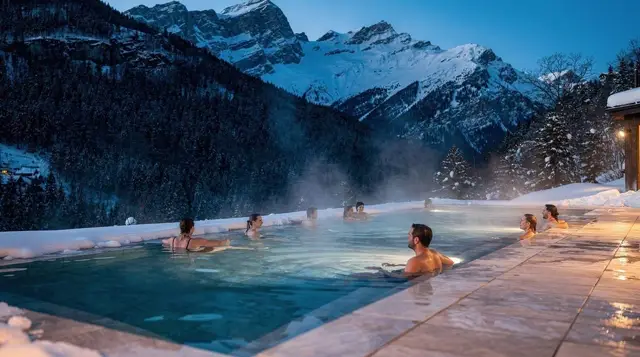
Grindelwald is the strongest single base for this kind of day out, which is why this guide is filed under the destination. The Belvedere’s rooftop pool is the one photograph that keeps circulating online, and it earns it: swimming laps at altitude with the Eiger’s north face directly in front of you is a genuinely different experience from an indoor hotel pool with a window. The catch is that the same view draws in day-pass demand from people who’ve seen the photo, so this is the property where advance booking matters most.
The Schweizerhof and Sunstar are more modest but also more reliably available, and both sit an easy walk from the village centre, useful if you’re combining spa time with things to do in Grindelwald or a rest day between hikes. None of the Grindelwald hotel spas compete on scale with Interlaken’s biggest properties — think one or two pools and a couple of saunas rather than a wellness complex — but the price reflects that, and the mountain backdrop does most of the work.
Interlaken: bigger facilities, bigger crowds, bigger bill
The Victoria-Jungfrau is the name most visitors have already heard before they arrive, and its spa is the largest and most polished in the region: around 3,000 square metres, an indoor-outdoor pool that opens onto the Höhematte lawn, several saunas and steam rooms, and a full treatment menu running from CHF 90 massages to half-day packages well over CHF 300. It’s also the most expensive day pass in this guide, and on a busy Saturday the pool can feel closer to a smart public bath than the tranquil retreat the brochure photos suggest. Worth it for the one-off experience; less obviously worth it as a repeat visit given what else CHF 100-plus buys elsewhere in Interlaken.
The Lindner Grand Hotel Beau Rivage is the more consistently good value of the two big Interlaken spas — smaller, quieter, and its terrace looks toward Lake Thun rather than the Jungfrau, which some visitors actually prefer since it avoids peak-hour crowding at the pool rail. For something smaller and further out, the Grandhotel Giessbach on the shore of Lake Brienz trades pool size for setting: it’s a 19th-century grand hotel reachable by its own funicular, and the spa is modest, but a day pass here doubles as an excuse to see one of the more atmospheric buildings in the region. See where to stay in Interlaken for how these hotels compare as overnight bases too.
What a day pass buys you versus a full treatment
| Package | Typical price (CHF) | What you get |
|---|---|---|
| Pool and sauna day pass | 30–90 | Access to pools, saunas, steam rooms, fitness area (hours vary, often 3–6 hours) |
| Half-day package | 80–160 | Day pass plus one treatment (massage or facial, 25–50 minutes) and sometimes a light lunch |
| Single treatment only | 90–220 | Massage, facial or body treatment; pool access sometimes included, sometimes not — always ask |
| Couples package | 200–400 | Two treatments plus pool access, often in a private suite; the most consistently overpriced option per minute of actual treatment time |
The couples package is the one to be most sceptical of. Across the properties in this region, the price premium for a “romantic” branded package rarely buys anything beyond a private room and a glass of prosecco; the treatment itself is the same massage offered individually for less than half the combined price.
Price-to-quality verdict
If the only thing you want is a swim and a sauna, the Sunstar in Grindelwald and the Lindner Beau Rivage in Interlaken deliver the best return on the franc: solid facilities, realistic prices, and none of the premium charged purely for a name or a view. The Belvedere’s rooftop pool is worth the extra cost once, specifically for the Eiger view, but it’s a photo-and-experience purchase rather than a wellness-facilities purchase.
The Victoria-Jungfrau is the hardest to recommend on value grounds — it’s the best-equipped spa in the region by a clear margin, but the day-pass price sits closer to what a full day at a regional thermal bath complex would cost, with a smaller pool and no outdoor mineral-water basins to show for it. If your priority is facilities over brand name, our guide to the thermal baths near Interlaken is the more efficient use of the same budget, and our broader sauna and alpine wellness guide covers standalone wellness centres that don’t require a hotel booking at all.
Booking, timing, and etiquette
Call or email the spa directly rather than the hotel’s general reservations line — response times are faster and the person answering will actually know that day’s availability. State the date, the number of people, and whether you want treatments alongside pool access, since some hotels block out treatment slots separately from pool capacity.
Turning up in ski boots is a genuine problem in January and February: the Jungfrau region’s ski season brings a spike in demand for exactly this kind of après-ski recovery, and hotels in Wengen and Grindelwald fill their day-pass allocation fastest on afternoons when the lifts close early for weather.
Winter is also when a hotel spa earns its keep most obviously, since the alternative on a bad-weather day or when it’s simply raining in Interlaken is a good deal thinner. Summer demand is steadier but less spiky, and midweek mornings are consistently the easiest slots to get.
Wengen’s spas come with one extra wrinkle worth flagging: the village is car-free, so a spa-only day trip means the train up from Lauterbrunnen and back, which adds roughly 40 minutes each way to what would otherwise be a straightforward pool visit. It’s a reasonable add-on if you’re already exploring Lauterbrunnen that day, less so as a stand-alone errand.
For those weighing a spa day against a further-afield option, some visitors extend the idea beyond the Bernese Oberland altogether. Zermatt runs a private night spa session that’s a different proposition entirely — later hours, a private setting rather than a shared hotel pool — reachable via the rail link through Spiez and Visp, though it’s a long day if you’re based in Interlaken and want to be back the same night.
Crans-Montana, further along the same rail corridor, takes wellness in a different direction with a nature-reset mindfulness and meditation session for anyone who’d rather pair rest with a hike than a swim.
Getting between hotels without a car
None of this requires a rental car, and driving between Interlaken, Grindelwald and Wengen for a spa day is more hassle than it’s worth given parking is limited at most hotels and non-guests aren’t guaranteed a space. The regional trains run every 30 minutes or better between Interlaken Ost, Grindelwald and the Lauterbrunnen valley, and a day pass under the Swiss Travel Pass or a regional ticket covers the whole loop cheaply.
If you’d rather not deal with connections and timetables at all, a private scenic train tour in Grindelwald covers the same ground with a guide handling the logistics, which suits a spa day nicely since you arrive relaxed rather than having navigated three timetables to get there.
Frequently asked questions about spa hotels in the Jungfrau region
Can you use a hotel spa in the Jungfrau region without staying there?
Yes, most of the larger hotels in Interlaken, Grindelwald and Wengen sell day passes to non-guests, subject to availability. Some smaller boutique hotels reserve spa access for their own guests only, so it’s worth checking before turning up.
How much does a day spa pass cost in Interlaken or Grindelwald?
A basic pool and sauna day pass typically runs CHF 35 to 60 on a weekday. Five-star properties such as the Victoria-Jungfrau in Interlaken charge closer to CHF 90 to 120, and that often still excludes treatments, which are priced separately from around CHF 90 for a 25-minute massage.
Do you need to book a day spa pass in advance?
Yes. Weekends, school holidays and the ski season fill up fastest, and several hotels cap the number of day visitors so their own guests aren’t crowded out. Phoning or emailing the spa reception a day or two ahead is the reliable approach; walk-ins are hit and miss.
Are hotel saunas in the Jungfrau region mixed and textile-free?
Often, yes. Following the wider German-Swiss convention, many hotel saunas are mixed-gender and swimwear-free inside the sauna cabin itself, with swimwear required in the pool area. This isn’t universal, so ask at reception if it matters to you, and expect some discomfort if you’re not used to the custom.
Which hotel spa in the region has the best view?
The rooftop pool at the Belvedere Swiss Quality Hotel in Grindelwald faces the Eiger and Wetterhorn and is widely regarded as the standout. In Interlaken, the Victoria-Jungfrau’s pool looks toward the Jungfrau massif over the Höhematte, though trees and buildings interrupt the sightline more than the marketing photos suggest.
Is a hotel day spa better value than a public thermal bath?
Not usually on price alone. A regional thermal bath such as the ones covered in our thermal baths guide costs less and includes larger pool facilities. Hotel day spas earn their premium on the view and on quiet, adult-oriented spaces rather than on facilities per franc spent.
What age can children use hotel spas in the Jungfrau region?
Most hotel spas set a minimum age of 14 to 16 for pool and sauna access, and this is enforced at reception regardless of parental supervision. Families travelling with younger children are better served by the region’s thermal bath complexes, which typically welcome all ages in designated pool areas.
Wellness & spa experiences on GetYourGuide
Verified deep-linked GetYourGuide tours. Book through these links and we earn a small commission at no cost to you.
GetYourGuide does not provide a product photo for this activity — the image shows the meeting point, photographed by us.