Faulhorn and Bussalp loop: the high route from Grindelwald First
How long does the Faulhorn and Bussalp loop take from Grindelwald First?
Allow around 6 hours for the full loop: about an hour from First to Lake Bachalp, another 1.5 hours up to Faulhorn at 2,681m, then 2 to 2.5 hours down to Bussalp for the bus. It only works in clear, calm weather — wind regularly shuts the First cable car and fog removes the entire point of the walk.
What the loop actually involves
The Faulhorn and Bussalp loop links three things that don’t usually sit in one day: the short, crowded walk to Lake Bachalp, a proper mountain summit at 2,681m, and a long, quiet descent that almost nobody bothers with. Start at the top of the Grindelwald First cable car, walk up to Bachalpsee, keep climbing to Faulhorn, then drop the far side to Bussalp for the bus back down to Grindelwald. It’s roughly 12km all in, with about 500m of ascent and 1,100m of descent, and it takes a fit walker around six hours including a stop at the summit hut.
The reason it’s worth the length is the second half. Everyone who takes the cable car up to Grindelwald First photographs Bachalpsee and turns back. Past the lake, the crowds thin out fast, and the ridge walk to Faulhorn opens onto the Eiger, Mönch, and Jungfrau on one side and the Brienzersee basin on the other, with almost nobody else on the path. The descent to Bussalp is unglamorous — steep grass and switchbacks with no view to speak of for the last hour — but it’s the price of doing the loop rather than the there-and-back everyone else does.
Getting up to Grindelwald First
Trains from Interlaken Ost run to Grindelwald in around 35 minutes, and the First cable car station (Grindelwald Terminal) is a short walk from the railway station, sharing a building with the Eiger Express terminal for Kleine Scheidegg and Männlichen. The First gondola runs in stages up to the top station at 2,168m in about 25 minutes.
| Item | Approximate cost (CHF) |
|---|---|
| First cable car, adult return | 80–90 |
| First cable car, adult one-way (for this loop, buy one-way up) | 60–70 |
| Postbus, Bussalp to Grindelwald | 8–10 |
| Berghaus Faulhorn, simple lunch | 20–28 |
Buy a one-way ticket up to First rather than a return, since you’ll come down by bus from Bussalp instead. The Berner Oberland Pass and Jungfrau Travel Pass both cover the First cable car and are worth checking against the one-way fare if you’re doing several mountain excursions in the same week, and the Interlaken guest card covers the local Postbus network on the way back down.
a guided version of the First to Bachalpsee walk that handles the cable car ticket and timing for you is worth considering if you’d rather not plan the logistics yourself, though the loop described here is straightforward enough to do independently with a map.
Stage one: First to Bachalpsee
From the top cable car station, the path to Bachalpsee is wide, well signed, and busy — this is the section every First visitor walks, and in July and August it can feel more like a queue than a hike for the first 20 minutes. It’s about 3.5km and an hour at an easy pace, with roughly 100m of gentle climbing. The lake itself, at 2,265m, is genuinely worth the crowds: two shallow pools reflecting the Wetterhorn and Schreckhorn on a calm morning, though by midday the water is often disturbed by wind and the mirror effect is gone.
This is the point to be honest about timing. Arrive at Bachalpsee before 9.30am if you want the reflection photograph without fifty other people in the frame, which means taking one of the first cable cars of the day. Arrive at noon in high season and you’ll be sharing the shoreline path with day-trippers who came for the lake alone and are heading straight back to First.
Stage two: Bachalpsee to Faulhorn
Past the lake, the crowd drops away almost immediately — most Bachalpsee visitors don’t continue. The path climbs steadily along the ridge, gaining about 420m over 2.5km, roughly 1.5 hours. The surface changes from gravel to rockier ground in the upper section, with some scree near the final approach to the summit that’s easy in dry conditions and unpleasant if wet or icy.
Faulhorn’s summit, at 2,681m, is one of the widest panoramas in the region: the Eiger’s north face, the Mönch and Jungfrau, the Schilthorn and Männlichen ridge to the west, and the Brienzersee laid out to the north below the ridge you’re about to descend. Berghaus Faulhorn, a working mountain inn since 1832, sits right on the summit and serves simple food — rösti, soup, sausage — to hikers rather than anyone who drove up, because nothing drives up. It’s the only real stop on the route and the natural lunch point.
Check conditions before committing to this stretch specifically, not just for the day overall. The ridge above Bachalpsee has no tree cover and very little shelter, and it’s the section most affected by wind, late snow, or an approaching storm — see when mountain railways and this route close for how the same weather that shuts cable cars also makes this ridge a bad place to be.
Stage three: Faulhorn to Bussalp
This is the long, unglamorous part, and it’s exactly why the loop stays quiet. From the summit, the path drops steeply at first, then settles into a long series of switchbacks down open alpine pasture toward Bussalp at 1,538m — around 6km and 2 to 2.5 hours, losing over 1,100m in total. There’s no view to compare with the ridge above; it’s grazing land, cowbells, and knees that will feel every one of those metres by the bottom.
Some hikers shorten this stage by branching off partway down toward First instead of continuing to Bussalp, effectively turning the loop back into an out-and-back with a Faulhorn summit added — a reasonable option if the legs or the clock are against you, though it means paying for the cable car back down rather than the cheaper bus.
Bussalp back to Grindelwald
Bussalp is a working alp with a small mountain restaurant and a Postbus stop, not a village. Buses run down to Grindelwald roughly hourly through the day in summer, take about 15–20 minutes, and cost a fraction of the cable car fare. Check the timetable before you set off from Faulhorn — missing a bus at Bussalp means either waiting close to an hour or walking further down the road, and there’s little else to do while you wait beyond the restaurant terrace.
Stage-by-stage summary
| Stage | Distance | Time | Elevation |
|---|---|---|---|
| First (2,168m) to Bachalpsee (2,265m) | 3.5km | ~1h | +100m |
| Bachalpsee to Faulhorn (2,681m) | 2.5km | ~1h30 | +420m |
| Faulhorn to Bussalp (1,538m) | 6km | ~2h–2h30 | −1,150m |
| Total | ~12km | ~5h–6h walking | +520m / −1,150m |
Add 30–45 minutes for a stop at Berghaus Faulhorn and the wait for a bus at Bussalp, and the full day from leaving Grindelwald to returning comes to roughly 7–8 hours including transport.
When this hike doesn’t happen
This is the section that matters more than the route description, because more days get cancelled than get walked in bad conditions. Three things stop this loop happening as planned:
Wind closes the First cable car. First is one of the more exposed lifts in the region and shuts in strong wind more often than Grindelwald’s other stations. No cable car up means no loop, full stop — there’s no reasonable walking alternative from the valley that keeps the day to a sensible length.
Fog removes the point of the walk. The entire second half of the route — the reason to do it instead of just visiting Bachalpsee — is the open view from the ridge and the summit. In cloud, Faulhorn is a cold, grey walk to a hut with nothing to see, and the descent to Bussalp is featureless pasture in mist. If the forecast shows cloud sitting on the summits, do Bachalpsee alone or choose a lower walk from the region’s easier options instead.
Afternoon thunderstorms build fast in summer. The Faulhorn ridge and the open slopes above Bussalp offer no shelter and no fast retreat. Starting late and being caught up there when a storm rolls in is the single most avoidable bad outcome on this route — start early, and treat any afternoon cloud build-up over the peaks as a reason to keep moving down rather than lingering at the summit.
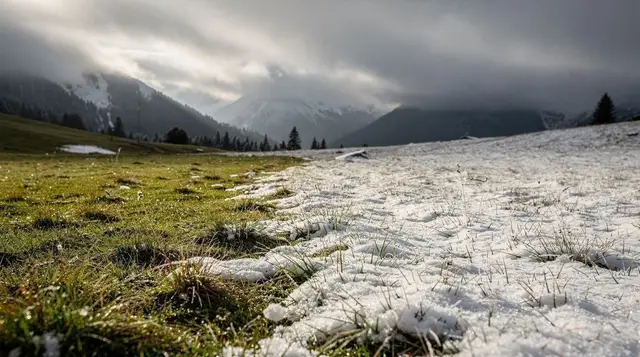
Snow is the fourth factor: patches can persist on the upper ridge into late June in a heavy year and return from October, and after fresh snow the scree sections near the Faulhorn summit turn treacherous. If in doubt, ask at the First cable car base station before buying a ticket — staff there generally know the current state of the upper route.
Fitness, gear, and timing your day
This isn’t a technical hike, but it is a long one with real elevation change and no easy bail-out for most of its length. Proper hiking boots rather than trainers make a real difference on the scree near Faulhorn and the loose gravel on the Bussalp descent. Poles help considerably on the way down. Bring more water than feels necessary — there’s no source between the lake area and Berghaus Faulhorn — and pack a layer for the ridge, which is reliably colder and windier than Grindelwald below regardless of the season; see what to pack for altitude for specifics.
Sun exposure is easy to underestimate at this elevation with little shade for most of the route. Sunscreen and a hat matter even on a cool-looking day. If you’re travelling with children or prefer a shorter, gentler day, the Bachalpsee walk on its own or a look at family-friendly mountain trips are better matches than this loop.
Shorter alternatives if the full loop doesn’t fit
Not every schedule or fitness level suits a six-hour ridge walk with 1,100m of descent. A few honest substitutes:
- Bachalpsee only, there and back to First: about 2 hours, flat by comparison, and the version most visitors actually want.
- First to Faulhorn and back the same way, skipping Bussalp: adds the summit and the views without committing to the long knee-jarring descent, at the cost of retracing the ridge.
- A different high walk entirely, such as the Hardergrat ridge or the Mannlichen to Kleine Scheidegg trail, both of which offer comparable views for less overall distance.
For a broader view of what else fits around a hiking-focused stay, the best day hikes from Interlaken covers how this loop compares to the region’s other classics, and the six-day hiking itinerary shows where a day like this sits alongside lower-effort options such as Schynige Platte.
If the forecast simply isn’t cooperating, Interlaken in bad weather and the best time of year to visit are worth reading before you commit a whole day to this route. For general category browsing, the nature and hiking section lists the region’s other walks side by side.
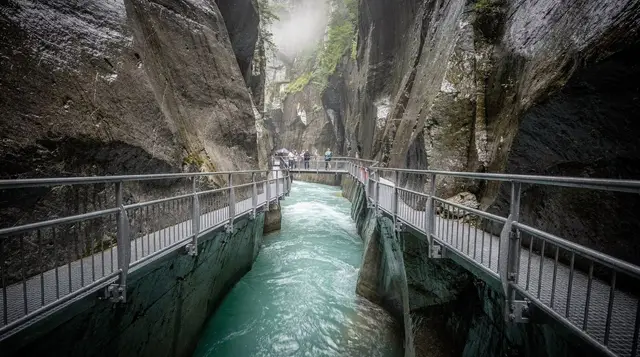
a shorter, low-altitude walk through Grindelwald’s Glacier Canyon makes a reasonable half-day fallback if the ridge is closed by wind or cloud when you arrive, since it sits at valley level and isn’t affected by the same conditions. For a day that combines this area with other Bernese Oberland highlights rather than focusing on one long hike, an organised mountain-adventure day trip from Interlaken to Grindelwald First covers the cable car and Bachalpsee section without requiring you to plan the connections yourself.
Faulhorn and Bussalp loop: frequently asked questions
How difficult is the Faulhorn and Bussalp loop?
It’s a long day rather than a technical one. The First to Bachalpsee section is broad and well graded, the climb to Faulhorn is steeper with loose scree near the summit, and the descent to Bussalp is relentless on the knees over more than 1,100m of loss. Reasonable fitness and proper boots matter more than climbing skill.
Can beginners do this hike?
A fit beginner who has done a few multi-hour walks before will manage it, but it isn’t a first-ever mountain hike. The distance, the altitude gain to Faulhorn, and the length of the final descent add up to a full day rather than a stroll, and there’s little shelter if the weather turns.
What happens if the First cable car is closed by wind?
The loop doesn’t happen that day. Without the cable car there’s no practical way up to First without adding hours of extra ascent from the valley, and the whole route depends on starting from the top station at 2,168m. Check the status before travelling to Grindelwald, not after arriving.
Is there snow on the trail in summer?
Patches can linger near Faulhorn’s summit ridge into late June or even early July in a heavy snow year, and they return from October. Between roughly mid-July and late September the route is normally clear, but ask locally after a late spring or an early autumn cold snap.
What time should I start to avoid afternoon storms?
Take the first or second cable car up, which usually means leaving Grindelwald by 8am or 8.30am. Alpine thunderstorms build through the afternoon in summer, and Faulhorn’s open ridge is the last place to be caught in one. Finishing the descent to Bussalp by early-to-mid afternoon is the safe target.
Can I do the loop in the opposite direction, from Bussalp up?
Yes, and some hikers prefer it because the steepest ground is then climbed rather than descended, which is easier on the knees. The trade-off is a harder ascent day and a longer final stretch across to First for the cable car down, so most people still find First-to-Bussalp the more manageable order.
Is there anywhere to eat on the route?
Berghaus Faulhorn, at the summit, serves simple hot food and drinks and is the only proper stop on the whole loop — worth timing lunch around. There’s also a restaurant at the First cable car station before you set off. Bussalp has a mountain restaurant near the bus stop for a coffee while you wait.
Hiking & nature tours on GetYourGuide
Verified deep-linked GetYourGuide tours. Book through these links and we earn a small commission at no cost to you.
GetYourGuide does not provide a product photo for this activity — the image shows the meeting point, photographed by us.