Switzerland’s biggest sheet of ice, and the villages built to look at it
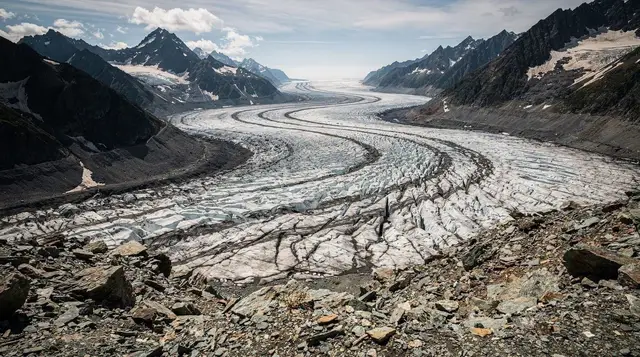
The Aletsch glacier runs for roughly 23 km down the northern flank of the Valais Alps, more ice than anywhere else in the Alps by a wide margin. It has been protected as part of the Swiss Alps Jungfrau-Aletsch UNESCO World Heritage site since 2001, the same listing that covers the Jungfraujoch on the Bernese side. The two sit on opposite faces of the same massif, but they are visited completely differently, by different trains, from different valleys, and most Interlaken visitors never make it to this side at all.
That is the case for going. The Aletsch Arena is the collective name for three car-free villages perched on the balcony above the glacier’s northern flank: Riederalp, Bettmeralp and Fiescheralp. None of them sits on the ice. All three sit a few hundred metres above it, connected by cable car from the Rhone valley floor, and each gives a different angle on the same glacier along with the Aletsch Forest, a nature reserve of ancient arolla pine that has been left alone since 1933.
None of this is a quick add-on to a Jungfraujoch day. It is a separate excursion, on a separate railway line, that happens to look at the same ice from the other side.
Getting there from Interlaken
There is no direct train. From Interlaken Ost, take the train to Spiez, where you change onto the BLS line towards Brig. That line runs through Kandersteg and the Lotschberg Base Tunnel, a route worth knowing in its own right if you are also curious about the Oeschinensee above Kandersteg. At Brig, change again onto the Matterhorn Gotthard Bahn branch that runs up the Rhone valley towards Fiesch; this is also the line you would take onward to Zermatt or Saas Fee, both roughly the same distance beyond Brig as Fiesch is before it.
Get off at the station that matches your chosen village: Morel for Riederalp, Betten Talstation for Bettmeralp, or Fiesch for Fiescheralp. Each has its own cable car straight up from the platform. Door to door from Interlaken Ost, budget around 2 hours each way, with one change at Spiez and one at Brig; miss a connection and add 30-60 minutes for the next train.
A Swiss Travel Pass or Half Fare Card covers the train legs at the usual discount; see the Swiss Travel Pass guide and the Jungfrau and Berner Oberland regional pass if you are trying to work out which covers more of this specific route, because neither regional pass reaches all the way to the Aletsch Arena’s cable cars, only the rail approach through Spiez. The three village cable cars themselves are priced separately, and that is where the Aletsch Arena Explorer Pass earns its keep.
an Aletsch Arena Explorer Pass covering the cable cars to all three villages is the simplest way to buy the lift access in one go rather than working out three separate tickets on the day, and it is worth doing the maths on it only if you plan to ride more than one of the three systems.
The three balconies: Riederalp, Bettmeralp and Fiescheralp
| Village | Altitude | Cable car from | Character |
|---|---|---|---|
| Riederalp | 1,925 m | Morel (about 4 min) | Closest to the Aletsch Forest and Moosfluh; quieter, more residential |
| Bettmeralp | 1,950 m | Betten Talstation (about 7 min) | Largest of the three, most hotels and restaurants, direct access to Bettmerhorn |
| Fiescheralp | 2,212 m | Fiesch (about 8 min) | Highest and starkest, launch point for Eggishorn |
All three villages are genuinely car-free, in the same way as Wengen and Murren are on the Bernese side: everything arrives by cable car, and once you are up there you walk, or take a small electric taxi if your hotel offers one. This changes the pace of a visit noticeably; there is no traffic noise, and children can be let out of sight without the usual road worries.
Riederalp is the pick if the Aletsch Forest and the Moosfluh viewpoint are your priority; it is a short, mostly level walk from the top of the village to the forest edge. Bettmeralp has by far the most beds, the most restaurants, and a lively summer programme, plus the Bettmerhorn cable car climbing to 2,647 m for a wide sweep of the glacier and the peaks beyond it, including the Matterhorn on a clear day. Fiescheralp sits highest and feels the starkest of the three, more rock and scree than meadow, but it is the base for Eggishorn, generally reckoned the single best glacier panorama the Aletsch Arena offers.
Bettmerhorn and Eggishorn: the two big viewpoints
From Bettmeralp, a cable car runs up to Bettmerhorn at 2,647 m. The top station has a restaurant and an open terrace looking directly across the glacier’s mid-section, with the Fiescherhorner and the back of the Eiger-Monch-Jungfrau wall visible in the distance on a clear day. It is a straightforward ride, no walking required to get a glacier view, which makes it the easiest option for anyone short on time or mobility.
Eggishorn, reached by a two-stage cable car from Fiescheralp, tops out at 2,869 m and is where most of the postcard shots of the full 23 km glacier come from. The final stretch of platform to the summit cross involves some rough, uneven ground rather than a paved path, so it needs sturdier footwear than Bettmerhorn does, but it does not require technical hiking. Both viewpoints close for scheduled maintenance in spring and again in autumn, and Eggishorn in particular closes on high-wind days since the top section is exposed; check the current status before committing a whole day to it, the same caution that applies to any mountain railway in this region.
If you want a genuinely alpine hike with glacier views rather than a cable car ride to a platform, a guided high-alpine hike to 2,869 m above Saas Fee covers similar altitude and similar glacier scenery one valley further south, and is worth comparing if the Aletsch Arena’s lift-based viewpoints feel too passive for what you had in mind.
The Aletsch Forest and its ancient trees
Below Riederalp, the Aletsch Forest (Aletschwald) has been a protected nature reserve since 1933, one of the oldest in the Alps. It is a stand of arolla pine (Swiss stone pine) and European larch clinging to the steep ground above the glacier’s lateral moraine, and some of the arolla pines are genuinely old: individual trees in the reserve are reckoned at several hundred years, with a handful of specimens estimated at close to a thousand.
The reserve is criss-crossed by marked paths, mostly gentle by Alpine standards, running through the trees with occasional breaks in the canopy that open onto the glacier below. This is a different kind of Aletsch Arena visit from the cable-car-to-viewpoint pattern above: quieter, shaded, and slower, more in keeping with a flat, easy walk than an alpine excursion, even though it happens to sit at 2,000 m. Wildlife sightings are possible but not guaranteed, chamois and marmots among them, in the same way as elsewhere in the region’s higher pastures.
Hiking the balcony trails
Beyond the forest, a network of longer trails runs along the balcony connecting all three villages, broadly known as the Aletsch Panoramaweg. Walking the full stretch from Riederalp to Fiescheralp via Bettmeralp, with the Moosfluh and Bettmerhorn viewpoints along the way, is a full day on foot, typically 5-6 hours of walking with the climbs and descents involved, and is one for hikers who already have a season’s worth of the best day hikes from Interlaken under their belt. Shorter sections, such as Riederalp to the forest and back, or Bettmeralp to Bettmerhorn and down, suit anyone wanting two or three hours rather than a full day.
Altitude here runs from around 1,900 m in the villages to nearly 2,900 m at Eggishorn, high enough that weather changes fast and afternoon cloud is common in summer; the same altitude and packing advice that applies on the Bernese side of the valley applies here too, if anything more so, since the Aletsch Arena’s trails are more exposed to sun and wind than the shaded valley walks around Lauterbrunnen.
A day trip budget
| Item | Approximate cost (CHF) |
|---|---|
| Return train, Interlaken Ost to Fiesch or Betten | 70-90 (half with Half Fare Card) |
| Aletsch Arena Explorer Pass (cable cars, one day) | 65-80 |
| Lunch at a mountain restaurant | 25-35 |
| Coffee or snack stop | 8-12 |
| Total per person | roughly 170-215 |
That total assumes full-price train tickets; a Swiss Travel Pass or Half Fare Card cuts the rail portion substantially, which matters more here than on shorter Bernese Oberland trips simply because the rail leg from Interlaken is longer than most. None of these are the region’s most expensive excursions by Swiss standards, but they add up quickly if you ride more than one cable car system without the combined pass, which is exactly the trap the Explorer Pass is built to avoid.
Combining Aletsch with the rest of Valais
Because the approach runs through Brig, the Aletsch Arena sits naturally alongside other Valais stops on the same line. Zermatt is roughly the same onward distance past Brig as Fiesch is before it, and Sion, the Valais cantonal capital, lies further down the Rhone valley in the other direction. Travellers building a longer loop through Zermatt or continuing on to Saas Fee sometimes fold in a half-day at Bettmerhorn or Riederalp en route, rather than treating the Aletsch Arena as a separate return trip from Interlaken; it is worth checking whether your itinerary already passes through Brig before booking a dedicated day.
For a broader look at how the Aletsch Arena compares with other high-altitude excursions reachable from Interlaken, including how it stacks up against a Jungfraujoch day, see the best mountain excursions from Interlaken and the wider list of day trips from Interlaken.
If you are also curious about the Top of Europe rail journey on the other side of the same massif, a full-day trip to the Jungfraujoch, the Top of Europe is the direct comparison point, and the two make an interesting pair if you have time to see the glacier from both sides on the same trip, though not on the same day.
Anyone building a longer stay around Interlaken with several such excursions folded in should look at the seven-day itinerary with day trips, which is the kind of timeframe that comfortably fits a full Aletsch Arena day without crowding out the closer Bernese Oberland sights. A shorter comparison of what glacier retreat actually looks like on the ground, rather than in a brochure, is covered in the cost of a glacier, which uses the Aletsch as one of its examples.
Where to stay
Bettmeralp has the largest choice of hotels and holiday apartments of the three villages and the most restaurants open outside peak lunch hours, which makes it the practical base if you are staying overnight rather than day-tripping. Riederalp is quieter and better suited to a nature-focused stay near the forest. Fiescheralp has the fewest beds and functions more as a day-visit base from the valley than an overnight village, though a handful of options exist near the cable car station.
Winter changes the picture: the Aletsch Arena runs its own ski area across the three villages from December to March, entirely separate from the glacier-viewing appeal of summer, and in winter a snow day trip built around a well-known Central Switzerland peak like Titlis is a reasonable comparison if you are choosing between Alpine snow excursions rather than committing to the Aletsch Arena specifically. Outside those two windows, in late autumn and April to early June, several lifts run reduced schedules or close entirely for maintenance, so this is not a shoulder-season destination in the way some Bernese Oberland viewpoints are.
Is this better than the Jungfraujoch?
Not better or worse, just different, and the two rarely make sense on the same day given how far apart the approach routes are. The Jungfraujoch puts you inside a railway station built into the mountain, at nearly 3,500 m, with an observation deck, a sphinx-shaped research post, and by far the heaviest visitor numbers of anything in this guide.
The Aletsch Arena puts you on the outside, looking across at the glacier from a grassy or forested balcony a thousand metres lower, with a fraction of the crowds and none of the enclosed, indoor feel that catches some Jungfraujoch visitors by surprise. If crowding is your main concern, the Aletsch Arena wins by a wide margin. If “the highest point in Europe reachable by train” is specifically what you are after, it does not substitute for that.
Frequently asked questions about visiting the Aletsch Arena
How do you get to the Aletsch Arena from Interlaken?
Take the train from Interlaken Ost to Spiez, change onto the Lotschberg line towards Brig via Kandersteg, then change again at Brig for the branch line to Morel, Betten or Fiesch. From there a cable car climbs to Riederalp, Bettmeralp or Fiescheralp. The whole journey takes around 2 hours each way.
Which of the three villages should I choose: Riederalp, Bettmeralp or Fiescheralp?
Riederalp sits closest to the Aletsch Forest and the Moosfluh viewpoint. Bettmeralp is the liveliest, with the most hotels and the Bettmerhorn cable car. Fiescheralp is the launch point for Eggishorn, generally rated the best single glacier panorama of the three.
Is the Aletsch Arena the same as the Jungfraujoch?
No. The Jungfraujoch is a railway station at 3,454 m reached from Interlaken via Grindelwald or Lauterbrunnen and the Kleine Scheidegg. The Aletsch Arena is a separate group of three villages in Valais, reached via Brig, from which you view the same glacier from the opposite, southern side.
How much does the Aletsch Arena Explorer Pass cost?
Pricing changes by season, but expect somewhere around CHF 65-80 for a one-day pass covering the main cable cars linking Riederalp, Bettmeralp and Fiescheralp. It only pays off if you plan to use at least two of the three lift systems in the same day.
Can you walk on the Aletsch glacier itself?
Only with a roped, guided glacier trek, since the surface is crevassed. Almost everyone visiting the Aletsch Arena views the glacier from marked balcony trails well above the ice rather than walking on it.
Is the Aletsch Forest walk suitable for children?
The lower paths near Riederalp are flat, shaded and mostly stroller-unfriendly only where roots cross the trail, so they suit most families. The higher balcony trails towards Moosfluh have more exposure and are better for children who are confident walkers.
What is the best viewpoint for photographing the glacier?
Eggishorn, reached by cable car from Fiescheralp, gives the widest view over the full 23 km of ice. Moosfluh, above Riederalp, is easier to reach and shows the retreating glacier tongue and bare moraine especially clearly.