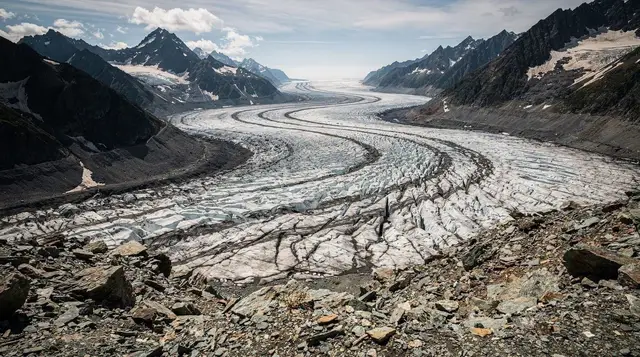
Saas-Fee sits one valley east of Zermatt, ringed by thirteen peaks over 4,000 metres, and it spends a good deal of its marketing budget being compared to its more famous neighbour. The comparison is fair enough — both are car-free, both back onto serious glacier terrain, both built their tourism industries on 19th-century mountaineering — but Saas-Fee has no Matterhorn.
What it has instead is the Mittelallalin, a lift station at 3,456 metres with the world’s highest revolving restaurant, a glacier grotto carved directly into the ice, and a ski area that keeps a few lifts turning through summer. For visitors based in the Bernese Oberland, it’s a longer haul than Zermatt and a less famous name, which is exactly why it tends to be quieter and noticeably cheaper.
Why come here instead of Zermatt
The honest answer is: not instead, necessarily, but as an alternative if Zermatt’s prices or crowds put you off, or as a second stop if you’re already deep into a Valais trip. Saas-Fee’s own selling points stand on their own. The Feegletscher glacier is visible from the village streets, which isn’t true of any glacier from central Zermatt.
The Mittelallalin’s revolving restaurant turns a full circle roughly every hour, giving diners a slow-motion tour of the Dom, Täschhorn, Alphubel and the rest of the 4,000-metre ring without moving from the table. And because Saas-Fee doesn’t have a single postcard peak driving global demand, hotel rates, lift passes and restaurant bills tend to sit 10–20% below Zermatt’s for comparable quality. It’s still expensive by any standard outside Switzerland — this is not a budget destination — but it’s the cheaper of the two.
What you give up is the Matterhorn itself, the Gornergrat rack railway’s views of it, and Zermatt’s larger restaurant and hotel scene. If you want both, several visitors combine a day in each, though that means two separate legs from Visp and a longer overall trip. For skiers extending into the Zermatt side, the cable car up to Testa Grigia and the Gornergrat rack railway ticket cover the two big Zermatt-side excursions, but they’re separate trips from anything in Saas-Fee — the two resorts aren’t lift-connected.
Getting to Saas-Fee from Interlaken
There’s no railway into the Saas Valley, which is the main practical difference from a Zermatt trip. From Interlaken Ost, take a train via Spiez to Visp — about 1 hr 10 min with a change, sometimes two. At Visp, instead of continuing on the narrow-gauge line toward Täsch and Zermatt, you switch to a postbus that climbs the Saas Valley to Saas-Fee, a run of around 50 minutes with tight hairpins near the top. All told, budget around 2 hr 10 min for the journey, and check the connection times before you leave — the postbus doesn’t run as frequently as the Zermatt train, and missing one by five minutes can cost you the better part of an hour.
A Swiss Travel Pass covers the train legs and gives a discount on the postbus; check current terms before assuming full coverage, since regional bus discounts change more often than the rail network’s. There’s no need for a car — in fact you can’t drive into the village itself, only to the car park at its edge — so this is a straightforward public-transport day out or a train-plus-bus arrival if you’re staying over.
Mittelallalin and the world’s highest revolving restaurant
The lift journey up is part of the experience. From the village, the Alpin Express gondola rises to Felskinn at around 3,000 metres. From there, the Metro Alpin takes over — an underground funicular bored through the glacier itself, which is a genuinely unusual way to gain the final few hundred metres of altitude. It surfaces at Mittelallalin, 3,456 metres, one of the highest points in the Alps reachable without technical climbing.
At the top, the revolving restaurant completes a slow rotation roughly every hour, so a normal lunch stop gives you a full circuit of the surrounding four-thousanders without leaving your seat: the Dom (4,545 metres, the highest summit entirely within Switzerland), the Täschhorn, Alphubel and Allalinhorn are all visible from the terrace and dining room on a clear day. The restaurant is unapologetically a tourist operation — expect resort prices, roughly CHF 25–45 for a main course, and a queue at peak lunch hours in both winter and summer — but the view is the point, not the food.
Outside on the terrace, the air is noticeably thin at this altitude; most visitors feel it as light-headedness or shortness of breath on quick movements rather than anything serious, but it’s worth pacing yourself, especially with children or anyone unused to altitude.
The Ice Pavilion and the Feegletscher
Directly accessible from the Mittelallalin station, without stepping outside, is the Ice Pavilion — a series of tunnels and chambers cut into the Feegletscher glacier itself, marketed as the largest ice pavilion in the Alps. It’s included in the lift ticket price rather than a separate charge, and it’s a genuinely different experience from most glacier viewpoints in the region, which show you a glacier from the outside rather than letting you walk through one.
Expect cold air, low ceilings in places, ice sculptures, and informational panels on glacier formation and the visible retreat of the Feegletscher over recent decades — a retreat you can see for yourself if you compare the ice pavilion’s current tunnels against older photographs on display.
It’s a short visit, 20–30 minutes at a comfortable pace, and works well combined with lunch at the revolving restaurant and a walk out onto the marked glacier viewing areas outside, weather permitting.
Skiing Mittelallalin in winter — and in summer
Saas-Fee’s ski area spans a genuine range of terrain from village-level runs up to the glacier itself, and unlike most Alpine resorts, a portion of the glacier terrain above Mittelallalin stays open through summer on a reduced schedule — usually a handful of lifts and a couple of pistes rather than the full winter network. This is one of only a few places in the Alps where summer skiing is a realistic day-trip option rather than a niche activity for racing squads, though hours are shorter and conditions more weather-dependent than winter, and not every summer day has lifts running, so check before you commit to travelling up specifically for it.
Winter conditions are more straightforward: a full ski area serving beginners through advanced skiers, generally reliable snow given the glacier base, and shorter lift queues than the big-name resorts on quieter weekdays. For visitors without their own gear or experience, both a private ski or snowboard lesson and a group lesson open to all ages and levels are bookable in the village, useful if you’re building a first-timer’s day around the mountain rather than arriving with your own instructor already arranged.
Anyone splitting a Swiss ski trip between the Jungfrau region and the Valais should compare conditions and pass coverage before committing, since lift passes generally don’t cross between the two areas.
Saas-Fee versus Zermatt: a straight comparison
| Saas-Fee | Zermatt | |
|---|---|---|
| Headline sight | Mittelallalin, Ice Pavilion, revolving restaurant | Matterhorn, Gornergrat, Klein Matterhorn |
| Highest point reachable | 3,456 m (Mittelallalin) | 3,883 m (Matterhorn Glacier Paradise) |
| Typical hotel cost | Roughly 10–20% below Zermatt | Highest in the region |
| Crowds at peak season | Busy but manageable | Very busy, especially midday at Gornergrat |
| Rail access | None — train to Visp, then postbus | Direct narrow-gauge train from Visp/Täsch |
| Car-free village | Yes | Yes |
| Summer glacier skiing | Yes, limited hours | No |
Neither destination is cheap; the difference is one of degree, not kind. If price is the deciding factor and you don’t need the Matterhorn specifically, Saas-Fee is the more forgiving choice.
The village itself
Saas-Fee is smaller and quieter at street level than Zermatt, with a compact centre of chalet-style hotels, ski and outdoor shops, and a handful of restaurants serving Valais specialities — raclette, dried meat platters, and rösti feature heavily on most menus. It sits in the Saastal, the Saas Valley, alongside three smaller villages — Saas-Grund, Saas-Almagell and Saas-Balen — none of which see anywhere near Saas-Fee’s visitor numbers but which offer quieter bases with their own smaller lift systems if you want valley access without the resort atmosphere.
Cars stop at a multi-storey park at the village edge; from there it’s a short walk or an electric taxi to most hotels, a system that works the same way in Zermatt and in the car-free villages of the Lauterbrunnen valley back in the Bernese Oberland. Luggage transfer between the car park and hotels is generally arranged by the hotel itself rather than left to guests to carry uphill.
Planning around weather and altitude
A trip up to Mittelallalin lives or dies by visibility. On a clear day the ring of peaks is the whole point; in cloud, the same lift ride delivers a white window and not much else. Look at the forecast the evening before and again at breakfast, and if the top is socked in, the Interlaken in bad weather page and the things to do when it rains list give you a fallback closer to base. Our altitude, weather and what to pack guide covers layers, sun protection and sensible pacing, all of which matter more on a glacier than in the valley.
The same logic applies to lifts generally. Mountain lifts close for maintenance, wind and snow conditions, and the way mountain railways open and close through the year is worth a look before you commit to a long journey. If you have never ridden a gondola or underground funicular, cable cars and funiculars explained answers the practical questions about queues, boarding and what happens in high wind.
Eating, warming up and pacing the day
A high-altitude day is cold even in summer, and the best way to handle it is to alternate outdoor time with indoor stops. The revolving restaurant is the obvious warm-up, but the village has plenty of smaller places for a slower meal once you are back down. If you have not tried the Valais classics yet, fondue and raclette are the dishes to look for, and the cheese dairies of the Bernese Oberland are a good way to understand where they come from once you are back on your home turf.
Pacing matters more than ambition. Do the Ice Pavilion and the terrace first while you are fresh, eat when the restaurant is calmer if you can, and leave the village stroll for the end of the day when the light softens. Rushing every stop to fit one more thing in is the surest way to turn a good day into a tiring one.
How Saas-Fee fits with the rest of your trip
Saas-Fee works best as a deliberate choice, not a default. If you are still deciding between the big Alpine names, Interlaken versus Zermatt lays out the trade-offs, and the full Zermatt destination page shows what the neighbouring valley offers. A single long outing to the other side is covered in the Zermatt day trip from Interlaken, while Gornergrat and the Matterhorn Glacier Paradise explains the two famous high points there. Travellers linking resorts by rail will also want the Glacier Express guide, and anyone building a longer loop can use the grand tour of Switzerland from Interlaken as a starting frame.
If the long transfer puts you off, the home-region alternatives are strong. The Jungfraujoch and the Schilthorn both deliver glacier-and-summit drama from Interlaken, with the Jungfraujoch guide and the Schilthorn and Piz Gloria guide explaining each in detail. For something gentler, the Harder Kulm guide covers a half-day viewpoint above the town.
Is a day trip enough, or should you stay?
Realistically, the round-trip travel time from Interlaken — a bit over four hours there and back — leaves four to five hours in Saas-Fee itself once you account for lift queues and connections. That’s enough for the Alpin Express and Metro Alpin up to Mittelallalin, an hour or so at the top for the Ice Pavilion and a meal, and a short walk around the village before heading back down to catch the return postbus to Visp. It is not enough time to ski properly, and it’s a long day for a single mountain excursion when Interlaken’s own peaks — the Schilthorn, the Jungfraujoch, Harder Kulm — are all considerably closer.
Anyone planning to ski, or who wants a slower, less rushed visit, is better off booking a night or two in the village itself rather than treating it as a single long day from Interlaken. It also makes more sense as part of a broader Valais loop — combined with Zermatt, Sion, or a wider Swiss itinerary — than as a stand-alone day trip squeezed between Bernese Oberland excursions.
Tickets, luggage and money
Because the journey involves a train and a postbus, it pays to sort the paperwork before you leave. The Swiss Travel Pass guide explains what a pass covers and where discounts replace free travel, and trains, buses and boats around Interlaken shows how the local network connects with the main line. If you are changing hotels on the way, the luggage and lockers page helps you avoid hauling bags up to a glacier. For a realistic sense of what the day will cost against other outings, see Interlaken travel costs.
The way the village handles traffic is explained in how car-free villages work, and the same logic applies in Wengen and Lauterbrunnen closer to home. Skiers comparing resorts will find the skiing in the Jungfrau region guide useful, and Interlaken in winter shows what the season looks like from the Bernese side. If you are still working out how long to stay overall, how many days in Interlaken is the place to start, and the Sion and Valais page is a natural companion for a trip that stays south of the Alps for a few nights.