Why bother with Zug at all
Zug rarely makes a first-time Switzerland itinerary, and that is roughly fair. It is a small, wealthy lakeside town — around 30,000 people — better known among accountants for its tax rate than among travellers for its sights. What it does have is a genuinely handsome medieval old town on the water, a clock tower older than most of what you will see in Lucerne, a cherry cake with a real history, and a wooded hill you can reach by funicular in eight minutes. None of that fills a whole day. All of it fills a good half day, and it slots neatly into a longer trip that also takes in Lake Lucerne, Mount Rigi or Zurich.
The honest pitch: go if you are already routing through central Switzerland or between Interlaken and Zurich, not as a dedicated round trip from Interlaken. The travel time works against it as a standalone destination.
Getting there from Interlaken
There is no direct train between Interlaken and Zug — every route involves at least one change. The fastest and simplest option runs via Lucerne.
| Route | Change | Approx. journey time | Notes |
|---|---|---|---|
| Interlaken Ost → Lucerne → Zug | Lucerne | ~2h15 | Brünig line (1h50) then IR to Zug (~25 min) |
| Interlaken Ost → Bern → Zurich → Zug | Bern and Zurich | ~3h | Longer but useful if continuing to Zurich anyway |
| Interlaken West → Bern → Zug | Bern | ~2h30 | Slightly slower, avoids the scenic Brünig line |
Trains from Interlaken Ost on the Brünig line run roughly hourly and require reservations for some of the older panoramic carriages in summer. A Swiss Travel Pass or Half Fare Card covers or discounts the whole route; without one, a same-day return from Interlaken to Zug in second class runs to roughly CHF 130–150 per adult, which is another reason this trip makes more sense as a stop on a longer loop than as a there-and-back day.
Zug’s own station is a five-minute walk from the old town and the lakefront — flat, straightforward, no confusion between multiple stations the way Interlaken has with Ost and West.
The old town and the Zytturm
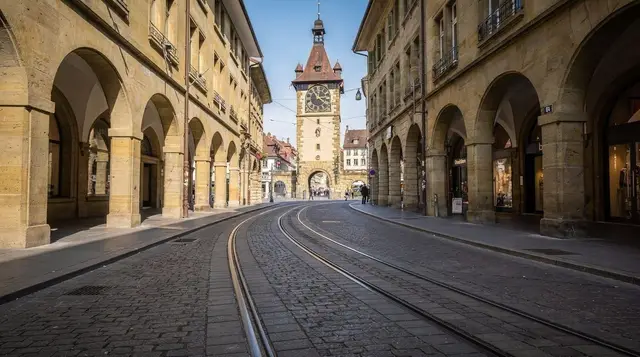
Zug’s Altstadt is compact enough to see properly in an hour: a scatter of gabled, painted townhouses along narrow lanes, opening onto Kolinplatz and the lakefront. The landmark is the Zytturm, a stone clock tower dating to the 13th century, topped with a distinctive blue-and-white tiled roof and a clock face added in 1574 that also tracks the phases of the moon. You cannot usually go up it — it is not set up as a public viewpoint — but it anchors every photo of the town and is worth the two minutes it takes to walk under its arch into the old town proper.
Behind it, the old town’s fortified walls and towers (parts of the medieval defences survive, including the Kapellturm and sections of wall near the lake) are worth a slow ten-minute loop rather than a single photo stop. This is also where the crypto-and-old-town walking tours tend to start, weaving the medieval streets together with Zug’s newer identity as a blockchain and finance hub — a genuinely odd combination that a guide explains better than a plaque does. If that angle interests you, a guided walk through the old town covering Zug’s Crypto Valley story, finishing with a Swiss aperitif covers both halves in one outing.
Zuger Kirschtorte: the cherry cake worth the detour
Zug’s culinary claim to fame is Zuger Kirschtorte — a round cake built from almond meringue layers and a butter-cream sponge, heavily soaked in kirsch (cherry brandy), topped with toasted almonds and a lattice pattern. It dates to a 1915 recipe from the Zug baker Heiri Höhn and is protected enough as a regional product that it is genuinely difficult to buy an equivalent outside the canton.
Bachmann Confiseur, with a flagship branch on Kolinplatz in the old town, is the standard stop: a slice with coffee runs around CHF 10–13, a whole cake to take away CHF 45–65 depending on size. It is strong stuff — the kirsch is not subtle — so it is not for everyone, but it is a more honest food souvenir than most Swiss chocolate sold at inflated prices in station kiosks. If chocolate is more your interest than kirsch-soaked sponge, a private day trip from Zurich taking in Zug and the Aeschbach chocolate factory pairs the two towns with a factory visit, useful if you are approaching from Zurich rather than Interlaken.
The lake promenade: Zugersee, and Lake Ägeri behind the hill
The lakefront promenade runs along the Zugersee shoreline past the old town, lined with plane trees and benches, with the water clean enough for the public lidos (Strandbad) that open from roughly June to September on both sides of the lake. Free lake access, a small fee (a few francs) for changing rooms and lawn areas. Across the water, on a clear day, you get a good sightline to Mount Rigi and Pilatus in the distance — the same peaks visible from Lucerne, seen from a quieter angle with none of the crowds.
Lake Ägeri (Ägerisee) is a separate, smaller lake in the hills above Zug, about 20 minutes away by bus or car — worth knowing so you do not assume it is walkable from the promenade. Travellers coming via Zurich sometimes combine both lakes on the same outing: a private day trip pairing Zug’s old town with Lake Ägeri is built exactly for that, though it is not the efficient choice starting from Interlaken.
Sunset on the water
This is the one thing Zug does better than most towns its size: the promenade faces roughly southwest across the lake, and on a clear evening the water, the old town skyline and the Alpine silhouette beyond catch the light for a genuinely good half hour before dusk. It costs nothing, needs no ticket, and is the single best reason to time a Zug stop for late afternoon rather than midday if your schedule allows it — arrive around 4–5pm, cover the old town and a cake stop first, then finish on the waterfront as the light goes rather than rushing back for a train.
Up to the Zugerberg
The Zugerbergbahn funicular climbs from Schönegg, on the edge of town (a 10-minute walk or short bus ride from the station), to around 990 metres on the wooded Zugerberg ridge in about eight minutes. A return ticket costs roughly CHF 15–18 for adults, discounted with some regional travel passes. At the top: forest paths, a handful of restaurants with lake and Alpine views on a clear day, and — depending on season — grazing cattle and a genuinely rural feel a ten-minute ride from a financial centre.
It is not a dramatic Alpine panorama on the scale of the Jungfrau region, but it is an easy, low-effort viewpoint that most visitors to Zug skip because they run out of time — worth prioritising over a second lap of the old town if you have to choose.
For a longer hike from the same starting point, some tours use Zug as a base for the wider ridge country further south — a guided hike along the Stoos ridge with transport included from Zug is the option for that, though it is a half-day-plus commitment on its own and makes more sense as an alternative to the town visit than an add-on to it.
Where to eat and what to budget
| Item | Typical price (CHF) |
|---|---|
| Coffee and a slice of Zuger Kirschtorte | 10–13 |
| Lunch, casual restaurant | 22–35 |
| Zugerbergbahn return ticket | 15–18 |
| Lake Zug lido entry (bathing area fee) | 3–6 |
| Whole Zuger Kirschtorte to take away | 45–65 |
A realistic half-day budget, not counting the train fare from Interlaken, is CHF 90–130 per person: cake and coffee, a simple lunch, and the funicular. That is in line with the rest of central Switzerland — Zug is not noticeably cheaper or more expensive than Lucerne for a visitor, whatever its reputation as a low-tax canton for residents and companies.
A realistic day plan
For those routing Interlaken–Lucerne–Zug–Zurich or similar, a workable sequence:
- Interlaken Ost to Lucerne on the Brünig line (~1h50) — see the Lucerne day trip guide if stopping there too.
- Lucerne to Zug (~25 min); drop bags at the station if continuing same day.
- Old town loop and the Zytturm (45–60 min).
- Cake and coffee at Bachmann, Kolinplatz (30–45 min).
- Zugerbergbahn up and a short walk at the top, or the lakefront promenade if short on time (1–2 hours).
- Sunset on the promenade before the onward train (30 min, free).
- Zug to Zurich (~25–30 min) or back to Lucerne, depending on the next stop.
This whole sequence, minus the Interlaken legs, fits a single afternoon.
Zug vs Lucerne: which one if you can only pick one
If forced to choose, Lucerne wins for almost every visitor: a bigger old town, the covered Kapellbrücke, direct lake cruises on Lake Lucerne, and direct access to Mount Pilatus and Mount Rigi without a further change. Zug’s case is narrower: it is quieter, less touristy, cheaper to visit on a per-person basis because there is less to spend money on, and better for a genuine sunset walk without competing for bench space. See the fuller Zug versus Lucerne comparison for the trade-offs if you are deciding between the two rather than doing both.
Common mistakes
- Treating Zug as a standalone day trip from Interlaken. The travel time (4.5 hours round trip) is disproportionate to what fills the day. It works far better as a stop en route to or from Zurich, or paired with Lucerne on the same ticket.
- Confusing Lake Zug and Lake Ägeri. They are different lakes; Ägeri is up in the hills, not walkable from the promenade.
- Skipping the Zugerberg for lack of time. It is the best-value hour in town and consistently the first thing cut when a schedule runs long — worth protecting deliberately.
- Expecting tourist-priced everything. Because Zug sees fewer visitors than Lucerne, some restaurants and cafés are aimed at residents and locally priced, which can mean better value, but also shorter opening hours outside typical meal times.
Questions people ask about visiting Zug
Is Zug worth visiting from Interlaken, or is it a wasted day?
It is not a full-day destination on its own. The old town, the Zytturm and a cake stop fill about two to three hours. Most visitors do better folding Zug into a longer trip toward Lucerne or Zurich rather than making the roughly 4.5-hour round trip from Interlaken just for Zug.
How do you get from Interlaken to Zug?
There is no direct train. The practical route is Interlaken Ost to Lucerne on the Brünig line (about 1h50), then an onward regional or InterRegio train from Lucerne to Zug (about 25 minutes), for a total of roughly 2h15 door to door including the connection.
What is Zuger Kirschtorte and where do you buy it?
It is a round, kirsch-soaked sponge and almond-meringue cake, a Zug speciality since the early 20th century. Bachmann Confiseur, with several branches in town including one on Kolinplatz, is the best-known bakery for it; a slice costs around CHF 6–8, a whole cake CHF 45–65 depending on size.
How much does the Zugerberg funicular cost?
A return ticket on the Zugerbergbahn from Schönegg, on the edge of town, costs around CHF 15–18 for adults; it is discounted or free with some regional passes. The ride takes about 8 minutes up to around 990 metres.
Can you swim in Lake Zug?
Yes. There are public lidos (Strandbad) on both the town side and across the lake, open roughly June to September, with free lake access and a small fee for changing rooms and lawns at the main bathing areas.
Is Zug expensive compared to Lucerne or Interlaken?
Prices are similar to the rest of central Switzerland — Zug is one of Switzerland’s lowest-tax cantons for residents and companies, not for tourist prices. Expect Lucerne-level costs for coffee, cake and lunch, with fewer tourist-priced restaurants simply because there are fewer tourists.
Is Zug the same as visiting Lake Ägeri?
No. Lake Ägeri (Ägerisee) is a separate, smaller lake about a 20-minute bus or drive from Zug town, in the hills above. Some day tours pair the two, but a standalone Zug town visit does not include it unless you add the extra leg yourself.
Does Zug have anything to do with Bitcoin and Crypto Valley?
Yes — the canton is home to the Ethereum Foundation and a cluster of blockchain and crypto firms, a nickname that stuck after Zug became one of the first places worldwide to accept Bitcoin for some municipal fees. It shows up mostly as office buildings rather than anything visually interesting, but guided walking tours cover the story alongside the old town.