Interlaken in spring
Is spring a good time to visit Interlaken?
Late April to early June brings full waterfalls, green valley floors and thin crowds, but several high mountain railways and cable cars close for spring maintenance into May, and trails above 1,800 m can stay snow-covered into June. Aim for the second half of May, once the top stations have reopened but before school-holiday crowds arrive.
The shoulder season nobody plans around
Interlaken has an obvious high season and an obvious low one, and spring sits awkwardly between them. The town itself wakes up early: the Hohematte turns green in March, the lake promenades are walkable in a jumper by April, and by May the terraces along the Höheweg are full again. But the mountains above town run on their own calendar. Several of the railways and cable cars that make the Jungfrau region worth the trip shut down for weeks at a time each spring for maintenance, cable inspection and avalanche clearance, and nobody advertises the exact dates until the season is nearly on top of you.
That gap between “the town looks like spring” and “the summits are actually open” is the whole story of visiting Interlaken between March and June. Get the timing wrong and you arrive to find the cable car you built a day around is closed for revision, or you hike into fresh snow in trainers because the valley floor felt warm enough to skip the shell jacket. Get it right, and you get something the July crowds never see: waterfalls running at full snowmelt volume, footpaths with nobody on them, and hotel rates well below summer. This guide is about hitting that window rather than missing it either side.
What spring weather actually looks like, month by month
Altitude does more to the weather here than the calendar does. At 568 metres, Interlaken itself warms up steadily from March. Two thousand metres higher, winter holds on for another two months.
| Month | Interlaken (568 m) | Mid-mountain (~2,000 m) | Typical rainfall pattern |
|---|---|---|---|
| March | 3–10°C, still cold mornings | Snow cover, sub-zero at night | Mixed rain and late snow showers |
| April | 6–14°C, green returning | Snow retreating above 1,800 m | Frequent showers, changeable |
| May | 10–19°C, settled spells | Snow lingering above 2,200 m | Afternoon thunderstorms possible |
| Early June | 13–22°C, first summer days | Most trails clear by mid-June | Wetter than July on average |
The practical read: down at lake level, March already feels like early spring and by May you can sit outside comfortably. Up at the Schilthorn or Jungfraujoch, March and April are still full winter, and even in May you should expect the restaurant terrace to be cold and the paths outside to be icy or closed off. Pack for both climates on the same day — see what to pack for the altitude swing before you go.
The waterfalls at full power
This is the best argument for a spring visit, and the one most first-time planners miss. The waterfalls around Interlaken are fed largely by snowmelt, and the volume peaks in spring, not summer. By August, many of the same falls have thinned to a fraction of what they carry in May.
The Staubbachfall above Lauterbrunnen drops 297 metres and is visible from the village street; in spring it throws spray far enough to soak anyone standing near the base. A few minutes’ walk further into the valley, the Trümmelbach Falls carry glacial meltwater from the Eiger, Mönch and Jungfrau down through a series of ten falls inside the mountain itself — the paid access tunnel is often closed in the depths of winter but reopens in spring, and the water inside is at its most dramatic exactly when the melt is running hardest. Read the full route in the Lauterbrunnen valley waterfall walk.
On the other side of Interlaken, the Reichenbach Falls near Meiringen — the ones tied to the Sherlock Holmes story — run at their fullest in the same window; the Aare Gorge and Reichenbach Falls walk combines both. Along Lake Brienz, the Giessbach Falls cascade past the historic Grandhotel Giessbach in fourteen stages, reachable by a funicular that restarts service in spring; the Giessbach Falls and shore path guide covers timings. If waterfalls are the reason you’re coming in spring rather than summer, this is the one thing to build the trip around.
a half-day trip through the region’s wild valleys and waterfalls covers several of these in one outing if you’d rather not plan the routes yourself, though every one of them is also reachable independently by train, bus or on foot.
What’s still closed, and when it reopens
This is the part that catches people out. Spring maintenance closures are set by each operator individually, vary by year depending on snow conditions, and are rarely announced more than a season ahead. As a rule of thumb:
| Summit or railway | Typical spring closure pattern |
|---|---|
| Jungfraujoch (via Kleine Scheidegg or Eiger Express) | Runs year-round, no seasonal closure |
| Schilthorn (Piz Gloria) | Short revision closures possible in April |
| Harder Kulm funicular | Usually closed through winter, reopens mid to late spring |
| Schynige Platte rack railway | Closed all winter, opens once snow clears, often not until late May or June |
| Grindelwald First | Runs year-round, but some summer-only attractions (mountain cart, first flyer) open later |
| Niederhorn cable car | Winter and spring closures for maintenance, dates vary |
| Brienzer Rothorn steam railway | Closed over winter, opens once track is clear, typically late May or June |
The one genuinely reliable exception is the Jungfraujoch itself, reached either via Lauterbrunnen and the Kleine Scheidegg cog railway, or via the Eiger Express cable car from the Grindelwald Terminal — both operate year-round, snow conditions permitting.
Everything else on this list should be checked against the operator’s current calendar before you commit a day to it; the guide to when mountain railways open and close tracks the pattern in more detail, and it’s worth reading before booking accommodation timed around a specific summit. Wind closures add another layer on top of maintenance closures — cable cars in particular stop running in high wind regardless of season, which matters more at altitude in spring’s more unsettled weather.
If you’re set on the highest viewpoints and want a fallback, the Jungfraujoch guide is the safest single booking in the shoulder season precisely because it doesn’t carry the same closure risk as the Schilthorn, Schynige Platte or Niederhorn.
Snow at altitude versus green in the valley
The contrast is stark enough to plan around directly. In April, you can be photographing daffodils on the Höheweg in the morning and looking at metres of snow on the Männlichen ridge by early afternoon. This isn’t a rare event — it’s the normal state of the region in spring.
For hiking, this means the valley-floor and lower-hillside paths open first. Easy routes around Interlaken, Unterseen and along both lakeshores are walkable from March, and the easy flat walks around Interlaken hold up well even in a wet spring.
Anything above roughly 1,500 to 1,800 metres is a different question: routes like the Bachalpsee hike above Grindelwald First and the loop around Oeschinensee near Kandersteg typically stay snow-covered or have a still-frozen lake well into late May or June, regardless of how warm Interlaken feels. Don’t take a green Interlaken as a signal that the high trails are clear — check current conditions with the local tourism office or the railway operator before setting out, not the forecast for the valley.
An e-bike is a reasonable way to cover valley-floor and lakeside distance quickly in spring without committing to a high-altitude hike that might turn back on you. renting an e-bike in Interlaken gives you the flexibility to change plans if a summit turns out to still be under snow.
The May window few people use
If there’s a single insight worth taking from this guide, it’s this: the second half of May is close to the best value the Bernese Oberland offers all year, and comparatively few visitors use it. By then, most of the maintenance closures listed above have ended, the waterfalls are still running on full snowmelt rather than the reduced late-summer flow, lower alpine meadows are turning green with the first wildflowers, and — critically — Swiss and neighbouring countries’ school holidays haven’t started yet, so the crowds that fill Interlaken from late June onward are still weeks away.
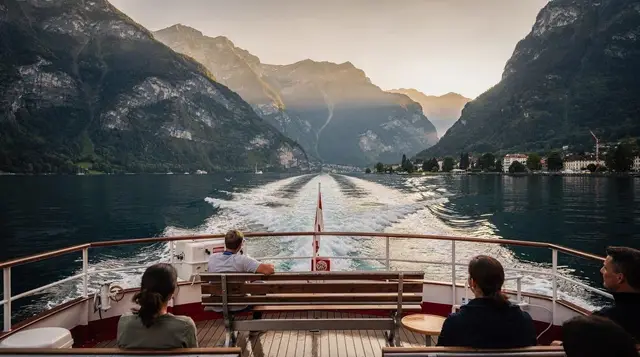
Hotel rates in this window sit below the summer peak, restaurant tables are easy to get without booking days ahead, and the paddle steamers on Lake Thun and Lake Brienz are usually back in service, running lighter timetables than midsummer but running nonetheless — see the two-lakes cruise guide for the current schedule pattern. The trade-off is that the very highest trails, anything above about 2,200 metres, may still be snow-affected into early June, so this window suits valley walks, lake activities, lower funiculars and the Jungfraujoch itself far better than a serious high-altitude hiking trip.
A short outing that works well in this exact window is a morning on the water combined with a village: an e-bike route out to Iseltwald and the Giessbach Falls covers Lake Brienz’s shoreline while the waterfall is still running at its spring volume.
What’s reliably open, whatever the month
For anyone visiting in March or April specifically, before the later closures lift, it helps to know what doesn’t depend on a spring reopening:
- The Jungfraujoch line, via either Lauterbrunnen–Kleine Scheidegg or the Eiger Express from Grindelwald Terminal, runs all year.
- Harder Kulm, once its own spring reopening has happened (check the date each year), gives an eight-minute funicular ride to a viewpoint over the town, the Hohematte and both lakes.
- Boat services on Lake Thun and Lake Brienz typically resume a reduced spring timetable before the full summer schedule starts.
- Ballenberg open-air museum and most of the region’s indoor museums, including in Bern and Lucerne, run on their normal calendar, unaffected by mountain snow.
- Valley-floor walking, cycling and the town of Interlaken itself — the Hoheweg, the Bödeli between the two lakes, Unterseen’s old town — are unaffected by any of the above.
For rainy stretches, which are common in April and early May, the things to do in Interlaken when it rains guide and the general rainy day activities guide both lean on exactly these weatherproof options.
Booking around the uncertainty
Because closure dates shift year to year, the safest approach is to build a spring itinerary with one or two fixed anchors — the Jungfraujoch, a lake cruise, a valley walk — and leave the higher, weather-dependent summits as flexible add-ons you confirm once you’re on the ground and can see the operator’s current status page. A short Interlaken 3-day itinerary built this way absorbs a closure without wasting a day, whereas a plan that hinges entirely on the Schilthorn or Schynige Platte being open on one specific date is a plan with a real chance of falling apart.
It’s also worth comparing spring against the seasons either side before committing to dates: the Interlaken in summer guide covers the trade-off in crowds and prices once everything reopens, and the Interlaken in winter guide explains the opposite end of the closure calendar, when snow sports take over and some of these same waterfalls freeze solid. For a broader steer on timing generally, the best time to visit Interlaken guide sets spring in context against the rest of the year.
If outdoor activity rather than sightseeing is the goal, spring’s meltwater volume also affects river-based trips: rafting on the Lütschine and Aare tends to run higher and faster in May than in the calmer late-summer months. a rafting trip paired with a raclette meal is one way to make use of that higher water while it lasts, rather than waiting for a summer flow that’s actually gentler.
Spring in Interlaken, in short
Spring rewards planning more than any other season here. Come in March or early April expecting full winter at altitude, wet and changeable weather in the valley, and several major cable cars and railways still shut. Come in the second half of May and you get a genuinely good window: reopened summits, waterfalls at their fullest, green lower slopes, and a town that hasn’t yet filled up with the summer crowd. The gap between those two experiences is a matter of a few weeks on the calendar, so if your travel dates have any flexibility at all, that’s where to spend it.
Frequently asked questions about Interlaken in spring
When do the mountain railways reopen after winter?
There is no single date. The Jungfraujoch line and the Eiger Express run all year, but the Schilthorn, Harder Kulm, Schynige Platte, Niederhorn and Brienzer Rothorn each set their own spring maintenance closures, typically a window somewhere between mid-March and mid-May depending on snow clearance. Check each operator’s site for the current year before booking a hotel around a specific summit.
Are the waterfalls better in spring than summer?
Often, yes. Snowmelt from March to June sends far more water over the Staubbachfall and through the Trümmelbach Falls than the drier late-summer months, and Giessbach and the Aare Gorge run harder too. May is usually the peak for volume, before the upper snowfields are exhausted.
Can you hike in Interlaken in spring?
The valley floor around Interlaken, Bönigen and Unterseen is walkable from March onward. Trails above roughly 1,500 to 1,800 metres, including the routes around Mürren, Grindelwald First and the Bachalpsee, typically stay snow-covered until late May or June, and some, like the path around Oeschinensee, are not reliably clear until June.
What should I pack for Interlaken in spring?
Layers, a waterproof shell and proper waterproof shoes at valley level, plus warmer clothing for anything above 2,000 metres, where temperatures can sit near freezing even in May. Weather changes quickly in the Bernese Oberland, and a clear morning at lake level says nothing about conditions at the Jungfraujoch or Schilthorn.
Is spring cheaper than summer in Interlaken?
March, April and the first half of May are the cheapest months for hotels in the Bodeli, before the late-May to September peak. Late May itself sits in between: railway and cable car prices are unchanged year-round, but accommodation is still below summer rates.
Does it snow in Interlaken in spring?
Rarely at 568 metres after March, though a late cold snap can bring a dusting. Snow is far more likely and far more persistent above 2,000 metres, where the Jungfraujoch, Schilthorn and Männlichen can see fresh snowfall well into May.
When is the best week in spring to visit?
The last two weeks of May tend to give the best combination: most summit railways have reopened, waterfalls are still running full on snowmelt, wildflowers are out on the lower alps, and Swiss school holidays have not yet started.
Lake cruises & boat tours on GetYourGuide
Verified deep-linked GetYourGuide tours. Book through these links and we earn a small commission at no cost to you.
GetYourGuide does not provide a product photo for this activity — the image shows the meeting point, photographed by us.