The last steam rack railway
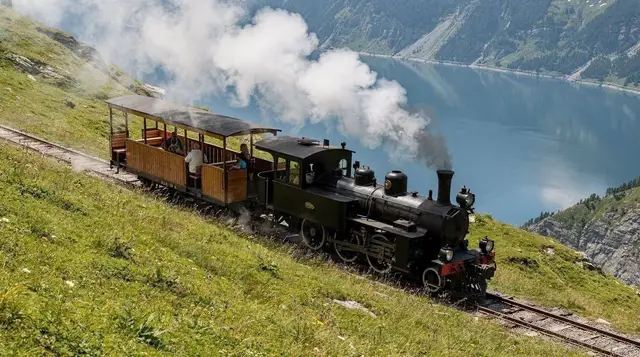
I got to Brienz station early enough to watch them raise steam, which is not something you can do at a normal Swiss railway, because a normal Swiss railway does not need three hours’ notice before it can move. The fireman had been in since before six, shovelling coal into a firebox that was cold overnight and needed to be hot enough by nine to build working pressure. By the time the first passengers arrived, the locomotive was already ticking and hissing at the platform, smelling of coal smoke and hot oil, looking like it had rolled straight out of a photograph from the year it was built: 1892.
That is the detail that keeps pulling me back to the Brienzer Rothorn. Most rack railways in this country modernised decades ago. The Jungfrau railway has run on electricity since it opened in stages up to 1912. Schynige Platte electrified in 1914. Even the Wengernalp railway switched over long ago. The Brienz Rothorn Bahn is the one line in the region, and one of very few left in the Alps, that still sends steam locomotives up a mountain on a working timetable, not as a once-a-year heritage run but as the normal way you get to the top.
Why steam survived here and nowhere else nearby
The honest answer has less to do with romance than with money and timing. When most Swiss mountain railways electrified in the early twentieth century, it was because hydroelectric power was cheap, plentiful, and already being generated in the valleys below for exactly this purpose.
The Brienz Rothorn Bahn went bankrupt not long after opening in 1892, closed for decades, and when it reopened after the Second World War it did so as a tourist line with a much smaller passenger base than the Jungfraujoch or Grindelwald First routes. Electrifying a short, low-traffic line was never cheap enough to justify, and by the time it might have made financial sense, the company had realised something else: people were coming specifically to ride behind steam.
That is the part that gets missed when people call this “quaint.” It is a deliberate, ongoing business decision, renewed every season, to keep operating a form of traction that costs more per passenger than diesel or electric ever would. The railway now markets itself on the fact that it is the last rack railway of its kind still running steam as its primary motive power, and that positioning brings in exactly the kind of visitor who will build a whole day around watching a locomotive work, rather than just wanting to get up a hill and back down again.
What an 1892 locomotive actually costs to keep alive
I asked one of the crew what a boiler inspection involves, expecting a short answer. I did not get one. Swiss steam boilers are recertified on a fixed cycle by an external inspection body, and a full internal inspection means stripping back the cladding, checking every tube and stay for corrosion, and pressure-testing the whole vessel. If a boiler fails that test, it does not get patched, it gets rebuilt, and rebuilding a boiler to an 1892 pattern is not a job you can hand to a general engineering firm. The Brienz Rothorn Bahn keeps its own workshop in Brienz specifically because so few outside contractors can machine parts to fit a locomotive that predates standardised spares by more than a century.
That workshop is the real reason the line survives. Original drawings, where they still exist, get used to remake components from scratch; where they do not, someone measures the worn part and reverse-engineers a replacement. A major overhaul of one locomotive can take the better part of a year, which is why the fleet includes both the historic 1890s originals and later steam locomotives built in the 1990s and 2000s to the same rack-and-pinion principle, so that something is always available for the timetable while an older engine is in pieces in the shed.
There is also a couple of diesel locomotives on the roster, used mainly for the first and last runs of the day and as cover, which is a detail some steam purists find deflating until they realise it is the only reason the advertised steam departures run as reliably as they do.
None of this is cheap, and none of it is subsidised by nostalgia alone. Coal has to be bought and hauled up from the valley, water has to be taken on at intervals along the climb, and every crew member on the footplate needs training that a normal train driver’s licence does not cover. Ticket prices reflect that: a return trip to the summit costs noticeably more per kilometre than a comparable ride on an electrified line nearby, and the railway is upfront that steam operation is the reason.
A day with the crew
The two-person crew, a driver and a fireman, work the footplate together for the whole climb, which takes close to an hour at a walking-pace gradient that would be alarming in a car and is completely routine here because the rack rail underneath does the actual work of holding the train on the slope.
The fireman’s job does not stop once the fire is lit; on the way up he is constantly reading the pressure gauge and feeding coal in small amounts rather than large ones, because a badly managed fire either loses pressure on the steepest sections or wastes fuel building pressure the locomotive does not need yet. The driver watches the rack mechanism, the water level, and the brakes, which on a rack railway are the genuinely critical system: on the way down, the train is held by the locomotive’s own braking system engaging with the rack, not by gravity and momentum the way a normal train would be.
At the summit, the locomotive gets serviced again before the return run: ash raked out, water topped up, moving parts checked. Crews rotate through several return trips a day in season, and by the last departure the fire has to be managed down deliberately rather than just left to die, because tomorrow’s fireman will be lighting a cold firebox again at six the next morning. It is unglamorous, physical, repetitive work, and it is also the only reason any of this still exists to look at. If you want to see it up close, stand near the front of the platform at Brienz before departure rather than boarding straight away; the ten minutes before a steam train leaves tell you more about how the whole operation runs than the hour on board does.
If your Interlaken itinerary already includes a rack railway to the Jungfraujoch or a cable car up to Grindelwald First, the Rothorn is worth treating as a separate outing built around Lake Brienz rather than a rushed add-on. Pair it with a walk along the shore towards Giessbach, or combine both lakes into one day using the region’s boat network.
Either way, check the Swiss Travel Pass conditions before you buy, since discounts on this particular line are not always as generous as on the fully electrified routes covered in our overview of how the Bernese Oberland’s railways fit together, and browse other day trips from Interlaken if you are building a longer stay around Wilderswil and Schynige Platte as well.
For the Jungfraujoch side of that comparison, an day trip from Interlaken to the Jungfraujoch covers the electrified alternative, and a small-group tour to the Jungfraujoch is worth it if you would rather not manage the connections yourself. If you are basing a day around Lake Brienz instead, an e-bike ride out to Iseltwald and Giessbach makes a good pairing with watching the steam train depart from Brienz.
The Brienz Rothorn Bahn: practical points
| Detail | What to know |
|---|---|
| Base station | Brienz, on Lake Brienz |
| Summit | Brienzer Rothorn, 2,350 m |
| Journey time | About 1 hour each way |
| Distance / ascent | 7.6 km, roughly 1,680 m of climb |
| Traction | Mixed steam and diesel; steam on most peak-season departures |
| Season | Early June to late October, weather permitting |
| Oldest locomotives | Built 1892, still in service after repeated overhauls |
Scenic train tours on GetYourGuide
Verified deep-linked GetYourGuide tours. Book through these links and we earn a small commission at no cost to you.
GetYourGuide does not provide a product photo for this activity — the image shows the meeting point, photographed by us.