Most people who come to Interlaken are here for mountains and lakes, and the Emmental has neither. What it has is rolling farmland north-west of Bern, dairy cattle on steep green slopes, farmhouses built to a scale that looks almost institutional, and the cheese that gave the region its export identity for over a century. It is not a dramatic day out. It is a genuinely different one, and it is the closest thing the Bernese Oberland region has to an agricultural heartland you can actually visit and understand in an afternoon.
Where the Emmental is and why it looks the way it does
The Emmental takes its name from the Emme river valley, which runs roughly from the hills south-east of Bern up toward the pre-Alps near Escholzmatt. It is not a single valley so much as a broad band of hill country, farmed intensively for dairy since the Middle Ages. The soil and climate here suit grass rather than grain, which is precisely why the region turned to cattle and cheese: milk that could not be transported far in an age before refrigeration was more valuable converted into a hard cheese that would keep and travel.
That history is written into the landscape. Villages are small and spread out along ridgelines rather than clustered at valley floors, farms sit on their own land rather than in tight settlements, and almost every farmhouse follows the same distinctive plan: a single steeply pitched roof, often shingled, that shelters the house, barn, hayloft, stable and machinery all under one structure, with eaves overhanging the walls by two metres or more.
It is a practical design for heavy snow and long winters, and some of the largest surviving examples are considered among the biggest wooden farm buildings anywhere in Europe. Driving the back roads between Thun and Langnau, you will pass dozens of them, still working farms rather than museum pieces.
There is no dramatic centre to the Emmental. The two towns worth actually stopping in are Langnau im Emmental and Burgdorf, and the single most useful stop for understanding the region is the demonstration dairy at Affoltern im Emmental, a short distance from both.
Affoltern im Emmental: the Emmentaler Schaukäserei
The Emmentaler Schaukäserei (literally “show cheese dairy”) in Affoltern im Emmental is a working cheese dairy set up for visitors, and it is the one stop in the region that justifies the journey on its own. Cheesemakers produce genuine Emmentaler on a public viewing schedule several times a day, using copper vats, wood-fired heating and hand-turned methods that are largely unchanged from a century ago, even though the dairy is a modern, purpose-built visitor facility rather than a working farm.
A ticket covers the production floor, an ageing cellar where you can see and smell wheels at different stages of maturation, and a reasonably substantial shop and restaurant. A visit runs 60–90 minutes if you catch a demonstration; check the schedule before setting off, since arriving between sessions means a long wait or an empty vat. An entry ticket can be booked in advance:
a Königsweg entry ticket for the Emmentaler Schaukäserei, which covers the full route through the production hall, cellar and exhibition.
What a 95-kilogram wheel actually tells you
The number that sums up the Emmental better than any other is the size of a finished wheel. A traditional Emmentaler wheel weighs somewhere between 75 and 120 kilograms, with cheesemakers commonly targeting around 95 kilograms, and each one absorbs roughly 1,000 litres of milk — close to the daily output of around 100 cows. Ageing runs from a legal minimum of four months up to 18 months or longer for the more intensely flavoured reserve grades, with the eyes (the holes) forming gradually as a bacterial culture releases carbon dioxide that becomes trapped inside the paste as it hardens.
That single wheel is really a proxy for the whole regional economy: hundreds of small dairy farms, each milking a modest herd, feeding a network of village and valley dairies, each dairy specialising in one product at scale because a wheel that size cannot be made in small batches. It is the reason farms here are dairy-focused rather than mixed, the reason villages are spaced the way they are, and the reason the region built its reputation on exporting one product rather than a variety.
Langnau im Emmental
Langnau is the largest town actually inside the traditional Emmental and the most useful base if you want a slower, less staged impression of the region than Affoltern’s visitor centre gives. The old town has a cluster of half-timbered houses and the Chüechlihus, a well-preserved sixteenth-century merchant’s house that now serves as a restaurant. A regional museum covers Emmental farming and craft history in more depth than the Schaukäserei’s shop-facing exhibition, useful if the cheese-making demonstration leaves you wanting more context rather than less.
Langnau’s Tuesday market is the best single moment to see the region’s produce culture in action, with cheese, cured meats and baked goods sold directly by the people who make them. Outside market day, the town is quiet and functional rather than picturesque, which is itself informative: this is a working regional centre, not a tourist set piece.
Burgdorf
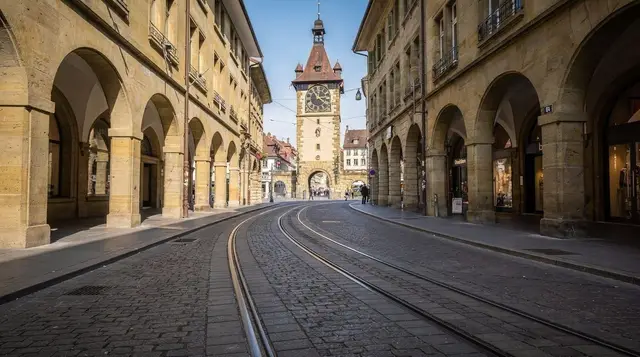
Burgdorf sits at the more accessible, Bern-facing edge of the Emmental and works better as a standalone half-day stop than Langnau does, mainly because of Schloss Burgdorf, a hilltop castle with wide views over the old town’s tiled roofs and the surrounding farmland. The castle itself houses a small museum; the real appeal is the old town below it, with an arcaded main street typical of Bernese towns and a noticeably livelier café and shop scene than Langnau.
Burgdorf also has a loose historical connection to educational reform through the Pestalozzi institute once based here, referenced in a few small plaques and exhibits around town, though this is a minor curiosity rather than a reason to visit on its own.
The scenic route between Bern and the Emmental hills
If you are driving rather than taking the train, the more rewarding route from the Interlaken side runs via Thun, then north through Steffisburg and Konolfingen before dropping into Affoltern and Langnau, rather than cutting directly through Bern. This road climbs gently through exactly the rolling, farm-dense hill country the Emmental is known for, with long views over ridgelines dotted with the overhanging farmhouses described above. It adds perhaps 15–20 minutes over the direct motorway route via Bern and is worth it if the point of the trip is the landscape rather than just the destination towns.
By train, the equivalent scenic value comes from the regional line between Bern and Langnau, which runs through the same hill country at a slower pace and gives unobstructed window views without the need to watch the road.
Getting there from Interlaken
There is no direct train link, so every route from Interlaken to the Emmental goes via Bern.
| Method | Route | Approx. time | Notes |
|---|---|---|---|
| Train | Interlaken Ost → Bern → Langnau/Affoltern | 1h15–1h30 | Change in Bern; Swiss Travel Pass and Half Fare Card both valid |
| Car | Interlaken → Thun → Konolfingen → Affoltern | Under 1 hour | Scenic option; parking available at the Schaukäserei |
| Car | Interlaken → Bern → motorway → Burgdorf | About 55 minutes | Faster but less scenic than the Thun route |
A Swiss Travel Pass covers the full rail journey, which matters here since there is no regional pass specific to the Emmental the way there is for the Jungfrau region.
Shaping the day around the timetable
The simplest way to plan the Emmental is to start from the one fixed point, the demonstration at the Schaukäserei, and build everything else around it. Check the schedule the evening before, work backwards to the train out of Interlaken Ost, and leave the rest of the day loose. A morning demonstration followed by lunch at the dairy restaurant leaves the afternoon free for Langnau or Burgdorf, while a later session suits visitors who would rather spend the morning in Bern on the way out.
Resist the urge to add a third town. The region rewards a slower pace, and the days that go wrong are usually the ones where the schedule is so tight that the farmhouses are only seen through a train window. Pick one main stop, one secondary stop, and let the journey home be unhurried. If you are weighing this against other outings, the day trips from Interlaken overview and the Lucerne day trip guide show what a busier, more scenic day looks like by comparison.
Cost of a day in the Emmental
This is one of the cheaper day trips available from Interlaken, since there are no cable cars or mountain railways involved.
| Item | Approx. cost (CHF) |
|---|---|
| Return train, Interlaken–Affoltern via Bern | 60–90 (less with Half Fare Card) |
| Emmentaler Schaukäserei entry | Modest, per-person ticket |
| Lunch (dairy restaurant or Langnau café) | 20–35 |
| Cheese and souvenirs from the shop | Variable, easy to spend 20+ |
| Total for a day, per person | CHF 60–120 |
That range sits well below a Jungfrau region day out, which is one honest reason to schedule the Emmental on a day when the weather is too poor for higher ground, or simply as a lower-cost break partway through a longer stay. See Interlaken travel costs for how this compares with other day trips.
Seeing the Emmental by e-bike
The gentler, still-hilly terrain around Affoltern and Langnau suits an e-bike better than a car for visitors who want to see farms and villages up close rather than pass them at speed. A guided option covers the working landscape with commentary on the farming and cheese-making history along the way:
a private guided e-bike tour through the Emmental, which is a reasonable way to combine the Schaukäserei with a slower look at the surrounding farms without needing your own transport.
Combining the Emmental with Bern
Because every route to the Emmental passes through Bern, most visitors either stop there on the way out, on the way back, or split the day between the two. Bern’s old town is compact enough to see in a couple of hours around the train timetable: a 90-minute guided stroll through Bern’s old town covers the arcades, the Zytglogge clock tower and the cathedral in a single loop, or for a self-paced option there is a self-guided audio tour through Bern’s history that works around your own train connections rather than a fixed group schedule.
See the Bern old town walking guide for a fuller route, or the dedicated Bern day trip from Interlaken guide if Bern itself is the main destination and the Emmental only a possible add-on.
Making the most of it with children or in poor weather
The Schaukäserei works well for families because the process is visible: children can watch the vat, the stirring and the wheels in the cellar without needing the background explained. The farmland around it is open and easy-going, which suits a day when nobody wants to be on a mountain. For more ideas of this kind, see Interlaken with kids and rainy day activities with children.
Weather matters less here than in the Oberland, since the main attraction is indoors, but the hills are much more rewarding on a clear day, when the ridgelines and their farmhouses stand out properly. If the forecast is poor in the high Alps, the Interlaken in bad weather guide lists other fallbacks, and the Emmental is one of the most sensible among them. Wear shoes you can walk in on wet grass or farm tracks, and bring a layer even in summer, because the hill country can feel cooler and breezier than the valley floor at Interlaken.
Honest verdict
The Emmental rewards a specific kind of traveller: someone genuinely curious about how a regional food economy works, who does not need mountains, lakes or adrenaline to justify a day out. The Schaukäserei is a strong, well-run attraction and the single reason to make the trip; Langnau and Burgdorf are pleasant but modest towns that would not draw visitors on their own. If your time in the Bernese Oberland is limited to two or three days, put the Jungfrau region and the lakes first.
If you have a fourth or fifth day, or poor weather grounds a planned mountain excursion, the Emmental is a sound, inexpensive way to use it, and it is one of the few day trips from Interlaken that has almost nothing to do with altitude. For other low-cost, weather-proof options, see things to do in Interlaken when it rains and the wider list of day trips from Interlaken.
Anyone extending the trip toward Solothurn or Biel/Bienne can treat the Emmental as a convenient staging point, since both sit within a similar travel radius of Bern. For food-focused travellers building a wider itinerary, pair this with cheese dairies of the Bernese Oberland, fondue and raclette in Interlaken, or the Gruyères cheese and chocolate day trip toward French-speaking Switzerland, which makes an instructive contrast with the Emmental’s German-speaking dairy tradition.
Drivers planning their own route should also check driving and parking in the Jungfrau region before setting off, and anyone building a longer stay around Bern and its surroundings may want the Zentrum Paul Klee and Bern museums guide or the seasonal events and festivals of the Bernese Oberland list for market and festival dates that might affect a visit to Langnau or Burgdorf.