Interlaken in 4 days: Mürren, the Schilthorn and Lake Brienz
Most people visiting Interlaken build a three-day plan: one day for the Jungfraujoch, one for Lauterbrunnen and Grindelwald, one to recover. That plan works, but it forces a choice between the Schilthorn and Lake Brienz, and both lose. The Schilthorn gets skipped because it looks like a repeat of the Jungfraujoch from a distance, and Lake Brienz gets reduced to a photo stop at Iseltwald on the way to somewhere else. Neither is true once you have actually done both.
The fourth day is what fixes this. It is not a padding day. It gives Mürren and the Schilthorn a proper slot of their own, on a schedule that does not compete with the Jungfraujoch for the same train line, and it keeps a full day on Lake Brienz instead of squeezing it into a lunch break. The trade-off is one more hotel night in Interlaken, which at mid-range prices is the cheapest part of the whole trip.
This itinerary assumes you arrive by train, stay in Interlaken all four nights, and do not have a car. Distances are given from Interlaken Ost unless noted, since that is the station for the Jungfraujoch line, the Brünig line to Lucerne, and the Lake Brienz boats. Interlaken West is the one closer to the Hoheweg and the Lake Thun boats.
Day 1: Arrival, the Bödeli and Harder Kulm
However you arrive, sort out tickets before doing anything scenic. If you are staying more than two days, work out whether a Swiss Travel Pass or the regional Jungfrau Travel Pass pays for itself against buying the Jungfraujoch and Schilthorn separately — for four days combining two big excursions, the regional pass usually wins, but check current prices against your exact itinerary.
Once you are settled, walk the Höheweg, the boulevard between Interlaken West and Interlaken Ost that runs along the Hohematte, the 14-hectare meadow where paragliders land through the afternoon. It is free, flat, and takes under an hour end to end. If the weather is clear, do not save Harder Kulm for another day: the funicular from Interlaken Ost takes 8 minutes and the summit at 1,322 m gives a straight-on view over both lakes and the town sitting on the strip of land between them, which explains the Bödeli layout better than any map. Return fare is roughly CHF 36; the last car down usually runs by early evening, so check the timetable at the base station.
If you would rather have someone handle the logistics and combine it with a look at Grindelwald the same afternoon, a private day trip to Harder Kulm and Grindelwald covers both without you working out connections on your first day. Otherwise, an early dinner in Interlaken and an early night: day two starts before 8am.
Full guide: Harder Kulm and free things to do in Interlaken if you have spare time before check-in.
Day 2: The Jungfraujoch, top of Europe
This is the expensive day and the one to protect from bad weather. The Jungfraujoch sits at 3,454 m, the highest railway station in Europe, reached through a tunnel bored into the Eiger and completed in 1912. A return ticket from Interlaken runs roughly CHF 220 to 260 depending on the time of day and any railway discount card you hold; the early “Good Morning” departure is the one genuine way to shave that down, and it also beats the crowds.
Two routes get you there. The classic way runs via Lauterbrunnen and Kleine Scheidegg; the newer way uses the Eiger Express cable car from Grindelwald Terminal to the Eigergletscher station in about 15 minutes, cutting close to an hour off the older Grindelwald route. Either way, build in the full day — allow 6 to 8 hours door to door with time at the top, since the point is not the summit station itself but the Sphinx observation terrace, the Ice Palace, and the Aletsch Glacier views on a clear day. Check the mountain webcam before you leave Interlaken; cloud at the top makes the ticket price hard to justify.
If you would rather not manage tickets and timings yourself, a guided day trip from Interlaken to the Jungfraujoch handles the connections and the train seat reservations that get tight in peak season. Some travellers extend this into a genuinely different experience by booking the overnight stay at 3,600 m instead of a return same-day ticket — it costs more but means sunrise on the glacier with no day-trippers around.
Read before you go: the Jungfraujoch guide, the Jungfrau railway explained, and the Eiger Express and Grindelwald Terminal if you are choosing between routes up.
Day 3: Mürren and the Schilthorn
This is the day the fourth-day itinerary is built around. Take the train to Lauterbrunnen, then the cable car up to Mürren, one of the car-free villages that sit above the valley floor — Wengen and Gimmelwald are the other two, and the road never reaches any of them. From Mürren, the cable car continues up to the Schilthorn at 2,970 m, where the revolving restaurant Piz Gloria gives a 360-degree view that includes the Eiger, Mönch and Jungfrau from the opposite side of the valley to where you stood on day two. A return cable car fare from Stechelberg or Lauterbrunnen typically runs CHF 90 to 110; from Mürren itself, less.
Do not schedule this on the same day as the Jungfraujoch, even though both start from the same valley. The lift systems do not connect efficiently between the two, and comparing the two viewpoints back to back tends to flatten both of them in memory. Spread over two separate days, they read as genuinely different mountains rather than a repeat.
For travellers who would rather not navigate the Lauterbrunnen-Mürren-Schilthorn connections solo, a private trip covering Lauterbrunnen, Mürren and the Schilthorn runs the whole loop with a driver-guide, which is worth it if train changes with luggage or kids are a hassle. On the way back down, stop in Lauterbrunnen itself if you have not already: the 297 m Staubbachfall is visible from the village street, and the valley holds 72 waterfalls in total.
More detail: the Schilthorn and Piz Gloria guide, the Mürren destination page, the Lauterbrunnen valley waterfall walk, and via ferrata routes around Mürren and Gimmelwald if you want to add a physical element the next time round.
Day 4: Lake Brienz, at a walking pace
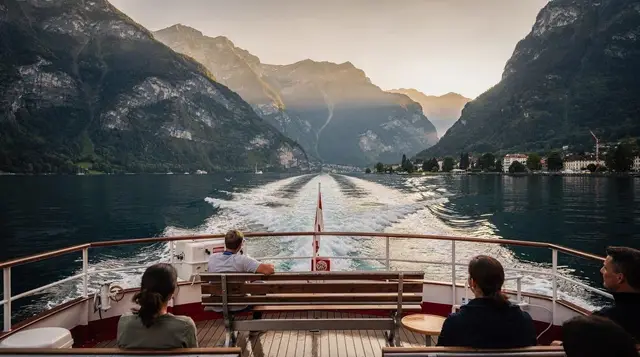
After two mountain days, Lake Brienz is a deliberate change of pace, and this is the day that a three-day itinerary usually cuts. Take the boat from Interlaken Ost — Lake Brienz boats depart from Ost, not West, which is a common mix-up with the Lake Thun services. The water here runs a stronger turquoise than Lake Thun, from glacial silt carried down by mountain streams, and the shoreline villages are quieter.
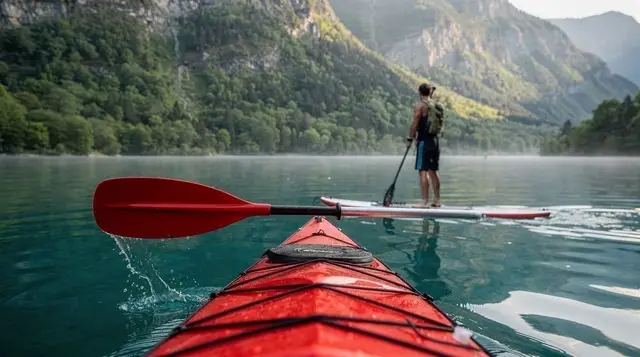
Get off at Iseltwald, a small village on a promontory that has become well known since it appeared in a Korean drama, and walk the shore path towards Giessbach, where a funicular from the boat landing climbs to a multi-tiered waterfall beside the historic Grand Hotel Giessbach. The whole loop — boat, short walk, funicular, waterfall, boat back — fits comfortably into a day without rushing, and costs far less than either mountain excursion. If you would rather be on the water than beside it, a kayak trip on Lake Brienz gets you onto that colour directly instead of viewing it from a boat deck.
Round off the afternoon back in Interlaken with something you skipped on day one, or simply sit on the Höheweg and watch the paragliders land on the Hohematte — free, and a fitting bookend to the trip.
Further reading: Lake Brienz boat trips, Iseltwald and Giessbach, and Giessbach Falls and the shore path.
Where to sleep each night
Staying in Interlaken for all four nights, rather than splitting a night in Mürren, keeps logistics simple and hotel choice wider. See where to stay in Interlaken for a fuller breakdown by neighbourhood.
| Night | Base | Why |
|---|---|---|
| 1 | Interlaken (Ost side) | Close to the Harder Kulm funicular and the Jungfraujoch line for an early start |
| 2 | Interlaken | Same base, no need to move after a long Jungfraujoch day |
| 3 | Interlaken | Cable car connections to Mürren run from Lauterbrunnen, a short train ride away |
| 4 | Interlaken | Boats to Lake Brienz leave from Interlaken Ost |
Budget for four days
Figures are per person, excluding accommodation and long-haul flights. See Interlaken travel costs for the full breakdown this table is drawn from.
| Item | Approx. cost (CHF) |
|---|---|
| Jungfraujoch return ticket | 220–260 |
| Schilthorn cable car return | 90–110 |
| Harder Kulm funicular return | 36 |
| Lake Brienz boat + Giessbach funicular | 40–55 |
| Meals, 4 days | 160–240 |
| Local transport, 4 days | 30–50 |
A Swiss Travel Pass or the Jungfrau Travel Pass can reduce the two big-ticket items; run the comparison against your own dates before buying, since discounts vary by season.
Tickets and passes worth buying ahead
Two things wreck this itinerary more than anything else: the Jungfraujoch selling out on a clear day in August, and a lift closing for scheduled maintenance in spring or autumn without you checking first. See when mountain railways open and close before fixing your dates, and cable cars and funiculars explained if the number of different operators around Interlaken is confusing — it is not one company, and passes do not always cover all of them.
Questions about a 4-day Mürren and Lake Brienz itinerary
Is four days enough for Interlaken, the Jungfraujoch and Mürren?
Yes, but only if you treat the Jungfraujoch and the Schilthorn as separate full days rather than trying to combine them. Four days also leaves room for Lake Brienz and one relaxed morning in Interlaken itself, which three days does not.
Do I need a car for this itinerary?
No. Every stop in this plan sits on the Swiss rail, cable car or boat network, and Mürren and Gimmelwald are car-free villages anyway. A car adds parking costs and no time saving on these routes.
Should I book the Jungfraujoch and Schilthorn tickets in advance?
Book the Jungfraujoch a few days ahead in July and August, since the railway caps daily visitor numbers and sells out on clear-weather days. The Schilthorn cable car rarely sells out, but check the live webcam before committing, since Piz Gloria is pointless in cloud.
Can I do Mürren and the Schilthorn as a day trip without staying overnight?
Yes, most visitors do exactly that from Interlaken. This itinerary keeps you based in Interlaken all four nights rather than sleeping in Mürren, since hotel choice and prices are far better on the Bödeli.
What is the biggest mistake on a 4-day Interlaken itinerary?
Scheduling the Jungfraujoch and the Schilthorn on the same trip up the valley to save a train fare. They are on opposite sides of the Lauterbrunnen valley, the connections do not favour it, and you end up rushing both.
How much should I budget per day, excluding hotels?
Plan on CHF 90 to 160 per person per day for a mountain excursion, meals and local transport, with the Jungfraujoch and Schilthorn days at the top of that range and the Lake Brienz day well below it.
Is Lake Brienz worth a full day if I have already seen Lake Thun?
Yes. Lake Brienz has a stronger turquoise colour from glacial silt, quieter shorelines around Iseltwald and Giessbach, and a different pace than a mountain day, which is exactly why this itinerary puts it on day four rather than dropping it.
Lake cruises & boat tours on GetYourGuide
Verified deep-linked GetYourGuide tours. Book through these links and we earn a small commission at no cost to you.
GetYourGuide does not provide a product photo for this activity — the image shows the meeting point, photographed by us.