Interlaken in autumn: larches, cloud seas and the quiet season
Is autumn a good time to visit Interlaken?
Yes, and many regulars rate it above summer: late September to mid-October brings gold larches, clear air and thinner crowds, plus lower hotel and tour prices. The trade-off is shorter days, colder mornings, and several cable cars and railways closing for one to three weeks of scheduled maintenance in November.
Why regulars rate this season over summer
Ask people who visit Interlaken more than once, and a surprising number will tell you autumn is the season they come back for. Not because it is warmer or the lifts are cheaper — though the second part is often true — but because the light changes, the crowds thin out on the Höheweg and around Lake Brienz, and the mountains put on a display that July and August simply cannot match: larch trees turning gold against dark green pine, and on the right mornings, a flat sea of cloud sitting in the valley while the summits sit in full sun above it.
The trade-off is real too. Days shorten fast after the equinox, mornings get properly cold, and by November several of the region’s cable cars and railways go dark for scheduled maintenance. This guide sets out what actually happens through September, October and November around Interlaken and the Jungfrau region, so you can plan around it rather than be surprised by it.
The larches: where and when
The larch, or Lärche locally, is the one European conifer that drops its needles in winter — and before it does, those needles turn a deep gold that can look almost orange in low afternoon light. Around Interlaken the best larch stands are at mid-to-high elevation: above Wengen and around Mürren, on the slopes below Grindelwald First, and scattered along the Schynige Platte railway line.
Timing shifts year to year, but as a rule of thumb: colour starts appearing above 1,800 metres from mid-to-late September, peaks in the first half of October, and by month’s end most needles are down. Lower down, around Iseltwald and Bönigen on Lake Brienz, isolated larches turn a week or two later than the high alpine stands. A hard frost or a windy storm can strip a hillside of colour in days, so this is not a display you can pin to a calendar date with confidence — check recent photos or webcams from the specific area you’re heading to rather than assuming “second week of October” holds every year.
an e-bike route along the Lake Brienz shoreline past Iseltwald and up to the Giessbach falls is one of the better ways to catch lower-elevation larch colour without committing to a full mountain excursion, and it works well on a cooler, shorter autumn day when a big alpine hike is less appealing.
The sea of clouds
Autumn in the Bernese Oberland brings temperature inversions more often than any other season: cool, damp air pools in the valley bottom around Interlaken, Lake Thun and Lake Brienz, while a ridge of high pressure keeps the upper slopes in clear sunshine. The result, on the right morning, is a valley filled with cloud like a lake of white cotton, with peaks and viewpoints poking through into blue sky above it.
The classic vantage points are close to town and quick to reach:
| Viewpoint | Elevation | Access from Interlaken | Best for |
|---|---|---|---|
| Harder Kulm | 1,322 m | 8-min funicular from Interlaken Ost | Quick sunrise trip, view over both lakes |
| Schynige Platte | 1,967 m | Rack railway from Wilderswil | Wider panorama, larch colour on the way up |
| Niederhorn | 1,950 m | Funicular + cable car via Beatenberg | Views over Lake Thun and the Stockhorn range |
| Jungfraujoch | 3,454 m | Train via Lauterbrunnen or Grindelwald | Above the inversion layer entirely, on a clear day |
None of this is guaranteed. Inversions depend on stable high pressure holding for at least a day or two, and a change in the weather pattern can wipe the effect out completely. The practical approach is to check the operator’s live webcam the evening before or the morning of your trip — most Jungfrau region lift companies post one — rather than booking a viewpoint ticket three days in advance and hoping.
What actually closes, and when
This is the part that catches people out. Interlaken’s mountain railways and cable cars run a genuinely packed schedule in July and August, then start trimming back once the region’s own shoulder season begins. Most lifts keep running through October in some form, but scheduled maintenance closures — one to three weeks, typically in November — are normal practice across the network, timed for the gap between the end of the hiking season and the start of skiing.
The specifics change year to year and lift to lift, so treat any date you read (including here) as indicative rather than fixed, and check when mountain railways open and close or the operator’s own site before building a trip around one particular summit. What tends to hold broadly:
- The Jungfraujoch line runs closures are rare and short since it is the flagship route, but individual sections can still shut for a day or two of works.
- Schilthorn, Grindelwald First, Männlichen and Schynige Platte are the ones most likely to have a multi-week November gap between the end of autumn hiking traffic and the December ski opening.
- Lifts also close for wind on any given day, autumn or otherwise — the cable cars and funiculars explained guide covers wind limits and what alternatives exist when a specific gondola is grounded.
If a single mountain is the reason for your trip, build in a spare day, or pick a date safely inside the October window rather than gambling on the very end of the season.
Prices: what actually drops, and by how much
Interlaken’s genuine high season runs through the summer school holidays across Switzerland, Germany, the Netherlands and the UK, roughly late June to mid-August. Once those end in early September, demand drops and hotel rates in Interlaken, Wengen, Grindelwald and around the lakes typically ease from their peak, though not dramatically — Switzerland does not have a “cheap” season in the way some Mediterranean destinations do, and prices stay firmly in Swiss-franc territory year-round.
Where the saving is more noticeable is availability rather than headline price: rooms that were fully booked in August open up in late September and October, and last-minute planning becomes realistic again. Tour and activity operators sometimes trim prices modestly through the shoulder months too, but the bigger factor is simply that popular slots — a sunrise Harder Kulm trip, a window seat on the Jungfraujoch train — stop selling out days ahead.
By November, once several lifts have closed for maintenance and the weather turns unreliable, Interlaken moves into its proper low season, and that is where the real price gap opens up, particularly on accommodation. The trade-off is that your options for what to actually do narrow at the same time. For a fuller breakdown of what things cost month to month, see Interlaken travel costs and Interlaken on a budget.
What still works well in autumn
Plenty of the region’s best activities are actually better suited to autumn than to peak summer heat.
E-biking and cycling. Cooler temperatures make longer rides more comfortable, and the routes along both lakes stay open and largely traffic-light. renting an e-bike directly in Interlaken gives you the flexibility to chase good light along the shoreline or up toward Beatenberg without committing to a fixed group schedule — useful when autumn weather windows can be short. See cycling and e-bike routes around Interlaken for route options.
Waterfalls. Autumn rain keeps the region’s waterfalls running well, and the crowds at Lauterbrunnen and the Trümmelbach falls thin out considerably compared with August. a half-day tour through the valleys and waterfalls around Interlaken covers several of these spots in one outing, which suits shorter autumn daylight better than trying to string together a full-day self-guided itinerary. The Lauterbrunnen valley waterfall walk and Aare Gorge and Reichenbach Falls walk both stay comfortably walkable into November.
Lower and mid-altitude hikes. Trails around Lake Thun and Lake Brienz, and the valley floor routes near Grindelwald, remain in good condition well past the point where high alpine routes become unreliable. The easy flat walks around Interlaken and best day hikes from Interlaken guides both flag which routes hold up latest in the season.
Above roughly 2,000 metres, treat mid-October onward as unpredictable: overnight frost, patchy early snow and markedly shorter daylight all narrow the safe window, and routes like the Faulhorn and Bussalp loop or the Bachalpsee hike are best attempted earlier in September if you want a wide margin.
Glacier and high-altitude day trips. Further afield, the Glacier 3000 cable car above Gstaad typically keeps running later into the season than some of the Jungfrau region’s own lifts, and clear autumn air often means sharper long-distance views than summer’s haze. It pairs naturally with a wider loop through Gstaad and Glacier 3000 as a day trip from Interlaken.
What gets harder
A few things genuinely get worse, and it’s worth being upfront about them rather than glossing over the downside.
Daylight shrinks fast: Interlaken loses roughly four hours of daylight between late August and late October, which compresses how much you can fit into a mountain day trip, especially once you factor in train and lift travel time each way. Weather becomes less stable and more day-dependent — a clear forecast three days out is far less reliable in October than in July. And the car-free villages of Wengen, Mürren and Gimmelwald go quieter in a way some visitors find atmospheric and others find a little flat, since a good share of their summer restaurant and shop hours scale back once the hiking crowds thin.
Fog is the other autumn regular worth flagging honestly: the same temperature inversions that produce a spectacular sea of clouds from a high viewpoint mean the town of Interlaken itself, sitting at valley level between the two lakes, can spend whole mornings sitting in grey mist with zero mountain visibility. It usually burns off or simply never reaches altitude — which is exactly why the viewpoints above it are worth the trip — but don’t judge the day’s prospects purely by looking out of your hotel window in Interlaken itself.
A short itinerary for a 3-4 day autumn visit
For a first autumn visit, a workable structure is:
- Day 1 — Arrive, walk the Höheweg and the Hohematte, acclimatise at valley level.
- Day 2 — Early start for a sea-of-clouds check: Harder Kulm if the inversion looks promising, otherwise straight to a higher target like Schynige Platte for larch colour along the railway.
- Day 3 — Lauterbrunnen valley and waterfalls, at a slower pace than a summer day allows given the shorter light; e-bike option along the valley floor if the weather holds.
- Day 4 — Weather-dependent: Jungfraujoch if the forecast is clear, or a lower lakeside outing around Lake Brienz and Iseltwald if cloud has set in.
For a longer stay or a first visit generally, how many days in Interlaken and the 3-day itinerary both adapt reasonably well to autumn’s shorter days with the timing adjustments above.
Rainy and grey days in the shoulder season
Autumn weather rarely holds steady for a whole trip, so it helps to have a second plan ready before you leave the hotel. When the cloud sits low and the lifts feel pointless, the region has plenty to offer indoors and at valley level: the things to do in Interlaken when it rains and the wider Interlaken in bad weather guide are written for exactly these mornings. If you are travelling with children, rainy day activities with children saves a lot of improvising.
Grey weather also suits the slower pleasures. The thermal baths near Interlaken and the sauna and alpine wellness days feel better once the evenings turn cool, and a long lunch of fondue and raclette in Interlaken makes more sense in October than it ever does in a July heatwave. Mountain huts that stay open are worth a look too; mountain huts and berghaus dining explains what to expect from a hot meal with a view.
Autumn on the water and in the towns
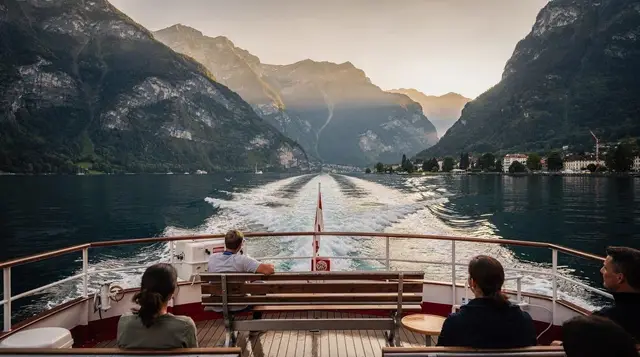
The lakes are one of the most dependable parts of an autumn visit, because low cloud over the summits does not spoil a shoreline walk or a boat trip. Soft light on the water and colour on the lower slopes make the Interlaken two lakes cruise guide and the Lake Brienz boat trips guide good fallbacks, with Lake Thun boat trips as the gentler alternative. The paddle steamers of the Bernese Oberland are a pleasure in this season, when you can usually find a quiet seat on deck.
Towns reward a visit when the mountains are hidden. Thun has an old town and castle to explore at an easy pace, described in the Thun old town and castle guide, and Bern is an easy outing covered in the Bern day trip from Interlaken. If you want a change of scene altogether, Lucerne makes a comfortable day away, and a day trip that links Lucerne and Interlaken is one way to see how the two compare. Our Interlaken vs Lucerne guide helps you decide which base suits your dates better.
Autumn food, markets and events
Autumn is a good season to eat well around Interlaken. Menus lean towards heartier dishes, and the Interlaken restaurant guide is a useful starting point for choosing where to book. The cheese dairies of the Bernese Oberland and the markets of the Bernese Oberland show the region’s farming side at a time of year when producers are busy. For what is on during your dates, check events and festivals in the Bernese Oberland, and if your trip runs towards the end of the season, the Christmas markets of the Bernese Oberland look ahead to winter.
Packing for the shift
Layering matters more in autumn than in any other Interlaken season, because the temperature gap between the valley floor and a 2,000-metre-plus summit widens as the season goes on. A T-shirt afternoon in town can mean a below-freezing wind at Schilthorn or the Jungfraujoch on the same day. Pack a proper windproof and water-resistant outer layer, gloves and a hat for anything above roughly 2,000 metres from October, and shoes with real grip, since dew, mud and — from mid-October at altitude — an early dusting of snow all become more likely underfoot. See altitude, weather and what to pack for a fuller list.
Lake cruises & boat tours on GetYourGuide
Verified deep-linked GetYourGuide tours. Book through these links and we earn a small commission at no cost to you.
GetYourGuide does not provide a product photo for this activity — the image shows the meeting point, photographed by us.